

The True Purpose of Practice
Cultivating the Inner Silence
By: Cheng Tong - Jan 13, 2026
I ended my last essay with the line: “Presence is the practice.” If you missed it, you’ll find it here. I wish to expand on that in this essay.
In many of my previous discussions, I established two foundational truths for a life lived according to the Dao: first, that existence is an Effortless Flow lived through us by the cosmos; and second, that while a teacher can point, the student must make the Non-Transferable Choice to walk the path.
This leads us inevitably to the question of the method. If the ultimate goal is to stop resisting and surrender the ego’s striving, then what is the purpose of practice? Why commit to the structure of Qigong, the movement of Taiji, or the discipline of sitting meditation?
The true purpose of these practices is not to strive toward awakening, but to create the deliberate conditions—the environment of Silence and Solitude—in which the Dao’s effortless flow can be perceived and received. The practices are not tools for exertion; they are technologies for dissolving resistance.
Silence as the Crucible of Qi
The profound value of a solitary and silent life is that it removes the ambient, external noise that validates the ego’s anxiety. The need for constant external stimulus—be it conversation, entertainment, or even social validation—is one of the most stubborn 49 Barriers to spiritual growth. It is noise that allows the ego to maintain its illusion of control and importance.
When the external world is silenced, the internal world of the body and mind becomes audible. This is the moment the true work begins.
We define Qigong and meditation, therefore, as practices of listening, not doing. They are the mechanisms by which we cultivate inner silence:
- In Qigong, we are not adding Qi; we are using slow, deliberate movement to locate and remove the structural and energetic blockages (resistance) that impede the Universal Qi that is already present. The form becomes a moving meditation designed to silence the body’s habitual tension.
- In Sitting Meditation, we are not thinking our way to enlightenment; we are choosing to sit in intentional solitude, allowing the torrent of thought (the internal noise) to exhaust itself. It is the conscious creation of a sanctuary where the cosmic voice—the still, small voice of the Dao—can finally be heard above the mental clamor. My Master, Li Shifu, the Abbot of the Five Immortals Temple, would tell us that while “sitting still, doing nothing,” we are observing our stillness.
The solitary life, then, is not a withdrawal from the world; it is the essential practice of carving out the space required for the highest form of presence. It is in this profound silence that the channel is cleared, and where Silence is your intuition becoming louder than the noise of the world.
The Grace of Responsiveness: The Power of Completion
Once the inner silence is cultivated, our entire relationship with the world reverses. The practice reveals that the ego’s striving is based on a foundational fallacy: the belief in incompleteness.
The moment we grasp that you are already perfect and complete as you are if you simply let life flow through you, the need to chase outcomes vanishes. We see that chasing after something with your words comes from the belief you are incomplete and “need” something more.
This transformation of perspective defines true Wu Wei in human interaction:
- We stop striving for external validation. In external silence, we cease to manipulate perception. We realize: Explaining yourself is your attempt to control how others see you; stay silent and let your actions speak for you. The quiet strength of presence is far more persuasive than any argument.
- We attract through stillness. When we are complete in the present moment, we emit a different energy. We learn that in silence, we stop trying to become chosen, and find that people will choose us — the strength of our silence draws them to us. This is the Dao at work in our social lives: we no longer pursue, but radiate.
- We receive the necessary flow. When the mind is quiet and the heart is full, we naturally enter a state of ease. When you stand in calm confidence, what you need comes to you. The practice is simply the maintenance of this calm confidence, ensuring the internal channel remains open to receive the gifts of the Dao.
The practices of Taiji and Push Hands provide the laboratory for applying this quiet strength. In the forms, we practice yielding (softness and suppleness), teaching the body to replace the burden of effort (rigid striving) with the grace of responsiveness (listening to the flow). The movement is not an act of personal, anxious striving, but an effortless, intelligent response guided by the completeness of the present moment.
The Universe’s Quiet Gaze
Finally, the cumulative effect of cultivating silence, solitude, and yielding leads us to the grand philosophical realization of why we were given life at all.
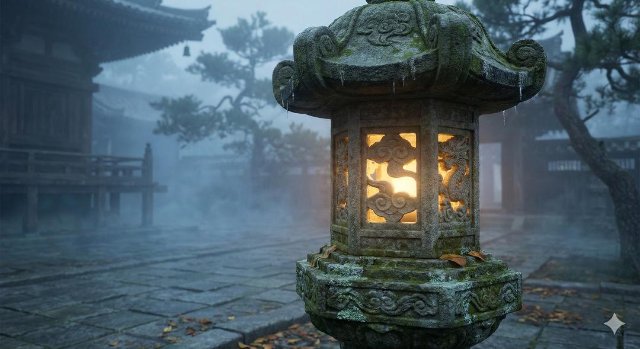
Our resistance—the ego’s desperate need to control and define—is what clouds our vision. By deliberately creating a solitary and silent container, we dissolve this clouding. We transition from being the frantic doer to the clear, non-judgmental observer. Like the lantern in the image above, while surrounded by the fog and mist of the world the inner light shines with great clarity and Stillness.
The purpose of practice, therefore, is to perfect this function of observation. When the self is quieted and resistance is dropped, the ultimate goal of the cosmos is fulfilled: the universe, having brought us to life, can look back on itself with our clear, quiet eyes.
We practice not to achieve, but to allow. We practice to become the perfectly still, clear vessel, prepared to receive and reflect the endless wonder of the effortless flow.