Share

Yinka Shonibare's Sanctuary

Rose Art Museum

By: - Jan 16, 2026


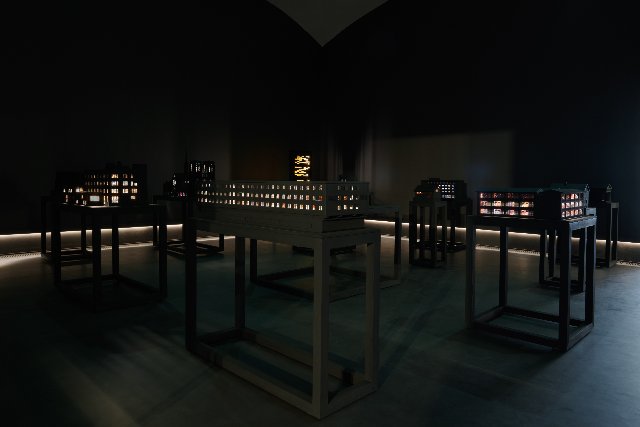
The installation consists of 18 scaled-down replicas of historical and contemporary buildings that have served—and, in many cases, continue to serve—as places of refuge for persecuted and vulnerable groups or individuals. These structures range from ancient temples and medieval cathedrals to modern safe houses and shelters. Together, they underscore the enduring human need for safety and refuge throughout centuries of global history, as well as the pressing necessity of protecting these rights in the present day. As Shonibare notes, “Shelter is one of the most pressing political concerns right now. Sanctuary is not just a structure—it’s a promise, and far too many people are denied it.”


Displayed within a darkened gallery, each black-painted architectural model glows from within, illuminated by light that shines through interiors lined with the artist’s signature Dutch wax textiles. Shonibare’s use of this historically rich and politically charged fabric, a symbol of cultural hybridity and the entangled legacies of colonial trade, links the intimate spaces of refuge to broader global histories of migration, empire, and resistance. As light emanates from each miniature “sanctuary,” the surrounding darkness is transformed: the gallery becomes an atmospheric landscape in which these havens punctuate the space like beacons of hope, resilience, and protection.


Shonibare, whose multidisciplinary practice spans sculpture, installation, photography, film, painting, and textile-based work, is internationally renowned for his incisive examinations of race, class, cultural identity, and postcolonial power structures. His art often draws on European art history and literary narrative, reinterpreting familiar scenes and symbols to reveal the exclusions, contradictions, and violence embedded within them. Sanctuary City continues this trajectory, using architecture as a metaphor to expose the politics of who is allowed to belong and who is excluded from safety.


“This installation speaks to the heart of what sanctuary means, physically, morally, and politically,” said Ankori. “Yinka Shonibare’s work challenges us to confront our responsibilities to one another, and to recognize the basic human need for refuge and a safe haven. It points to global history, but is also a call to action today and into the future.”


Reflecting on the project, Shonibare adds: “Sanctuary is not a privilege; it is a human right. Sanctuary City is a reminder that across history—and still today—people seek shelter not out of choice, but necessity. These buildings stand as testaments to courage, care, and the radical act of offering safety.”


ABOUT THE ARTIST


Yinka Shonibare (b. 1962, London, UK) is an internationally acclaimed British-Nigerian artist whose interdisciplinary practice—shaped during his studies at Byam Shaw School of Art and Goldsmiths, University of London—uses references to Western art history and literature to examine race, class, and the construction of cultural identity within the globalized world. His work has been featured in major exhibitions worldwide, including Suspended States at the Serpentine South, London (2024); the Nigerian Pavilion at the Venice Biennale, Venice (2024); new commissions for Sharjah Biennial 15, Sharjah (2023); and significant retrospectives at the Museum der Moderne, Salzburg, Austria (2022) and the Museum of Contemporary Art, Sydney, Australia which traveled to the Brooklyn Museum, New York, and the National Museum of African Art at the Smithsonian Institution, Washington, D.C. (2008–09). A Royal Academician since 2013 and recipient of the CBE in 2019, Shonibare is known for landmark projects such as Nelson’s Ship in a Bottle (2010), now in the collection of the National Maritime Museum, London, UK. His work is held in major public collections including Tate, London, UK; the Victoria and Albert Museum, London, UK; the Museum of Modern Art, New York; the National Museum of African Art, Washington, D.C.; Moderna Museet, Stockholm, Sweden; the Museum of Contemporary Art, Chicago; and the National Gallery of Modern Art, Rome, Italy. He is also the founder of the Guest Artists Space (G.A.S.) Foundation in Lagos and Ijebu, Nigeria, supporting international cultural exchange. Shonibare lives and works in London.