

The Little Foxes
Island City Stage
By: Aaron Krause - Jan 22, 2026
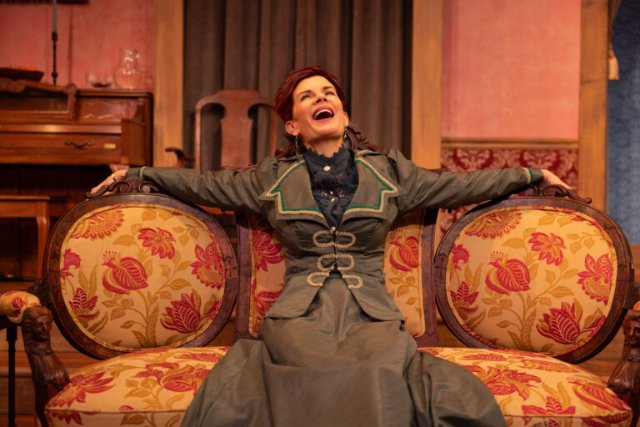
In Island City Stage’s razor-sharp professional production of Lillian Hellman’s classic masterpiece, The Little Foxes, talented actress Mia Matthews icily utters a key line from the play: I hope you die! I hope you die soon!
Clearly, we hear the bitterness in Matthews’ low-pitched, contempt-filled voice when she delivers the line to her ailing, weak husband, Horace. But Matthews, as Giddens, wisely doesn’t play the famous anti-heroine as a total b--ch. She also allows us to understand where the character is coming from, so we can at least sympathize with her, even if we don’t condone everything she says and does.
Sure, Giddens is ruthless. However, she is also needy and crafty. A key obstacle for her is a patriarchal system in 1900 Alabama that favors male inheritance, forcing her to rely on manipulation to gain wealth. She wears different “masks” depending on her goals and the situation. At the top of the play, Giddens seeks to make a good impression in front of visiting businessman William Marshall (a cordial Jeff Burleson) from Chicago. He’s at the Hubbard House to dine and finalize a deal to build a cotton mill in the family’s Alabama town in the spring of 1900.
At the beginning of Island City Stage’s production, which runs through Feb. 8 in the company’s intimate black box space in Wilton Manors, Matthews’ Giddens appears elegant and even charming. She resembles a classy socialite with reddish-brown hair, earrings, and a black glistening outfit. Matthews, a well-known, award-winning South Florida performer, leads a strong cast under Michael Leeds’ precise and well-paced direction: Randy Coleman as Cal, Christian Cooper as Leo, Christopher Dreeson as Horace, Mallory Flory as Alexandra, Johnbarry (JB) Green as Oscar, Carey Brianna Hart as Haddie, Margery Lowe as Birdie, and Stephen Trovillion as Ben. The production finds the humanity in the story while steering clear of excess melodrama.
The Little Foxes, which opened on Broadway in 1939, is one of Hellman’s best-known, most successful, and acclaimed 20th-century Southern Gothic plays. Its biting dialogue, unflinching examination of weighty, relevant themes, deft construction, and narrative pacing make it a great work of live theatrical art. Hellman (1905–1984) utilizes the “well-made play” format, carefully planting plot points and information that pay off as the story unfolds. The tale begins as a slow-burn family drama and builds into a high-stakes thriller, keeping audiences spellbound through rising tension and “cat-and-mouse” maneuvers.
Critics and scholars often group the play with The Children’s Hour as one of the definitive works that secured Hellman’s place in the American dramatic canon. It’s an intense, realistic depiction of greed and the “dark side” of the American Dream. The three-act piece, which runs about two hours and 40 minutes, including two intermissions, explores timely and timeless themes such as greed, corruption, and family betrayal. More specifically, the play follows the heartless Giddens and her greedy brothers, Ben and Oscar Hubbard, as they plot to build a cotton mill. It’s partially a cautionary tale about how greed and other vices can overtake humanity.
The play’s title comes from a section of the Bible’s Song of Songs: “Take us the foxes, the little foxes, that spoil the vines: for our vines have tender grapes.” In the Bible, small foxes are clever creatures that can ruin a vineyard by nibbling at the tender shoots and roots. In Hellman’s play, those “foxes” are the Hubbard siblings — Regina, Ben, and Oscar. Their relentless greed and constant “nibbling” at the family’s ethics and relationships ultimately destroy their own home and legacy. The “vines” and “tender grapes” represent the fragile, vulnerable parts of society and family, such as the ailing Horace.
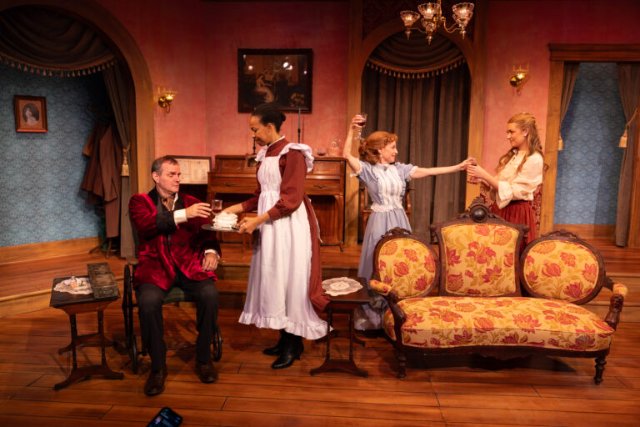
The action takes place in the Hubbard family’s upper-class home. For Island City Stage’s production, scenic and lighting designer Ardean Landhuis has crafted a spacious period set that appears orderly and upscale. With a wall painted pink, a chandelier overhead, a brightly patterned couch, brown furniture, candlesticks, a fireplace, blue-and-white wallpaper, and artworks on the walls, it’s clear that a wealthy family lives in the space. The performers wear W. Emil White's character-appropriate period costumes, and Landhuis's realistic lighting illuminates the set and actors.
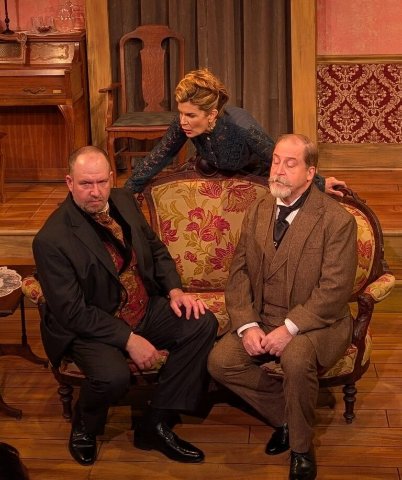
Leeds, who paces the production well, also makes good use of the space to convey information to audiences. Characters who are part of a conversation sit closely together downstage (closest to the audience). Meanwhile, someone not part of the conversation — such as Birdie — sits further upstage, away from the others, but still actively listening.
Birdie, Oscar’s timid, alcoholic wife and Regina’s sister-in-law, is often abused by her husband. She’s a “faded,” anxious, gentle woman who may call to mind Blanche Dubois from Tennessee Williams’ A Streetcar Named Desire. But Birdie is also Chekhovian — a lonely and fragile character who turns to alcohol to cope with her unhappiness. Lowe, one of the region’s finest actresses, plays her with stunning realism. Watch as she leans forward and touches others, desperate for connection. Hear the unmistakable ache in her voice as she talks about her sad circumstances, and the convincing compassion as she comforts Alexandra (Flory).
At the beginning of the play, Alexandra is largely blind to her mother and uncles’ cruelty. Flory nails her character’s wide-eyed naivete. As Alexandra becomes aware of what’s really taking place, realization and shock creep into Flory’s voice and facial expressions. Toward the end, she stands tall, confident, and assertive as she declares her independence from her mother and her household. Flory makes the character’s transition seamless and practically unnoticeable.
Leo, the weak-willed son of Oscar and Birdie, is invested with believable youthful energy, eagerness, and credible nervousness by Cooper. His mischievous streak makes it unsurprising that he conspires with his father to steal Horace’s bonds to invest in the planned cotton mill.
Green ably portrays Oscar, Leo’s father and one of the Hubbard siblings. Though the actor appears in the program as a brightly smiling man, as Oscar he looks completely different. With intense eyes that seem to look down and a seemingly perpetual scowl, Green’s Oscar is severe, impatient, and cold-hearted, speaking in a sharp voice that can rise to a thunderous shout. Even when displaying a hint of patience with his son, a modicum of menace remains in his voice and face.
A clear contrast emerges between Green’s Oscar and Trovillion’s Ben. While Ben is confident, determined, and capable of anger, he also displays sunniness and optimism, making him a brighter, more appealing character than the brooding Oscar.
The production’s stars also include the award-winning Dreeson, whose Horace conveys weariness and affability. He is a man who has been through a trying ordeal, yet remains charming and determined. During a key scene, Horace has a heart attack and struggles to climb the stairs for his medication. Although he pleads with her, Regina refuses to help, leaving him to manage on his own. This occurs near the line, I hope you die! I hope you die soon! I’ll be waiting for you to die!
While we may identify and connect with Regina during portions of the play, this certainly isn’t one of them. By the end, we harbor mixed feelings for her. Yes, she is alone, having driven nearly everyone away. But before the lights extinguish on her, Matthews shows us a troubled yet resolute woman — a survivor determined to carry on despite all that has transpired.
Island City Stage, a nonprofit company, produces professional, award-winning theatre that engages the community with LGBTQ+-focused, yet universally relevant stories. Some may wonder how The Little Foxes fits into the “gay theater” canon. Scholars have explored themes of repressed bisexuality in Hellman’s work, and her 1934 play, The Children’s Hour, tells the story of two women running a girls’ boarding school whose lives are destroyed by a malicious student’s false accusation that they are having a lesbian affair.
The Little Foxes is a story for a universal audience, reminding us that inaction in the face of wrongdoing can make us morally complicit. After experiencing Island City Stage’s gripping production of this cautionary drama, we walk away with a renewed awareness of the evil in society and the danger of complacency.
IF YOU GO
WHAT: Island City Stage’s professional production of The Little Foxes by Lillian Hellman
WHEN: Through Feb. 8. Performance times are 7 p.m. Thursday, 7:30 p.m. Friday-Saturday, 1 p.m. Saturday, and 5 p.m. Sunday.
WHERE: Island City Stage’s intimate black box theater is located at 2304 N. Dixie Highway in Wilton Manors.
TICKETS: $43-$48. Call (954) 928-9800 or visit www.islandcitystage.org.