

A Streetcar Named Desire
An Innovative Adaptation of a Classic at ACT
By: Victor Cordell - Jan 23, 2026


What is it about Tennessee Williams’ A Streetcar Named Desire that makes it one of the most loved and lauded plays in the American canon? Is it the clash of the common and earthy Stanley with the pretentious and fragile Blanche with its contrast between brutally honest and delusionally dreamy? Is it the multiple dynamics of love, loss, loyalty, and longing? Is it the exotica within America of Frenchified New Orleans with its Napoleonic Code? Is it vicariously experiencing aspects of the playwright’s sordid imagination and existence? Or was it propelled by the fame of its 1951 filming with the searing and iconic depictions of Stanley by Marlon Brando and Blanche by Vivien Leigh?
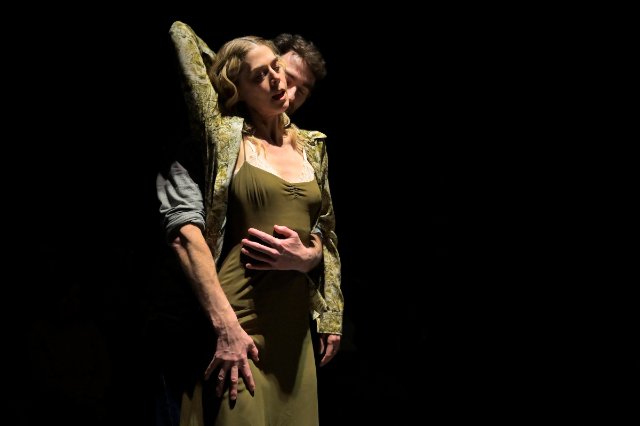
The premise is that Blanche DuBois (played by Lucy Owen, who has also “co-created” this production) has lost the family’s Mississippi plantation, Belle Reve (aptly, “beautiful dream”), and has intruded upon her sister Stella (Heather Lind) and her working-class husband Stanley Kowalski (Brad Koed) in their humble two-room flat in the French Quarter. Blanche finds the conditions beneath her and Stella’s dignity. Despite being a beggar, Blanche shares her disdain for the digs and verbally abuses Stanley, disparaging his Polish heritage, manners, livelihood, and all else. Not a gracious or endearing house guest. In time, we learn that Blanche’s history is more complicated than she lets on.
As a reviewer, I usually avoid comparing a theatrical production to a film, as the two vehicles are endowed with such different assets and potential. In this case, the film is probably what makes Streetcar such a familiar story, and it is probably a fine exemplar of the playwright’s intent – a grim and gritty commentary on working class life with the intrusion of a square peg in that round hole. Expectations and comparisons become hard to avoid.
Artistic contributors to live performance often struggle with the challenge of either producing a best-possible, classic rendition of a play or finding a unique interpretation to show the material in a different light. Owen and collaborator Nick Westrate, who also directs, have created a variation of Streetcar that holds faithfully to Williams’ text, yet its tone and staging depart radically. This variation was well-received by the opening night audience and does succeed on some levels, but its tone suppresses the power of Blanche’s accumulating angst and delusion.
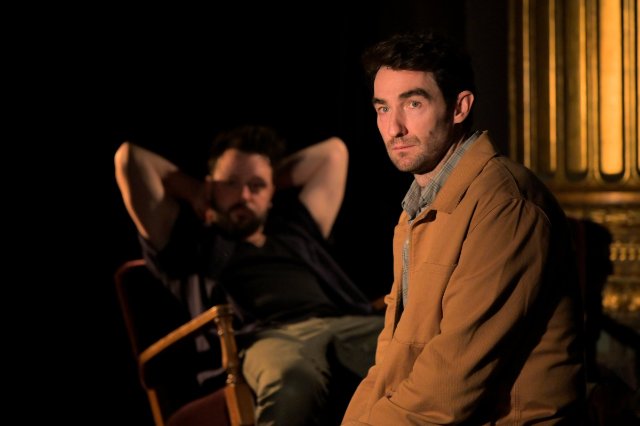
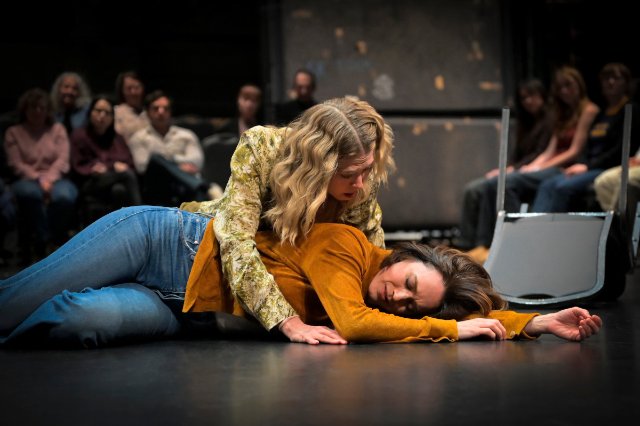
To establish a more intimate feel at the ACT performance, a number of audience members are seated on the three closed sides of the stage. In devising a more stripped-down, abstract telling of the story, the narrative plays out on the otherwise bare stage with the off-stage mechanics of pulleys, lifts, fly, and such exposed behind the stage-seated audience. The players do however frequently move beyond the stage into the aisles of the orchestra, into lower box seating, and even behind the stage audience to depict more private scenes such as showering. And in a final budget-saving practice, the cast is limited to four actors, with multiple parts played by James Russell, whose primary role is Mitch, Stanley’s friend who courts the newly-arrived Blanche.
The more significant variance is that Blanche’s role especially is played with a lighter lilt than expected. I don’t remember a single laugh in the film or the other staged version that I’ve seen, but the first act of this version is filled with chuckles and guffaws. While the humor on its own is winsome and shows how talented actors can mold lines in different ways, it detracts from the weightiness that otherwise makes this a great play. Another controversial element is the use of almost constant music, usually piano playing. Its tone sometimes seems to contradict the action, and at times drowns out the dialog. Otherwise, sound and lighting are highly impactful.
Streetcar’s greatness derives from its sharp characterizations and the conflicts they cause, with issues arising between each pair of major characters. The most pronounced is between the seemingly sexually repressed and somewhat guarded Blanche versus the candid, clever, cynical, and aggressive Stanley. Another important universal dynamic concerns the difference between Blanche, who lives in the past and cannot reconcile to a diminished socio-economic status, versus Stella, who accepts her new life and finds the good in it.
In the context of this interpretation, Lucy Owen is an effective Blanche, managing the contradictions of the character well. She is blithely self-indulgent, at once haughty and condescending, yet greedy for human contact. Her disconnections with reality are convincing and evocative. Heather Lind is a fine Stella, a positive and largely buoyant force, moving about with optimism and decisiveness as she tries to maintain loyalty to her sister and husband at the same time. The male cast members both bring serious acting cred and command to their roles, Koed relishing the underlying meanness of Stanley and Russell the ambivalence of Mitch, but more gravitas would make for richer depictions.
In any case, the importance of A Streetcar Named Desire must be recognized. It packs considerable depth of meaning in one evening and moves briskly except for a bit of drag toward the culmination. This treatment, while spare and experimental, captures the essence of playwright’s words in its own way and the attention of the theater goer in a provocative way.
A Streetcar Named Desire, written by Tennessee Williams and “created by” Lucy Owen and Nick Westrate, is presented by American Conservatory Theater and plays at its Toni Rembe Theater, 415 Geary Street, San Francisco, CA through February 1, 2026.