

My Fair Lady
The Wick Theatre in Boca Raton, Fla.
By: Aaron Krause - Feb 19, 2026
Folks will likely find themselves on Team Doolittle rather than Team Higgins in The Wick Theatre’s handsome, energetic, and imperfect professional production of the classic musical My Fair Lady.
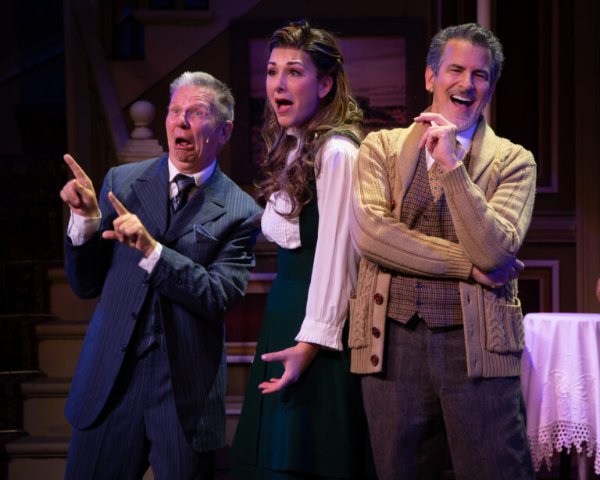
The roughly three-hour production, including intermission, runs through Feb. 22 in the company’s elegant and spacious Boca Raton venue. Under Norb Joerder’s mostly assured direction, the show features a large cast of vivacious performers who deliver engaging performances that are entertaining, if not always fully convincing. Also, the uncredited scenic design, sometimes featuring painted scenery, could be stronger, although the two-story depiction of Higgins’ house and study is effective. At times, when Higgins exerts control over Dolittle, he climbs to the top; he literally lords over her.
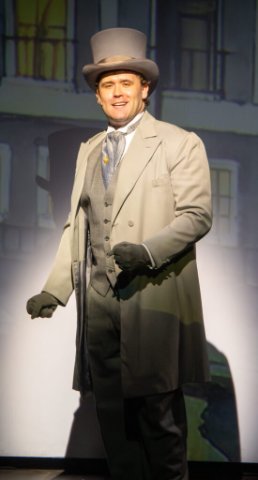
Don’t expect an overtly charming and witty Henry Higgins in the mold of Rex Harrison. Instead, Michael Coppola invests the professor of phonetics with a generally quiet, calm, and arrogant aura. The result is a less likable Higgins and an Eliza Doolittle — portrayed with skill and emotional depth by Allyson Rosenblum — who is easier to root for.
Many theatergoers are familiar with My Fair Lady, Alan Jay Lerner and Frederick Loewe’s classic 1950s musical adaptation of George Bernard Shaw’s witty and satiric 1912 play Pygmalion. Shaw drew inspiration from an ancient myth about the titular sculptor who despises women, falls in love with his own ivory statue, and marries it once it comes to life.
In Shaw’s play, Higgins similarly “sculpts” Eliza Doolittle, transforming her from an impoverished Cockney flower seller into a poised lady. But is Eliza the only one undergoing a transformation before the show ends? This production would argue “no.”
As Rosenblum portrays her, with a believable Cockney accent, Eliza’s transformation unfolds gradually. At the start, she is a loud, desperate young woman who leans into people like a beggar. Dirt smudges both sides of her face, and she wears clothes clearly associated with poverty (an uncredited costume designer deftly contrasts lower- and upper-class attire). She whines and, much to Higgins’ consternation, commits what he calls a “cold-blooded murder of the English tongue,” humorously exaggerating her accent—for instance, she says “cup of tay” instead of “cup of tea.” Early on, Rosenblum’s Eliza reveals her longing for a better life in the dreamy “I Want” number Wouldn’t It Be Loverly. While smiling, she imagines relaxing in a more comfortable environment, relishing chocolate, warmth, and small pleasures she’s never experienced.
Eliza is not without a goal. She wants to become a lady in a flower shop, so she comes to Higgins’ study to learn to speak like one. She tells him, assertively, her ultimate objective. Higgins’ competitiveness quickly surfaces, and he bets Colonel Pickering (Charles Baran) that within a few months, he can transform Eliza into a refined lady.
Humor, conflict, and, of course, glorious music follow as Higgins attempts to teach his student proper speech. The tension builds gradually, reaching a climax during one long night when Eliza finally enunciates the correct phrase. Slowly and with wonder, Rosenblum’s Eliza says, “The rain in Spain stays mainly in the plain.” Before, she’d pronounced it as “the rhine in Spyne stays minely in the plyne.” The scene segues seamlessly into the celebratory number “The Rain in Spain,” as Doolittle, Higgins, and Pickering sing and move with lively, triumphant energy during the irresistibly joyful song.
The cast sings with vigor and expression, accompanied by recorded music that supports the performers, though live musicians would have added richer sound.
“The Rain in Spain” is just one upbeat song in My Fair Lady. After a late night trying to get everything just right, Higgins is so overjoyed she can’t sleep. While smiling, she dreamily sings about this blissful state in “I Could Have Danced All Night.” During the number, Rosenblum’s Dolittle spreads her arms and moves freely, as though she’s flying through the air without a care in the world.
But “I Could Have Danced All Night” is the result of hard work. Other musical numbers similarly showcase the cast’s energy and humor. In fact, Higgins and Doolittle labor so much that the employees in Higgins’ house and study sing in unison in “The Servants’ Chorus.” In the Greek chorus-like number, they satirically remark on how the characters toil without results:
Quit, professor Higgins
Hear our plea or payday we will
Quit, professor Higgins
A, not I
Oh, not ow
Pounding, pounding
My Fair Lady offers sharp commentary on how things such as one’s accent, etiquette and manner of speech serve as rigid barriers to success. The musical starkly contrasts the lower class (characters such as Alfred P. Dolittle, Eliza’s father) and the wealthy upper-class characters who appear during the “Ascot Gavotte.”
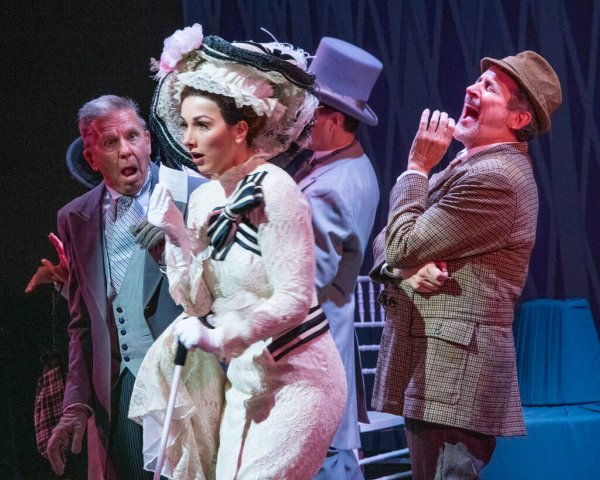
The song depicts high-society spectators at the Ascot horse races and the actors who portray these people do so with the requisite stiffness and propriety. Their movements mimic an 18th century gavotte dance. In addition, their voices, in unison, produce a rich (pun intended) sound that captures their social class. The only thing missing are sound effects of the horses’ feet constantly hitting the ground as they vie to finish first. On a more positive note, the uncredited costume designer has clothed them in fancy, period garb that fits them literally and figuratively.
Higgins brings Eliza Dolittle into this group. She performs surprisingly well for an impoverished Cockney flower seller recently turned into a poised lady. But you can’t help but laugh knowing that Higgins has instructed Eliza to limit her conversation to safe, uncontroversial topics. Specifically, she is to stick to the weather and everybody’s health. Clearly, this is Shaw (and librettist Alan Jay Lerner) poking fun at upper-class rigidity. A comical tension exists as Eliza arrives.
Mrs. Higgins: Colonel Pickering, you're just in time for tea.
Colonel Pickering: Thank you, Mrs. Higgins. May I introduce Miss Eliza Doolittle?
Mrs. Higgins: My dear Miss Doolittle.
Eliza: How kind of you to let me come.
Mrs. Higgins: Delighted, my dear. Lady Boxington.
Lady Boxington: How do you do?
Eliza: How do you do?
Mrs. Higgins: Lord Boxington.
Lord Boxington: How do you do?
Eliza: How do you do?
Mrs. Higgins: Mrs. Eynsford-Hill, Miss Doolittle.
Mrs. Eynsford-Hill: How do you do?
Eliza: How do you do?
Mrs. Higgins: And Freddy Eynsford-Hill.
Eliza: How do you do?
Freddy: How do you do?
As Eliza, Rosenblum pronounces it just right, as follows: “how do you doooooo.”
Later in the show, Henry’s mother, Mrs. Higgins (Elaine Levin), drily and with emphasis tells her son to follow the same advice he earlier gave to Eliza: when speaking, stick to your health and the weather. To her credit, Levin nails the tone. Generally, the cast performs with deft comic timing, which includes playing their roles with sincerity. This enhances the comedy.
In My Fair Lady, a subplot involves Alfred P. Doolittle, Eliza’s father, who satirically mirrors his daughter’s transformation. While Higgins has trained Eliza to join the upper class, her father is “ruined” by being accidentally thrown into it. At the top of the show, Alfred is a happy dustman who revels in his status as one of the “undeserving poor.” He famously claims he “can’t afford” morals and prefers a life of drinking and philandering.
As a joke, Higgins mentions Alfred to an American millionaire seeking a “moralist.” Upon the millionaire’s death, he leaves Alfred a surprise bequest, which forces him into middle-class respectability. Now, Alfred must wear fine clothes, give money to everyone who asks, and even (yikes!) finally wed his long-time partner.
Veteran South Florida actor Troy Stanley portrays Alfred, at first, with a carefree aura. Speaking freely in a high-pitched voice, mud streaking his face, and dressed plainly in dark attire, Stanley looks and sounds like a man who loves to hear himself talk and doesn’t give a hoot what others think. He seems to have fun during Alfred’s playful number, “With a Little Bit of Luck.” In it, Alfred sings about his philosophy of avoiding work, responsibility, and moral temptation through luck rather than effort. With a bit of luck, one can avoid responsibilities, marriage, and allow others to sweat instead. A few other actors join Stanley, moving and singing lightheartedly to enhance the fun.
A clear contrast exists between the plain, unappealing clothes Alfred wears at the beginning and the more upscale attire he dons toward the end. Stanley seamlessly shifts to a more refined manner by the time he’s about to be married. He sings “Get Me to the Church on Time” with wild comic energy, complete with physical choreography by Jeremy Benton. Unsteady, on the ground, and holding a bottle of liquor, Alfred rides off the stage on what resembles a bed of roses.
Eliza’s romantic interest, Freddy Eynsford Hill, would probably want to hand her those roses. Brady Ryan Phillips, making his Wick debut, lends Hill a devoted, somewhat naïve aura. You admire his smiling persistence in numbers such as “On The Street Where You Live.” During the song, Hill sings of how he adores Eliza and is content to merely wait for her outside. When the pair are together, Freddy looks lovingly at Eliza. A contrast exists between Hill’s gentle adoration and Eliza’s insistence that Hill “show” her that he loves her. Forcefully, Rosenblum’s Eliza insists that Hill take action.
While Eliza often drives the action, other characters provide support, contrast, or comedic foil. For instance, Pickering serves as a moral and behavioral foil to Higgins by embodying traits such as respect and empathy. Baran is unexpectedly intense as Pickering, which seems to highlight the contrast with Coppola’s calm, conceited Higgins. At times, this intensity even makes Pickering appear overly nervous or somewhat foolish.
Still, you’d probably prefer to be in his company rather than Higgins, who doesn’t mince words in some of his songs. In “I’m an Ordinary Man,” the professor bluntly explains his views on women. According to him, they are disruptive, demanding, and a “nuisance.” That sounds harsh in 2026, when we like to think we’ve progressed in supporting and advancing women’s rights. But Higgins’ words can also prompt us to reflect on where we may have regressed and how we might continue to move forward.
The musical’s creators structure “I’m an Ordinary Man” effectively. When Higgins sings about how content he is without a woman in his life, his feet rest comfortably on his desk and the music feels soft and serene. Then the number grows louder and more chaotic, mirroring how he believes women disrupt everything. Baran’s Pickering even covers his ears, as though trying to escape the noise. Coppola maintains a strong rhythmic command in “I’m an Ordinary Man,” a number that sits somewhere between spoken word and song. The same holds true in “A Hymn to Him.” In that song, Higgins intensely, yet believably extols the male sex while wondering, “Why can’t a woman be more like a man?” He directs the question toward characters such as Pickering while dismissing women as “nothing but exasperating, irritating, vacillating, calculating, agitating, maddening and infuriating hags.” Ouch. Such words should shock, but do they really in 2026, when division so often comes before dialogue?
My Fair Lady features glorious sights and memorable music, but it also makes us ponder how we treat others, and reminds us that there’s more to a person than their exterior -- there’s also their soul. In the Wick’s production, Coppola’s Higgins realizes that when he notes, “I’ve grown accustomed to her face.” When uttering “face,” his voice’s pitch goes high, as though he’s made a sudden realization. But is it merely Eliza’s face to which he’s grown accustomed, or is it something else? In the end, the musical, and this production, leave us realizing that Eliza Dolittle isn’t an object sculpted by someone. Rather, she’s a human being with a soul. And in the end, everyone -- Henry Higgins included – are endowed with a story and soul worth celebrating.
My Fair Lady runs through Feb. 22 at The Wick Theatre & Museum Club, 7901 N. Federal Highway in Boca Raton. For tickets call (561) 995-2333 or visit www.thewick.org.