

Sarasota Performing Arts Center
Updated Plans
By: Carrie Seidman - Feb 19, 2026

It has been just under a year since members of the Sarasota Performing Arts Foundation brought their plan for a new performing arts center within The Bay Park to the Sarasota City Commission, hoping to move the public/private partnership forward toward implementation and a final design. What they got instead was an earful of critiques and a charge to return to the drawing board prior to any vote on a controversial project that’s been part of Sarasota’s bayfront revision plan since its start in 2018.
The Foundation took the directive to heart. On March 2, leaders will return to City Hall with “Concept 2.0,” a revised design that responds to a multitude of raised concerns, from the site location to the parking needs to the overall cost.
“We’ve been quiet, but we haven’t been idle,” said Tania Castroverde Moskalenko, CEO of the Foundation since 2024 (following the resignation of Cheryl Mendelson), at the most recent of several “Center Stage Conversations” introducing the new design. “The last four months we have made more progress on this project than in the two years I’ve been here. I hope the Foundation’s willingness to listen and respond has really showed the city, and I hope the community, that we are being responsive and responsible.”
Among the major changes are:
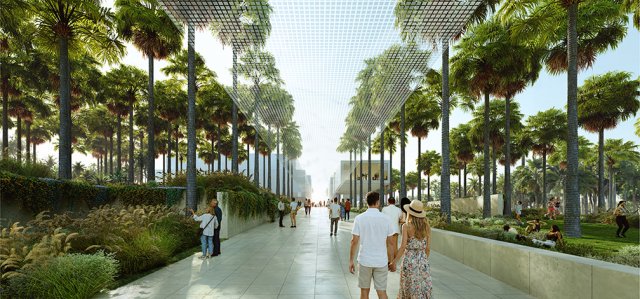
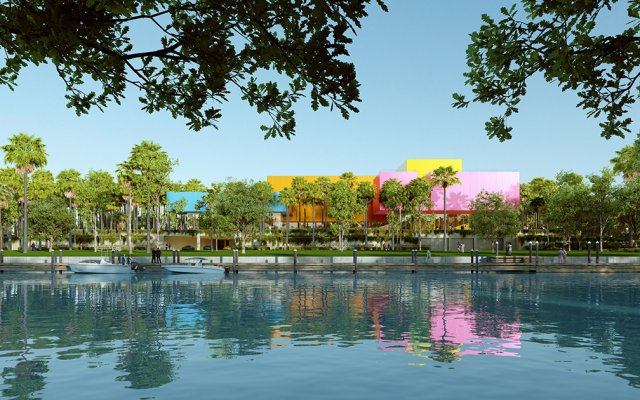
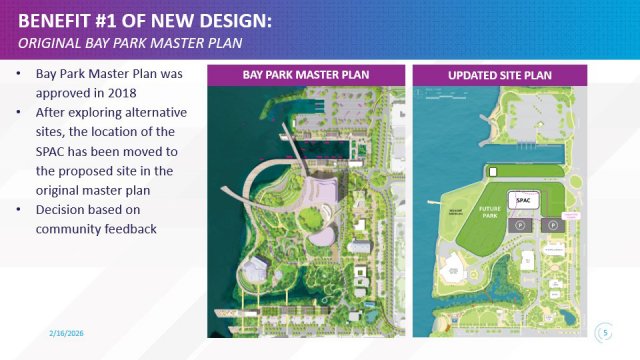
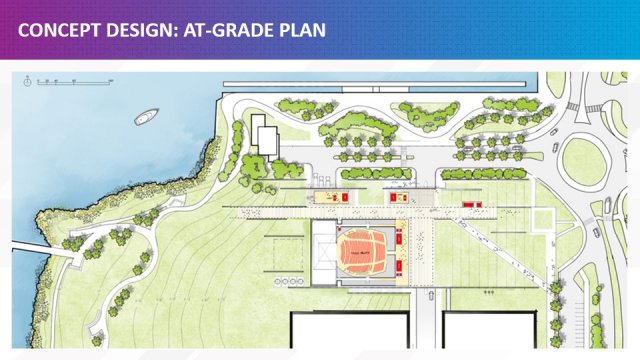
- Location: The proposed main theater, previously located on the north side of the 10th Street boat canal, is now on the south side of the canal and adjacent to Tamiami Trail, with a buffer of green space between them. Two other structures — a “multipurpose” space and a “donor lounge” — are located just north of the performing arts center (but south of 10th Street) with a long walkway and additional green space between them and the main theater.
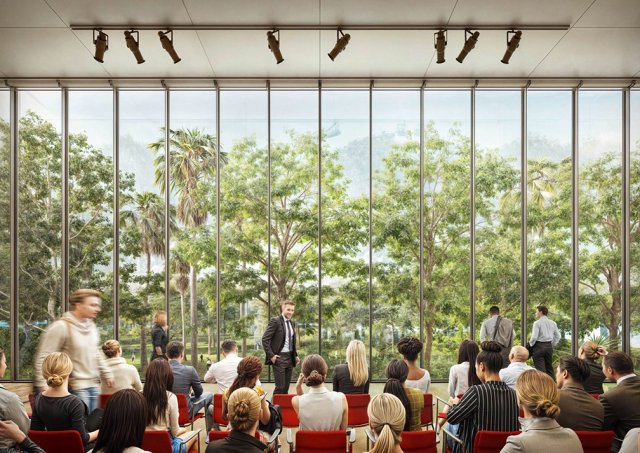
- Size: The large theater, previously proposed for a 2,700-seat capacity, has been reduced to 2,200 seats, a size Moskalenko called “more appropriate for our community.” (The Van Wezel Performing Arts Hall seats 1,741.) The multipurpose building will have a 250-300-seat capacity. Loading and unloading of trucks, which will enter off 10th street, will be hidden beneath the multipurpose building.
- Height/resiliency: Because the revised location is in an area with a view corridor that requires height restrictions, which the previous site did not have, the buildings will no longer be elevated 20 feet on stilts. Instead, the ground site itself will be elevated 22-26 feet for resiliency, leaving just a small percentage of the main structure that will sit below the FEMA flood line to be protected by a barrier known as a “bathtub.”
- Cost: Previously pegged at $407 million last March, the price tag has been reduced to approximately $288 million without, according to the Foundation, any reduction in quality or production capabilities. That is largely due to the reduced seating capacity. That figure includes the three buildings, but not the parking structures.
- Parking: Two multi-level parking garages, now proposed adjacent to and south of the main theater, will provide approximately 750 parking spots, to be used both by theater patrons and park visitors. Under the current concept, one is three levels tall, the other four. There is also room for 50 to 70 ADA-compliant (handicapped) spaces near the theater but underground and a potential 120 additional spots a short walking distance away in front of the “cultural district.” The Foundation believes this will be adequate for “most” activities, but discussions continue about additional parking spots on and off the park site.
- Unification with The Bay: More green spaces and walkways that will allow patrons to move seamlessly from the park or parking to the buildings at a continuous grade make for “greater integration” with the rest of the park, according to Foundation leaders.
The new plan evolved through extended, collaborative talks between Foundation staff, City staff and The Bay Park Conservancy, according to Drayton Saunders, who took over last year as co-chair (with Jenne Britell) of the Foundation, resulting in “a much more unified response.” Previously, each partner had been “more siloed,” Saunders said, which he believes contributed to the Commission’s hesitation.
“Although at the time it was disappointing, I actually think it was an opportunity to double down on how we do this as a community and as a partnership,” he said. “The silver lining is, you’re going to get a better project.”
Interim City Manager Dave Bullock — who will step down March 6 from the position he took over in May of 2025 — says the new concept is “a step in the right direction.”
“When I came in, I felt the aspirations had outstripped the budget,” said Bullock, who will be replaced by Jennifer Jorgensen while commissioners complete selection of the new city manager, hopefully by mid-March. “We’ve been working to try to get this into something that fits the site, the budget and the community. Now I think we’re much closer.”
The Foundation has committed to raising $200 million through a capital fundraising campaign that would be launched not long after it reaches an agreement with the city. This represents a step up from the 50/50 cost split for the new center between the Foundation and the city that had previously been discussed and would reduce the city’s contribution to $88 million. (Sarasota County has declined to contribute to the new hall, though it will continue to split other park costs with the City.)
Bullock cautions, however, about relying on those figures as fixed.
“The vagueness of the number matches the vagueness of the planning process,” he said. “The desire for precision at this stage is high, but it will go unfulfilled. What our job is at the city is to figure out the right facility at the right budget that we can afford and the community can support.”
Bullock said the first thing he did when he took over his position was to have the City’s financial advisors determine how much the TIF (tax increment funding) slated to support the center and the park could generate — an analysis, he said, which had not yet been done.
“When I came in, I believe the project had hit a dead end — or should we say a cul-de-sac — and was just spinning,” he said. “So my job was to see what we could do to give it an opportunity to progress.”
That analysis generated a figure of approximately $65 million that the city could contribute toward a new center, a number that could be amplified by funding from other sources such as the penny surtax charge.
Regardless of whether or not a new PAC is built, the city would also be responsible for the cost of the parking garages, as well as the park infrastructure and operating costs it will share with the county. Though an operating budget and agreement is much farther down the line, Bullock said that too needs to be considered in the decision to move forward.
“We can’t make any commitments about building it until we have a pretty good idea of operating costs and long term implications,” he said. “That’s just responsible planning.”
However, Bullock does think the project is “do-able.” He’ll give his recommendation at the March 2 commission meeting during which the Foundation will formally present its new concept to City Commissioners. The Foundation hopes to return to chambers a few weeks later for a formal vote. If the Commission responds favorably, it has projected a timeline for successive steps that ends with completion of the PAC in the summer of 2030. But Bullock warned against being tied to any specific timetable.
“If you try to force it before you’re ready, it won’t work. In fact, we saw that earlier with this project. All the pieces — the financial, the political, the philanthropic and the community — have to come together. Trying to be a slave to someone’s schedule is not how you get a successful project.”
In addition to the new site and design concepts, issues surrounding the future use of the current performing arts hall, the Van Wezel, have also reached a more collaborative detente. Though a report by the city’s “purple ribbon committee” did promote building a new PAC, it also advised “hardening” the Van Wezel against storms and climate change in order to prolong its usable life.
Gone is any thought of doing away with the iconic purple structure, as is the “non-compete” clause in the original contract with the city that would have forbade any arts performance programming to continue at the venue after a new hall was built.
“I never understood why our contract said there was a non-compete and the Van Wezel had to stop being a performance venue,” said Moskalenko, who managed a multi-venue complex in Chicago previously in her career. “I thought, why not just remove that from our agreement with the city, which we did last March.”
Instead, the Foundation has offered to “steward” programing for both the Van Wezel and the new PAC, with an eye toward “collaboration not competition,” as Saunders put it. Moskalenko calls the new hall part of “a unified arts campus, not a replacement project.”
“I think that approach maximizes public assets, gives the public more options, and there can be more community use and flexibility across venues,” she said.
Moskalenko also met with descendants of the Van Wezel family, who felt alienated by previous suggestions that their family’s arts legacy in Sarasota might not be preserved. Now, she said, descendants and the Foundation are “both on the same page.”
“All I can say is that it’s amazing what can be accomplished when people sit down and actually have a dialogue and listen to each other,” said Moskalenko, who met with the grandchildren of Lewis Van Wezel — Anthony Van Wezel Stone and Katherine Van Wezel Stone, last summer.
According to the Van Wezel Stones, those conversations “led us to an appreciation that the project is an evolving concept in which the Van Wezel Performing Arts Hall will continue to serve the city as a venue for the arts, in harmony with and alongside the new Performing Arts Center.”
The speed of any advancement of the PAC could, of course, also be hampered by additional roadblocks and, given Sarasota’s history, smooth sailing may be wishful thinking. One potential sticking point no one is willing to discuss yet is what impact proposals to reduce or eliminate property taxes promoted by Gov. Ron DeSantis and currently under discussion in the state legislature might have on the TIF funding.
Nor can anyone predict what pushback any major downtown project —- much less one that would become the largest and most expensive building ever undertaken by the city — may get from the public. Longtime residents who witnessed the protracted and divisive protests over the expansion of Selby Gardens or the building of the Ringling Bridge, know that public resistance can greatly stall, if not entirely quash, a proposal.
Saunders believes that kind of obstruction might be the kiss of death, insisting it is “of existential importance to do this now, or we will lose our grasp on what has been Sarasota’s calling card for a very long time. I do think this is our singular best shot to do this for the community and you don’t want to lose that momentum,” he said. “People protested the bridge until it was built and the same with Selby. What we hope is that when it’s all over and built, they’ll enjoy it and say, ‘Yeah, I called that one wrong’.”
Learn more at ArtsBeat.org.