

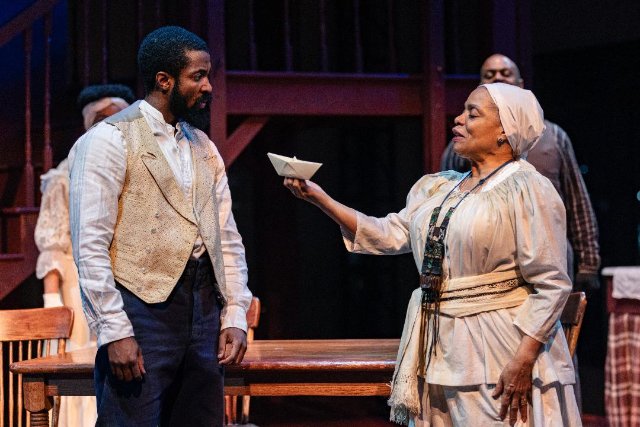
Long Wharf’s production of August Wilson’s Gem of the Ocean was very good, though the play is flawed.
This play, set in Pittsburgh in 1904, is chronologically the first in Wilson’s ambitious The American Cycle or The. The cycle reflects the African American experience through the decades of the 20th century; almost all the plays are set in Pittsburgh. Gem of the Ocean was actually the 8th play Wilson wrote; it was produced in 2003. The first was Jitney, produced in 1982. Six of his plays – Ma Rainey’s Black Bottom set in the 1920s, Fences set in the 1950s Joe Turner’s Come and Gone set in the 1910s, Radio Golf (1990s), The Piano Lesson (1930s), and Two Trains Running (1960s) had their premieres at the Yale Rep.
By the time Gem was written, Wilson had established some themes and techniques that are present in almost all the plays: characters have long soliloquies reminiscent of jazz riffs; supernatural elements or characters with mystical gifts are prevalent. The focus is mainly on African American men. In addition, the settings often revolve around real events. Joe Lewis’ boxing match versus Billy Conn in Seven Guitars and the assassination of Martin Luther King, Jr., in Two Trains Running.
In Gem, the event that triggers the action is a strike, followed by arson at a major Pittsburgh factory.
While Wilson was a brilliant playwright, many acknowledge that at times he needed editing. There are moments in the play when he draws things out too long.
The play is set in the home of Aunt Ester, a 275+-year-old woman known in the community as a cleanser of souls. Aunt Ester is referred to in several of Wilson’s plays. A former slave, she lives with Eli, who watches over her, and Black Mary, a young woman who is both housekeeper and student of Aunt Ester’s arts. Solly Two Kings is a regular visitor, with Eli, was a conductor on the underground railroad and a scout for the Union army.
The Long Wharf production, directed by Cheyenne Barboza, features a realistic set by Omid Akbari, lighting design by Joseph X. Fonesca, and sound design and music by Chris Felix. The costumes by Toni-Leslie James and Travis Chinick reflect the period.
The Boat House at Long Wharf works well for the play, as it did for the terrific production of A View from the Bridge; after all, Pittsburgh is set at the confluence of two major rivers that meet to form the Ohio River.
Caesar, the brother of Black Mary, is an unusual character for a Wilson play. It isn’t because he is successful, but because of his views. From a sketchy past, he is not a sheriff who adamantly follows rules to the absolute letter. He also owns property and has no compunction about evicting people who are just a day or two late with their rent, no matter what the circumstance. In the first act, he has a soliloquy that would be considered racist if a white character had espoused the views.
The catalyst for much of the action – besides the strike – is the arrival of Eli, a young man from the south. Aunt Ester gives him lodging and later oversees his visit to the land of bones – a representation of the slave ships – for a cleansing of his soul. The scene is terrific, but once again, Wilson drags it out.
Among the performance highlights are Grace Porter as Black Mary, Terrence Riggins as Solly Two Kings, Thomas Silcott as Eli, and Bjorn Dupaty as Caesar.
Long Wharf should be praised for this fine production.