

Camelot
Wick Theatre and Costume Museum in Boca Raton
By: Aaron Krause - Mar 31, 2026





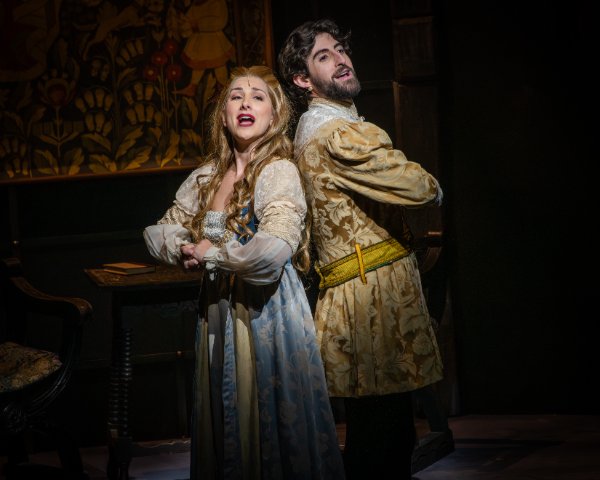
The American people spoke clearly this past weekend during “No Kings” protests across the country: they do not want a monarch. But would they accept the kind of ruler at the center of The Wick Theatre and Costume Museum’s romantic and invigorating production of Camelot? King Arthur, as Alex Martinez portrays him, is a youthful, likable leader whose humanity shines through. He can be commanding and, at times, severe, but he is far from a tyrant. Martinez leads a large, gifted cast in the production, which runs through April 12 in the company’s elegant Boca Raton venue and lasts about two hours and 45 minutes, including intermission.
Director Norb Joerder, who has a decades-long association with the musical, has gifted us with a youthful and moving Camelot that emphasizes the love triangle and Arthur’s humanity. The production, which leans into the show’s fairytale aspects while honoring its significant themes, uses the musical’s original script (the show debuted in 1960). This mounting takes place against a backdrop that evokes a magical 6th-7th century English atmosphere, with lighting by Clifford Spulock that enhances the show’s magical tone. There’s plenty that’s visually appealing: magical effects; projection designer Kacey D. Koploff’s picturesque visuals, which enhance the scenery; the show’s lush 200 costumes (set and costume designer Kimberly Wick); and 14 sets of armor. But, in the end, it’s the story’s emotional beating heart that lingers.
Based on T.H. White’s classic fantasy novel The Once and Future King, which retells the Arthurian legend, Alan Jay Lerner and Frederick Loewe’s Camelot is a romantic musical about King Arthur’s idealistic establishment of the Round Table and his vision for a utopian kingdom. The plot explores the tragic love triangle between Arthur, his Queen Guenevere, and his celebrated knight Lancelot, whose forbidden romance, combined with the evil Mordred’s machinations, destroys the kingdom’s promise. The show’s luminous score features some of the greatest songs in all of musical theater, and this cast honors it with stirring and clear vocals and vibrant yet unforced dance (choreography by Madeline Dunn). The sound is consistently clear, thanks in part to the fine work of sound designer/engineer Justin Thompson.
Martinez convincingly conveys King Arthur’s vulnerability at the top of the show, when the character is hiding in a tree. He’s nervous about his upcoming arranged marriage to Guenevere, and we hear his anxiety in his hesitant voice and mannerisms. In the production’s early moments, Martinez’s Arthur walks far downstage toward the audience and sits on the stage floor right by us. He looks at us and smiles, then moves around while singing “I Wonder What the King Is Doing Tonight.” He’s walking off his anxiety while singing a song that captures his vulnerability, humanity, and fear about the arranged marriage. With dark, shining eyes, dark brown hair, mustache, and beard, this Arthur looks and sounds youthful, uncertain, and accessible—rather than fearless and arrogant, qualities we know all too well these days.
While tension colors Arthur and Guenevere’s first meeting, they soon grow more comfortable with each other. During the show’s upbeat and serene title song, Martinez’s Arthur lays his head on his new bride’s shoulder while enthusiastically singing about Camelot’s virtues. Guenevere (Allyson Rosenblum) listens innocently yet attentively.
Martinez’s Arthur has a twinkle in his eye when he talks, for instance, about his childhood. While making fists, he mimes, with effort, pulling the sword Excalibur from a stone during his early years. Following this intensity, he turns charming and says, laid back and happy, “And that’s how I became king.”
Martinez may look young and unimposing, but don’t let first impressions fool you. At key moments, his Arthur assumes a commanding stance, raises his sword, and shifts his voice and facial expressions to an authoritative—even severe—tone. For instance, he is fearsome in a dramatic, emotionally charged monologue about his struggle with Guenevere and Lancelot’s betrayal. During the speech, Arthur wrestles with the desire for vengeance against the need for civilized, kingly justice. To his credit, Martinez shows us a king genuinely torn.
Lancelot’s arrival after learning about Arthur’s Knights of the Round Table disturbs the titular king’s idyllic Camelot. In the Wick’s production, the Frenchman bursts onto the scene with the grand, boastful song “C’est Moi,” which translates to “It’s Me” or “Tis I.” Jesse Luttrell’s Lancelot seems larger than life, making sweeping gestures with his sword while his deep, rich tenor with a baritone quality soars throughout the space. He even blows on his sword, while his posture and expression suggest he’s admiring himself. During such moments, you can’t look away—he seems fearless, self-absorbed, and totally in control.
Fortunately, Luttrell’s portrayal isn’t one-dimensional. In other scenes, he bows reverently, and his voice softens, becoming honorable and even humble. You hear credible sincerity in his voice and manners, especially during the passionate song “If Ever I Would Leave You.” In it, the performer mixes lower, earnest notes with higher, soaring tones that remain clear and compelling.
Luttrell shares strong chemistry with Rosenblum during key scenes between Lancelot and Guenevere. They hold hands, he gently touches her, and their lips meet in tender, believable moments that heighten the romantic tension.
As Guenevere, Rosenblum sounds completely different from portions of her admirable portrayal of Eliza Doolittle in The Wick’s previous production of My Fair Lady. For that performance, Rosenblum’s Doolittle sometimes spoke harshly, with a Cockney British accent, leaning into others like a desperate beggar and wearing a common flower girl’s outfit from London’s slums. Here, she’s upright, clad in royal period clothing, and her honeyed voice sounds graceful and eager. During the song “The Simple Joys of Maidenhood,” Rosenblum captures Guenevere’s genuine longing for the life of an unmarried woman. In the joyful number “The Lusty Month of May,” she and the other cast members dance and sing merrily, their enthusiasm contagious. We want to join in their celebration.
You also feel for Rosenblum’s Guenevere during tense moments, such as the song titled after her name. Its melody carries the anticipatory anxiety of something bad approaching, and you pray that Arthur will spare her life. Rosenblum’s well-developed Guenevere isn’t just a spectator. She’s assertive when necessary, standing firm and speaking forcefully without becoming unlikable. Just as Rosenblum shares strong chemistry with Luttrell, Arthur and Guenevere are believably husband and wife, a royal couple who clearly respect each other.
One character we don’t respect is Mordred, Arthur’s illegitimate son bent on destroying Camelot and the Knights of the Round Table. While Mordred and Lancelot are both conceited, at least Lancelot undergoes a positive change. You can’t say the same for Mordred, who remains the villain throughout the piece, possessing no redeeming qualities. Dressed in black, standing tall and proud, Elliot Mahon nails his character’s conceited manner along with his cynicism. He struts, smiles slyly, emits an evil laugh, whispers in disgust, and turns menacing, instigating a defiant “Fie on Goodness.” During this song, Arthur’s knights rebel against the king’s “too noble” civilized ways for their past, base behavior. With wicked glee, Mahon’s Mordred sings “The Seven Deadly Virtues,” a number in which the character mocks the chivalrous ideals of King Arthur’s Round Table.
It might seem easy to mock Pellinore, an elderly and eccentric knight devoted to Arthur. Besides supporting Arthur and his ideals, Pellinore also serves as comic relief. He comes across as a forgetful, confused old man as Mark Fishback portrays this rather one-dimensional character. Still, Fishback gives him some depth by sincerely playing moments when Pellinore strongly supports Arthur.
While Pellinore is up in age, Tom of Warrick is a young stowaway. The boy represents the future. Arthur knights him, hoping that Tom will spread the word of chivalry and Camelot to future generations. During the reviewed performance, child performer Zoey Madden, looking believable as a boy with short hair, imbued Tom with convincing eagerness—the kind of youthful enthusiasm that can carry over to others and leave us feeling hopeful. Madden alternates in the role with fellow child performer Nate Colton.
Unlike Aaron Sorkin’s 2023 Broadway revision of Camelot, which reimagines the musical by, among other things, scrapping its supernatural elements, Joerder builds the Wick’s production around the show’s original script. It retains the musical’s fantasy, which adds whimsy to the action. However, you get the sense that this timely and timeless show would resonate just as strongly without the supernatural material. Camelot, like shows such as Man of La Mancha, reminds us that even in dark times such as those we are living through, holding onto ideals never goes out of style. Such ideals give society something to strive toward and infuse us with hope.
Lerner and Loewe, who created such unforgettable shows as My Fair Lady and Brigadoon, are known for their sophisticated, memorable melodies as well as lyrics that reveal character and emotion. Under music director Bobby Peaco, The Wick Theatre uses recorded music, which ably supports the strong, clear-voiced performers. The Wick can now proudly add Camelot to the list of Lerner and Loewe shows that the company has successfully staged, leaving us not only with songs that linger in the mind, but also with powerful messages that resonate long after the curtain falls.
WHAT: The Wick Theatre and Costume Museum’s professional production of Camelot
WHEN: Through April 12
WHERE: The Wick Theatre and Costume Museum, 7901 N. Federal Highway in Boca Raton
TICKETS: Visit www.thewick.org, email boxoffice@theWick.org, or call (561) 995-2333.