

Saariaho's Innocence Beautiful at the Met Opera
The Composer's final opera is a Masterpeice
By: Susan Hall - Apr 07, 2026
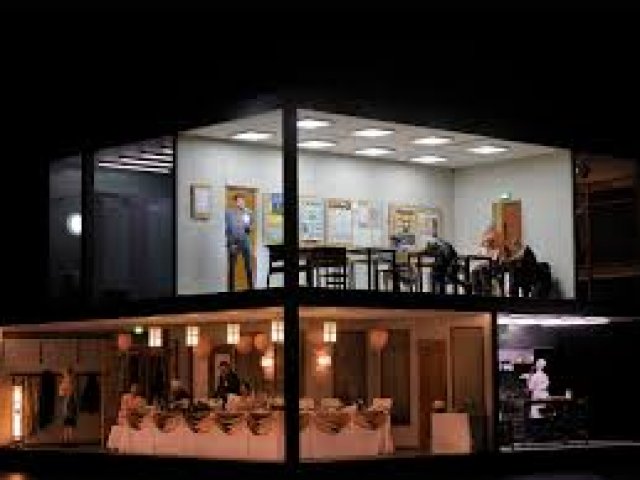
Innocence, Kaija Saariaho’s searing meditation on collective guilt, received its New York premiere at the Metropolitan Opera. Many of the artists from its world premiere at the Aix-en-Provence Festival five years ago are present here: Susanna Mälkki conducts, bringing her close collaboration with Saariaho to bear, alongside the brilliant director Simon Stone. Stone makes a work live in the moment, a powerful invitational tool for audiences.
Saariaho conceived the work for 13 characters, with nine languages spoken and sung. Aleksi Barrière, co-librettist and dramaturg, serves as master linguist, supplying this mosaic of tongues. Saariaho noted that each language carries its own music, and this rich diversity deepens the intricate orchestral fabric she creates.
The Met Opera Orchestra offers a splendid interpretation of the score, which incorporates the shimmering sonorities Saariaho first discovered by breaking glass with her own hand early in her career. In her mature language, they are transmuted into notes. The phrasing is often conversational, almost like chamber music, yet it remains lucid even within the vast forces of the orchestra.
This the first libretto for noted Finnish writer Sofi Oksanen. In discussion with Saariaho, three bold themes emerged, and, invited to pick one, Oksanen chose a school shooting. The collaborators explored the impact of such a singular, horrific act on those left behind. Too often, Saariaho observed, it is the perpetrator who commands attention; Innocence insists otherwise.
The set, by Chloe Lamford, is a rotating cube. On its upper level, memories unfold; below lies the opera’s present, grounded in the real world. When the banquet table stretches into a long horizontal tableau, it evokes The Last Supper, with its thirteen figures. The Met stagehands move the cube slowly and silently, allowing each brief scene to settle and resonate. Under Mälkki and Stone, the result is a compelling and devastating theatrical experience.
The multiplicity of languages at an international school in Helsinki is matched by a diversity of vocal styles. Vilma Jää, for whom Saariaho wrote the role of Markéta, sings in ancient Finnish and employs Finno-Ugric vocal techniques; tall and striking, she stands out in an excellent cast.
Saariaho’s interest in mothers finds powerful expression in Joyce DiDonato’s Tereza, a waitress and Markéta’s mother. A Met regular in demanding roles, DiDonato is deeply affecting. As Patricia, the killer’s mother, Kathleen Kim makes the most of an unsympathetic role, shaping a woman desperate to bury the past and celebrate her surviving son. Rod Gilfry is masterful as the father of two sons—one a groom, the other a killer—bringing a riveting authority to the part.
Mälkki conducts with a keen sense of drama, illuminating Saariaho’s dense, dancing textures.
Lamford’s two-story cube—memory above, present below—was developed in close collaboration with the production team. In some sense, this opera becomes a ‘Last Supper': the fragile interval between a family’s attempted erasure of its past and the inexorable revelation of truth.
Only Mieczys?aw Weinberg’s The Passenger, a work concerned with singular guilt, comes close to the shock to memory and conscience that Innocence delivers.
For Saariaho, it was essential that the music remain of this world. No other art form, she believed, carries such impact. Performed in the United States—where school shootings recur with tragic frequency—the opera may find audiences ready to engage with the difficult work of reckoning and change. Saariaho, whose humanism matches her musical imagination, would have wanted nothing less.
Playing on April 11, 14, 18, 22, 25, 29.