

Dennis Hopper, Actor, Director, Photographer and Art Collector
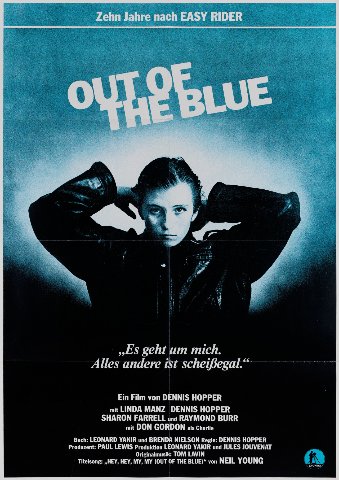
Out of the Blue
By: Charles Giuliano - Apr 24, 2026
Dennis Lee Hopper (May 17, 1936 – May 29, 2010) was an actor and director best known for the influential counter culture masterpiece Easy Rider. The 1969 film was written by Peter Fonda, Dennis Hopper, and Terry Southern, produced by Fonda and directed by Hopper. Fonda and Hopper play two bikers who travel through the American Southwest and the South, carrying money made from a cocaine deal. Other actors in the film include Jack Nicholson, Karen Black, and Toni Basi. Shot on the road it took two years to edit the film.
The independent film had a budget of $400,000 and earned $60 million when released by Columbia Pictures. It received two Academy Awards nominations for Best Original Screenplay and Best Supporting Actor (Jack Nicholson).
Based on that success Hollywood anticipated another hit with Hopper’s second directorial feature The Last Movie / Chinchero (1971) which proved to be a disaster. After viewing the final cut the studio opted to take a loss.
Roger Ebert’s 1971 review is to the point. “Dennis Hopper’s The Last Movie is a wasteland of cinematic wreckage. There are all sorts of things you can say about it, using easy critical words to describe it as undisciplined, incoherent, a structural mess. But mostly it’s just plain pitiful. Hopper hasn’t even been able to cover his tracks; the failure of his intentions is nakedly obvious. Near the movie’s end there’s a pathetic scene in which he sits, half-stoned, dazed, confused, and says the hell with it. It feels like he means it.”
There was method in the madness as legendary excess derailed what might have been a mainstream career. Off the grid he was cast in independent and European films. One of these was a low budget Canadian film Out of the Blue. Two weeks into production Hopper took over as a director in an effort to salvage the film. He rewrote the screenplay and found new locations.
The Ebert review was sympathetic. “The movie escalates so relentlessly toward its violent, nihilistic conclusion that when it comes, we believe it. This is a very good movie that simply got overlooked. When it premiered at the 1980 Cannes Film Festival, it caused a considerable sensation, and (Linda) Manz was mentioned as a front-runner for the best actress award. But back in North America, the film’s Canadian backers had difficulties in making a distribution deal, and the film slipped through the cracks.”
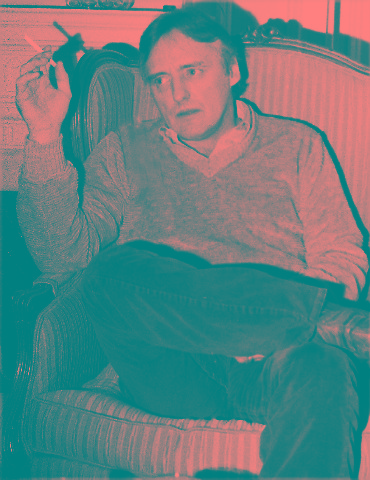
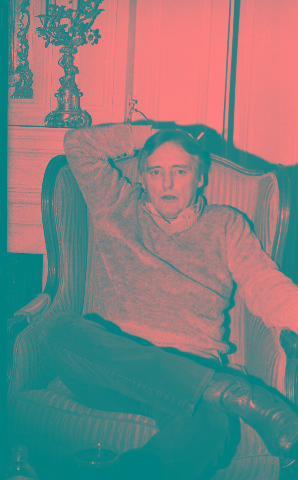
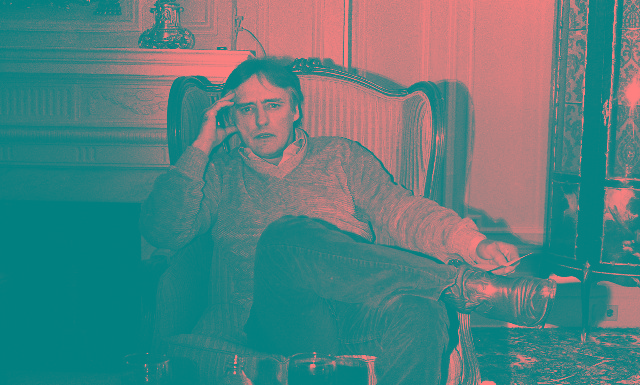
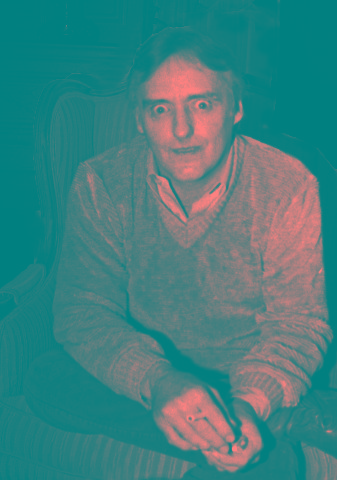
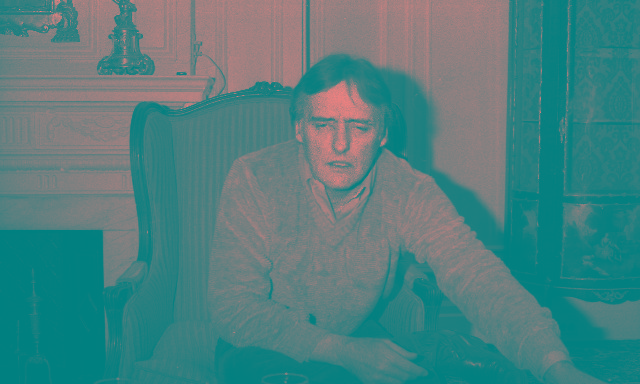
The film made its American premiere at Boston’s Coolidge Corner Theater. Justin Freed, who ran the theater at that time, arranged for interviews with critics. There was a schedule of one-on-one slots. My meeting occurred in late afternoon and by then Hopper was wired but open and unguarded. While fully engaged he returned from several breaks articulating mood swings which I captured in a series of five images.
Peter Biskind states in Easy Riders, Raging Bulls (Simon & Schuster, 1998) that Hopper's cocaine intake had reached three grams a day by this time, complemented by 30 beers, and some marijuana and Cuba libres.
Reportedly, after staging a "suicide attempt" in a coffin using 17 sticks of dynamite during an "art happening" at the Rice University Media Center, filmed by professor and documentary filmmaker Brian Huberman, and later disappearing into the Mexican desert during a bender, Hopper entered a drug rehabilitation program in 1983.
My time with Hopper ended with the arrival of Kathy Huffhines in the anchor slot. They attended the premiere together and partied after it.
On July 22, 1991, The Chicago Tribune reported that “Detroit Free Press movie critic Kathy Huffhines died Thursday in a Philadelphia hospital, never having regained consciousness after an accident July 13 in which a tree fell on the roof of a car in which she was a passenger. She was 48. Miss Huffhines died of head injuries, according to her fiance, Jay Carr, a film critic with the Boston Globe.
“Free Press Executive Editor Heath Meriwether, who nominated Miss Huffhines for a Pulitzer Prize in criticism last year, said she ”blossomed as a new and interesting critical voice in the forest of motion picture critics."
Seated in a suite of the Copley Plaza Hotel we began with Out of the Blue. “It’s not a pretty story. My character has no redeeming qualities but this is the reality of life today,” Hopper said “To me the subject is the disintegration of a family in the manner of Rebel Without a Cause. It’s the relationship between a father, his wife and daughter. It’s the kind of story which ends up on page four of the Daily News. A story like a girl kills her father then blows her mother and herself to kingdom come. This happens all the time and the film deals with certain current values.”
After seeing the film Jack Nicholson told him that Out of the Blue is to the 1980s what Easy Rider became to the 1970s. Another friend, Warren Beatty hailed it as a masterpiece and it was well received in Europe. The film cost $1.2 million and earned that much prior to its American debut. At the time he hoped that Out of the Blue would get him back on track as a director. His career imploded with his second film which was shot in Peru. This opportunity was a matter of luck.
“I inherited the script” he explained. “So there were certain situations which were not my decision. I did, however, make changes in the script. The original version had Linda killing her father after an implied instance of incest. But I decided to have her blow up the rig with she and her mother inside. After I met Linda on set I learned that she played instruments so I put that in and the whole punk rock thing that was not in the original script.”
Improvisation was an aspect of his approach which started early in his career. He studied at the Old Globe Theatre in San Diego, and the Actors Studio in New York City with Lee Strasberg for five years. He formed a friendship with actor Vincent Price, whose passion for art influenced Hopper. In parallel with acting he developed as an artist, photographer and collector.
James Dean was an influence and he recalled that “I was just 19 when I worked with Dean on Rebel Without a Cause (1955) He was 24. That film was done in about six weeks. A year later in Giant (with Hopper cast as the son of Rock Hudson) we were on location in a town of some 200 people for six months. So I knew Jimmy really well and his death was a great personal loss. He only made three movies. The first was East of Eden which he had done before we met on the set of Rebel. He never made any money to speak of. His paycheck for Giant, for instance, was just $15,000. He used the money to buy a Porsche as he was into racing cars. It was the car he was killed in.”
Hopper learned a lot from Dean. “Guys like Dean, Brando, and Montgomery Clift were changing the approach to acting” he said. “Until them everything was blocked out ahead of time by directors. They told you to cross the room and then, precisely on cue, pick up a glass of water and deliver the line. Guys like Dean and Brando were saying ‘Let me run through the scene before you block it out. I’ll pick up the glass of water when I damn well feel like it. But keep the camera rolling.’ It’s this “method” approach that reached its apogee in Easy Rider. “
The film which was shot for $350,000 later earned $130 million. Hopper had seven per cent interest which earned him $1.7 million during the first year of distribution. That disappeared during the production of The Last Movie. He ended up owing the IRS $785,000 while also going through a divorce. He was unable to finance his career as a director. There was a long gap until Out of the Blue in 1980. As an actor he was recognized for roles in Apocalypse Now and the Wim Wenders film American Friend among others.
“After Easy Rider I thought I was free to start to do what I wanted,” he said. “But I didn’t know how to play the Hollywood game. I learned that you weren’t doing the producers any favor by making a film for $350,000 rather than the millions they were used to. There are all kinds of hidden production costs that are a way for them to write off losses. They are willing to make ten movies on the chance that one will be a hit and make money. In Hollywood you are as good as your last movie. Everything would have been alright for my career as a director if The Last Movie had been successful.
“A lot of this is a matter of timing. Making Easy Rider, for instance, we were on location moving around the country for five weeks so there was no chance to see daily rushes as is the usual practice. After shooting we had so many hours of footage that it took me two years to edit the film.
“When I finished shooting The Last Movie on location in Peru there was a lot of excitement and media coverage. Both Rolling Stone and Life Magazine visited me at home in Taos and did cover stories. It was a year and half later when I tried to have it distributed. It got great reviews in Europe when it was shown at Cannes but the studio didn’t understand it. I made a movie about making a movie and showed just how foolish it all is. The film makes fun of the audience but the studio took this as an insult. They decided to make more money by dumping the movie and taking the loss than by releasing it. We’ll be getting it back and there are plans for its distribution.”
(Currently you are able to watch The Last Movie streaming on Night Flight Plus or for free with ads on The Roku Channel. It is also possible to rent The Last Movie on Amazon Video, Apple TV Store online and to download it on Amazon Video, Apple TV Store. Besides streaming, you can also buy the movie on DVD from Barnes & Noble and on Blu-ray from Zavvi, Barnes & Noble. You can also stream the title for free on Kanopy, Plex Player, Fawesome.)
On a more personal approach I asked about his living circumstances and finances. Stating that he is a direct descendant of Daniel Boone he also referred to several strains of Indian heritage. Accordingly, he was at peace on Sacred Land. He bought the Mable Dodge Luhan house in Taos in 1970. He listed his assets as 400 acres of land and a cabin as well as another dwelling, a movie theater, pickup truck and a Cadillac. “The important thing” he said “Is that I own everything and don’t owe anything, especially to the Government.”
In addition to his work in film he was an accomplished artist and photographer as well as a renowned collector. Hopper turned to photography after he was blacklisted by the director Henry Hathaway. His notable photographic works include portraits of Martin Luther King Jr., Jane Fonda, and Andy Warhol, as well as images taken during the Civil Rights March in Selma. In Taos he shot Drugstore Camera (1970–1972), in which Hopper used disposable cameras to document his secluded life in the desert town and road trips beyond its borders. The series was exhibited at Gagosian Gallery in 2011. In 2010, with the help of his friend Julian Schnabel, Hopper’s work was given a major retrospective at the Museum of Contemporary Art in Los Angeles.
”It was part of my training that I was expected to be acquainted with all aspects of life” he said. “Part if that became an interest in art. I was an art groupie in the way that someone might be a rock groupie. Several times a year, I would make the pilgrimage from Hollywood to New York to see what was happening in the art world which I began to follow avidly. I was very involved and came to know artists before they were showing in galleries. After abstract expressionism everyone was talking about a return to the figure and a new realism. It was expected to look like early de Kooning. The new artists rejected all that because it had already been done. During studio visits I began to see paintings of soup cans, comic strips, magazine illustrations, and takeoffs from advertising. I bought Andy Warhol’s first Campbell’s Soup painting for $100. That’s about what I paid for works by Lichtenstein, Rauschenberg, Johns and others.”
As a collector he was prescient in acquiring works before they received critical attention. His deep dive into the fine arts influenced how he framed shots as a director. “When I started to buy works by Op artists nobody was sure that it was art and not just design,” he said. “The paintings were regarded a works with no significant intrinsic value. I spent a total of about $38,000 on my collection. When I divorced my first wife, Brooke Hayward, (1969 after eight years of marriage) the value of the collection had risen to about $500,000. In today’s market it would be worth five to ten million but that’s not why I did it.
“When I looked at paintings often times I would be bothered and disturbed, “he said. “Like the first time I saw the constructions of Ed Kienholz. That excited my curiosity and I went back and asked myself ‘why are you upset? What’s going on here?’ It was a process by which I became involved and understood the work. I put together a collection of masterpieces.”
In his career Hopper made, spent, and lost a lot of money. As our time progressed, with his breaks for enhancers, the loose ends became ever more evident. There were five marriages that didn’t end well- Brooke Hayward, 1961-1969, one child, Michelle Phillips married October 31, 1970 – divorced November 8, 1970, Daria Halpern (a Boston University grad and co star with Mark Frechette of Antonioni’s Zabriski Point) 1972-1976, a daughter Ruthanna Hopper, Katherine LaNasa, 1989-1992, one son, and Victoria Duffy, 1996-2010, one daughter.
”I know the rap about drugs and sex,” he said. “The marriages and orgies. I’ve heard it all. What counts in the end is the film itself. You’re not supposed to do things differently. I fired Rip Torn and Terry Southern when they were getting nowhere in writing Easy Rider. I had been all over the country scouting locations. I walked in and found them sitting around a huge table as though it were ‘The Last Supper.’ I turned the table over and Rip Torn pulled a knife on me.”
(In 1994, Rip Torn filed a defamation lawsuit against Hopper over a story Hopper told on The Tonight Show with Jay Leno. Hopper claimed that Torn pulled a knife on him during pre-production of the film Easy Rider. According to Hopper, Torn was originally cast in the film but was replaced with Jack Nicholson after the incident. According to Torn's suit, it was actually Hopper who pulled the knife on him. A judge ruled in Torn's favor and Hopper was ordered to pay $475,000 in damages. Hopper then appealed but the judge again ruled in Torn's favor and Hopper was required to pay another $475,000 in punitive damages.)
Having fired the writers Hopper wrote the script in a matter of four weeks. “I would like to say that I wanted Jack Nicholson in the film,” he said. “The truth is that at first I didn’t. I had someone else in mind. I would like to say that Jack owes me a lot but it’s the other way around. He was also instrumental in getting backing to finish the film. We have remained friends ever since.”
In Hollywood there is a price to pay for stepping out of line. “They were never able to get to James Dean or Brando,” he said. “But they were able to get to me for not playing their game. I know the rap on me. There is a scene in Out of the Blue where I play a drunk and pour a bottle of whiskey over my head. I couldn’t be as drunk as I appear to be and still handle the 30 or so people in front and behind the camera that it took to make that scene. What they can’t take away from me is that I know my craft. The average career of a successful Hollywood actor is just three years. This is not a very reliable business but I hope that the success of Out of the Blue will make that happen. It will give me the chance to direct other films.”
It would be eight years before he directed Colors in 1988 then Catchfire and The Hot Spot in 1990 with Chasers in 1994. There were also two short films Homeless in 2000 and Pashmy Dream in 2008.
.