

Hamnet
Royal Shakespeare Production at A.C.T.
By: Victor Cordell - Apr 24, 2026

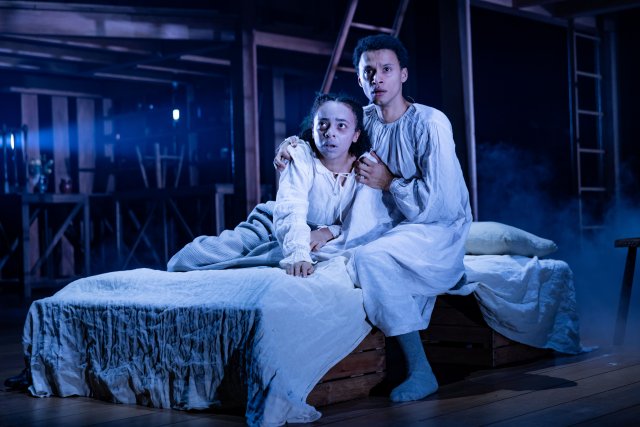
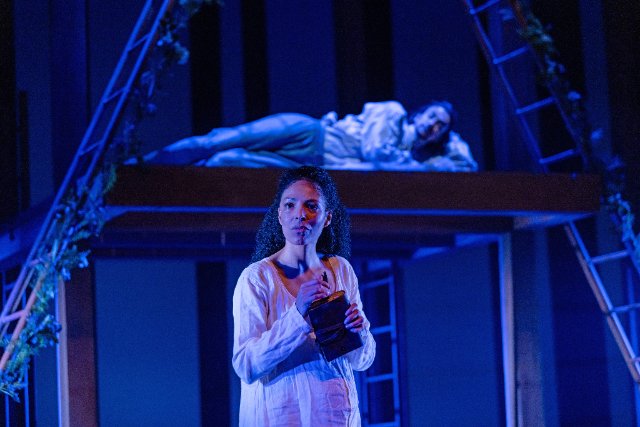
So pre-eminent is William Shakespeare as the world’s greatest ever playwright that the Bay Area alone possesses upwards of a dozen theater companies and festivals with the Bard referenced in the name. And his aura extends to other literary works that draw from his cachet. There are spin-offs from his plays like Rosencrantz and Guildenstern are Dead drawn from Hamlet, and fantasies such as the fictional love affair that became Shakespeare in Love.
Finally come the biographies with broad-brush truths but whimsical details like Maggie O’Farrell’s novel Hamnet which became the basis for the play and movie of the same name. Both adaptations are drawing favorable attention from critics and audiences alike, and The Royal Shakespeare Company is touring with a version that strikes the right notes at American Conservatory Theater.
First things first. Yes, the name Hamlet was largely used interchangeably with Hamnet in Elizabethan times. The latter was the name of Shakespeare’s only son who died at age 11, and the title character of the Shakespeare play was considered an homage to the playwright’s long deceased son. Though that death is a central event in this play, it is not really a defining one as he was far from being a main character and his death was just another rut in the road.
Presumably, like most others, I had heard of Shakespeare’s wife as Anne Hathaway, a designation that alters her given name and fails to recognize her married surname, despite her espousal and three children by William. One of O’Farrell’s motivations for her reinterpretation of Shakespeare’s wife and marriage was that this virtually unknown woman Agnes was scorned by centuries of possibly sexist male historians whose unsupported inferences about her were universally negative and often indefensible.
Determined by many writers to be an unappealing krone at the time of her marriage, she was only 26 years old, which was near average for the time. Though she was pregnant by the 19-year-old Will when they married, so were 40% of brides during that time. She was from a more comfortable financial background than the groom, so perhaps she wasn’t such a bad catch.
Given the small role that the title character in this play has, the title Hamnet is a bit of a misrepresentation, with its intent being to make the connection with perhaps Shakespeare’s greatest play. Nor does much of the play deal with Will’s playwrighting. For the greater part, the story could otherwise be about any fictional playwright. And a more appropriate title would be Agnes, as it is really about rehabilitating her reputation as possibly a woman of character with agency.
With the exception of the final scenes that largely concern Will’s time in London as an increasingly successful playwright and actor, the narrative is mostly a domestic drama, a slice of late 16th century life. We are reminded how brutal and benighted life was as Will’s father and Agnes’s stepmother, her only surviving “parent,” are physically and mentally cruel. Women are treated as chattel, even in Agnes and Will’s wedding vows. Also representative of the low value accorded women, Will’s mother refers to herself as “only being a woman.”
Sorcery was a common social concern, with Will’s mother even suspecting Agnes of being a witch. And while her use of herbs from a medical garden could be cast as naturalistic medicine, it really reflects the medical alchemy of the day which was based on folklore that was also suggestive of witchcraft.
Agnes is performed by Kemi-Bo Jacobs who provides an intense and riveting interpretation of the woman mostly through her first two decades as a wife and mother. Often buoyant and expansive, she also trembles with fear and anger toward her interfering and disagreeable elders. She also quarrels with Will, portrayed aptly as an engaging but self-absorbed intellectual by Rory Alexander. An absentee husband for many years, Will feels the need to be in London for his work while Agnes feels the need to stay in Warwickshire for the health of the children.
Acting is strong but tends to play a bit much to the back rows. Nigel Barrett stands out as both Will’s harsh ear twisting father and as effusive actor Will Kempe. However, he constantly seems to almost burst from his skin with zeal. The same can be said of Nicki Hobday as Agnes’s stepmother. Conversely, Penny Layden as Will’s mother Mary is suitably naturalistic and nuanced.
The action plays on a rudimentary but effective stage comprised mostly of framing beams that are used to depict everything from the small house annex that was the Shakespeare home for many years in Stratford to the Globe Theatre in London. Erica Whyman directs and intersperses a moody mysticism of otherworldliness with more literal reality. Some disembodied electronic verbiage at the opening however is too muddled to understand.
The out-of-sequence opening scene that one later learns is of the couple's twins, including Hamnet, causes a little confusion, and the first act is generally a bit slow. But the play is ultimately redeemed as an entertainment of supposition that speculates on filling in the mystery of William and Agnes Shakespeare.
Hamnet, based on Maggie O’Farrell’s novel as adapted by Lolita Chakrabarti, is produced by Royal Shakespeare Company and Neal Street Productions, presented by American Conservatory Theater, and plays at Toni Rembe Theater, 415 Geary Street, San Francisco, CA through May 24, 2026.