

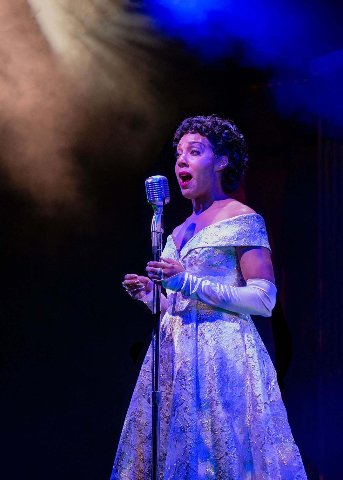
Playing Billie Holiday is the type of meaty role any actor would die for. Billie Holiday is revered as one of, if not the premiere, jazz singers of the 20th century.
Lady Day at Emerson’s Bar and Grill by Lanie Robertson, is receiving an excellent production at Ivoryton Playhouse through Sunday, May 31.
The key is the casting of Holiday: this could be considered a one-woman show, though the pianist does at times act as emcee.
Here, director Todd L. Underwood made his job easier by casting Christina Acosta Robinson as Holiday. Her credits are impressive: Broadway appearances in Bad Cinderella and Summer, The Donna Summer Musical, as well as performances at many of the top regional theaters.
The play is set in Emerson’s, a Philadelphia nightclub where Holiday often appeared. It was a “home” to her. It’s 1959, and Holiday’s health is deteriorating; she would die in July of that year at 44.
Between singing many of her most famous songs, she smokes and rambles (often using profanity) about her life and career. Holiday, a longtime heroin addict and alcoholic, was broke and suffering from cirrhosis, which, with heart failure, was the cause of her death.
Robinson conveys Holiday’s unique combination of in-your-face truth telling and her convenient ability to blame others for her problems. Certainly, she did not have an easy life; blame could be spread among many. Her mother, a teenager when she had Holiday, sent her to work as a maid in a brothel at the age of 8; Holiday’s husband not only introduced her to drugs, but let her take the fall for drug possession; record company executives exploited her talent; and the government tried to pounce for decades.
Much of the show are the songs that Holiday made famous; from “What a Little Moonlight Can Do” to “Carzy He Calls Me,” and “T’Ain’t Nobody’s Biz-ness If I Do.” But a high point of the show is Robinson’s rendition of two of Holiday’s most famous songs. “God Bless the Child” is a signature song for Holiday, which she co-wrote with Arthur Herzog, Jr. Robinson’s rendition captures Holiday’s interpretation and intonation.
But a highlight of the show is Robinson’s performance of “Strange Fruit.” Holiday introduced this song, by Lewis Allen, at a Greenwich Village jazz club in 1939. The title refers to the wave of lynchings and the song is dark and upsetting. It is also why the government became so interested in her.
Robinson is very effective in switching moods, as Holiday becomes increasingly intoxicated and desperate for a fix. When she briefly leaves the stage, her pianist, the fine Manny Houston tries to cover her for by saying she is “unwell.” She returns to the stage with one over-the-elbow glove rolled down, clearly showing track marks.
The stories of segregation and soul-destroying treatment are harrowing. Holiday toured with the Artie Shaw band in the segregated south, but even in NY City, she was often forced to enter and leave venues through the kitchen, or to take freight (not passenger) elevators.
Underwood and his production team have created Emerson’s as an upscale supper club (scenic design and lighting by Marcus Abbot) and terrific costumes by Sean Spina. Kudos to sound designer Rhian Franchebois who gets the balance between Robinson and the three-piece ensemble, just right.
See Lady Day at Emerson’s Bar and Grill for Robinson’s fine performance, the terrific music and the stories. You will leave with new appreciation for Holiday’s music and a reminder of our unfortunate past.
You can purchase tickets at IvorytonPlayhouse.org
This content is courtesy of Shore Publications and Zip06.com