

The Alchemical Ash
Part One of Three
By: Cheng Tong - Jun 02, 2026
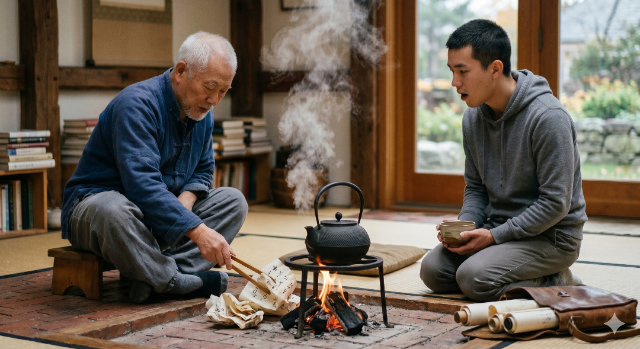
The scholar had spent three years tracing the lineage of a single, rare manuscript on the Heavenly Horse Water Form. When he finally tracked the old teacher to a drafty shack in the northern hills, he carried the text in a silk-lined case like a holy relic. He wanted to debate the translation of the third stanza. He wanted definitions.
The old man didn’t look at the silk case. He just looked at the morning frost on the deck. “The wood is damp, and the hearth is cold,” the teacher said, his voice flat. “If you want tea, we need a dry draft to wake the kindling.”
Before the scholar could offer to search the woods, the old man reached out, pulled the crisp, hand-inked pages from the silk case, and twisted them into tight, dense rolls. He tucked them firmly beneath the iron kettle and struck a flint.
The scholar’s hand flew to his mouth. His breath caught—a lifetime of academic achievement, historical preservation, and intellectual pride screaming silently in his throat as the corners of his precious text turned black and curled into flame. He opened his mouth to protest, to cite the age of the document, to explain its irreplaceable value.
But as the smoke began to rise, carrying the scent of ink and aged paper into the small room, the old man simply watched the water. He wasn’t angry. He wasn’t putting on a show. He was just waiting for the heat to rise.
The scholar looked from the burning words to the old man’s calm hands, and then down at his own empty, trembling palms. The sheer, ridiculous paradox of the moment washed over him. He had traveled many miles to read about the fire of the furnace, and here he was, watching the words themselves provide the heat.
The panic in his chest dissolved, but it didn’t leave him in a state of grace. Instead, a strange, tight emptiness settled into his belly. He looked from the burning words to the old man’s calm hands, and then down at his own empty, trembling palms.
A slow, involuntary movement twitched the corners of the scholar’s mouth. It was a smile, but it was the tight, uncomfortable smile of an infant with a gas pain—a reflexive grimace born of a sudden, sharp shifting of internal pressure. It was the face of a creature experiencing a movement inside its body that it could neither control, categorize, nor explain. It was slightly painful, utterly unbidden, and entirely real.
The old man caught the twitch of the scholar’s lips and nodded once, recognizing the internal alchemical shift.
“Is the draft drawing well?” the scholar whispered, his voice strained around the edges of that awkward grin.
“It is,” the old man replied, pouring the boiling water over the leaves. “The smoke is gone. Now, drink your books.
The tea was bitter, thick with the residue of charred ink. The scholar drank it anyway, his stomach churning with that same awkward, internal pressure.
“Now,” the old man said, rising from his stool and stepping out onto the frost-rimed wood of the deck. “Show me the third stanza. Show me the Heavenly Horse Water Form.”
The scholar felt a familiar surge of confidence. This he knew. He had memorized the foot placement down to the exact degree of the angle. He had analyzed the biomechanics of the weight shift in his sleep. He stepped onto the deck, cleared his mind of thoughts—or so he believed—and began the form.
He moved with precise, clinical accuracy. His spine was straight, his shoulders dropped, his weight centered. In his head, he was ticking off the checklist: Sink the qi to the dantian. Distinguish between substantial and insubstantial. Maintain the continuity. He was waiting for that clean, beautiful “Aha!” feeling—the sudden rush of spiritual wind that would reward his perfect execution.
Instead, the old man walked up behind him and lightly tapped the back of the scholar’s left knee with a bamboo switch.
It wasn’t a hard blow, but the scholar’s leg buckled instantly. He stumbled forward, his arms flailing, his perfect alignment shattering into a clumsy, undignified scramble.
The scholar froze, his face burning with a mixture of academic humiliation and deep confusion. He spun around. “My weight distribution was exactly seventy-thirty,” he protested, his voice rising with the authority of a man used to being right. “The text clearly states—”
“The text is currently warming the bottom of the kettle,” the old man interrupted quietly. “You were doing geometry, not Taiji. You were so busy thinking about seventy-thirty that you forgot you have bones. You are waiting for your head to give your legs permission to feel the earth.”
The scholar opened his mouth to argue, to quote the commentary of Master Huang, to logic his way out of the stumble. But the logic wouldn’t come. His mind was spinning its wheels in the mud, unable to solve the problem of a simple bamboo switch.
And there it was again—that tight, involuntary twitch at the corner of his mouth. The infant’s grimace. The shifting of the gas. He wasn’t having an “Aha!” moment. He was having an “Oh” moment. The realization that his mind was entirely useless out here in the wind.
There was nothing further to say, no purpose to stay. Leaving was the only thing remaining to be done, and so he left. With a hanging head and sunken shoulders, he began his walk down the mountain.
Needing a rest to think, the scholar sat on a damp stone, staring at his boots, trying to build a logical bridge across a chasm that had no floor. He was someone who had earned his living by being the smartest person in the room, and now he was completely bankrupt, frozen by his own inability to analyze his way out of a stumble.
Back at the shack, the old man didn’t watch him go. He reached for the iron kettle, lifted it from the white ashes of the scholar’s burned manuscript, and poured the steaming water into his purple clay mug.
The tea was hot, perfectly brewed, and entirely present. First was first, and the tea was ready. The old man allowed a wry, almost imperceptible smile to touch the corners of his mouth—not out of malice, but out of a deep, seasoned appreciation for the stubbornness of the human mind. Then, he let the smile go, lifted the mug again, and simply watched the mist rise off the valley.