

Light Switch
Strong Professional Production of Dave Osmundsen's Complex, Touching, and Funny Play
By: Aaron Krause - Jun 05, 2026
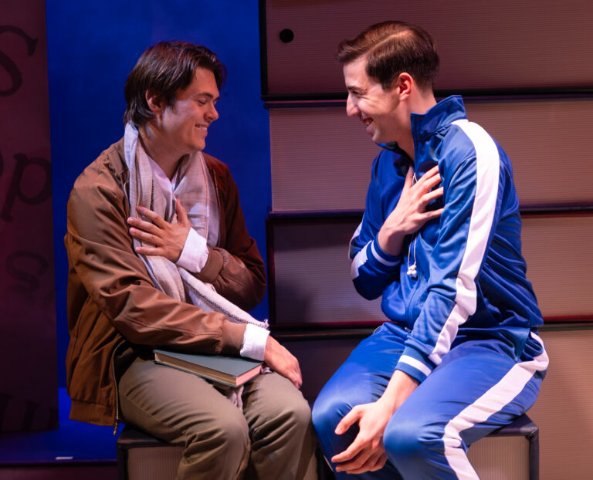

Henry Sullivan owns 19 copies of a particular book and has read it 67 times, but none of that helps him in modern dating. He encounters bumps as he navigates that world in Dave Osmundsen’s layered, touching, and funny play Light Switch, running in an admirable professional production at Island City Stage (ICS) through June 14 in the company’s intimate black box space in Wilton Manors. The running time is more than two hours, including intermission.
Osmundsen’s piece is a nonlinear play chronicling 20 years in the life of Sullivan, a gay autistic Ph.D. student seeking connection. He filters his understanding of human intimacy through 19th-century British literature. Henry struggles to reconcile his idealized notions of romance with the fast-paced realities of the contemporary gay community. Encouraged by his protective roommate, Roggie, to put himself out there, Henry discovers that real-life relationships do not always conform to fictional ideals. The play jumps between past and present, with sudden shifts between memory and immediate experience that mirror the on-and-off quality suggested by its title.
Meanwhile, the object of Henry’s primary obsession, Wuthering Heights, is a classic of English literature. It’s known for its dark, passionate, and tragic love story between Catherine Earnshaw and the orphan Heathcliff, set against the bleak Yorkshire moors. The novel explores themes of obsessive love, revenge, social class, and the supernatural through a complex narrative structure that spans two generations. While it can help to have a basic understanding of Wuthering Heights, it’s not essential to finding value in Light Switch.
Acclaimed director Michael Leeds guides a talented quintet of actors with an attention to realism and detail. As Henry, award-winning South Florida actor Gage Callenius protectively cradles one of Sullivan’s copies of Wuthering Heights against his chest, as though it were his baby. Robert F. Wolin’s set design reinforces Sullivan’s immersion in the novel, suggesting that the characters are living inside its pages. Upon entering the theater, the audience sees lightbulbs hanging from the ceiling and oversized pages of text, some marked with storm cloud imagery that reflects the mood and action of Wuthering Heights. The set also features box-like seating used as furniture, and a central board-like structure with shifting elements that function as bookshelves and other objects.
As Henry, Callenius speaks quickly and seamlessly, reciting passages from Wuthering Heights or analyzing the text with the ease of a student who has memorized the multiplication tables through repetition. It’s almost robotic in its fluency, but Callenius wisely never lets his performance become monotone. Instead, he varies pitch and tone, creating vocal texture that enhances Henry’s humanity. Some of Henry's comments may sound absurd, but Callenius says them with a sincerity that heightens the humor. He doesn't try to be funny. Rather, the performer commits to his character's reality.
Callenius's body is often in motion; he twitches, paces, and rocks back and forth. During moments of stress or confrontation, the movement becomes more pronounced, paired with a louder, more jittery vocal quality. The playwright doesn’t present Henry as perfect, and neither does Callenius. His Henry can be curt, arrogant, impatient, and rude. But if we are patient with him, we come to see an enthusiastic, talented young man who may be different in certain respects, but who desires and needs many of the same things we all do. Watching Light Switch becomes, in that sense, an exercise in empathy.
Roggie, Henry’s roommate, is also far from perfect, but he’s a calming presence in Henry’s life—and vice versa. When Roggie comes home wasted, which happens often, Henry brings him water to help center him. Henry, meanwhile, reads passages from literature to the drunken Roggie, which the latter enjoys.
While listening to Henry and Roggie converse, it becomes clear they have been with each other for some time and are intimately familiar with one another. At times, they sit near each other and speak in gentle tones, intently listening to one another. There’s even sexual tension between them, although they’re not boyfriends.
Roggie’s name is somehow endearing, and in a fine performance, Larry Toyter lends him sweetness, a laid-back charm, and patience. Such qualities come in handy especially when Henry is worked up. Roggie can also grow agitated, and in a multi-faceted performance, Toyter conveys convincing unsteadiness and aimlessness, particularly when Roggie is intoxicated. Contrastingly, Toyter makes Roggie sound wise and in control when he’s speaking on his social media channel dedicated to gay-scene dating advice. Toward the end, Toyter makes us sense his character’s emotional pain as Roggie and Henry grow apart. We find ourselves rooting for them to reconnect and reconcile with each other. It is never clear whether that will happen—until it does at the end, bringing relief as the play concludes on a conciliatory note.
Like Roggie, Joseph, one of Henry’s dates, appears to be a fun-loving, laid-back young man. To his credit, local actor Eric Gospodinoff instills such admirable qualities in the character. He initially acts genuinely interested and patient with Henry, but the two eventually separate. When Joseph reappears later in the play, his friendliness is gone, replaced with guarded suspicion and chilliness. Expressions such as an eyeroll and the slow folding of his arms convey clear annoyance, as Joseph believes Henry was stalking him. Clearly, he didn’t appreciate Henry’s repeated and lengthy voicemail messages, although Gospodinoff’s Joseph proves to be patient when he willingly agrees to meet Henry in person once again. But eventually, Joseph frustrates Henry, the young men part ways for good, and we accept the separation, realizing that perhaps this relationship was never meant to be.
Veteran South Florida performer Irene Adjan believably injects Henry’s mother, Marian, with a sincere, endearing maternal affection. Adjan balances Marian’s calming presence and patience with a well-intentioned concern that her son’s autism and homosexuality may make life more challenging for him. But Marian is hardly an alarmist, and Adjan never comes close to portraying her as one. With her honeyed voice and gentle manner, Adjan’s Marian seems to possess endless tolerance. Yet everyone has a limit, and Marian reaches hers when an argument with Henry builds to a brief boiling point. Suddenly, Marian commands her son to drink his “f--ing tea,” and the outburst lands with particular force after we have grown accustomed to her warmth and restraint -- qualities that Adjan deftly embodies throughout the production.
Light Switch is a complex, layered, but ultimately moving and humorous play inviting us to ponder several things – What is literature’s true purpose? What constitutes intimacy? How do autistic and non-autistic people bridge communication gaps? What happens when we measure real life against fictional stories?
The playwright doesn’t present easy answers to any of these questions. Instead, he presents them as food for thought and discussion. Also, Light Switch is that rare play exploring the intersection of being gay and autistic. It also resists making blanket assumptions about people and viewing them through reductive stereotypes. For instance, not all gay people are addicted to sex – “I don’t have a sex life. I’m not interested in sex. Usually. I’m not usually interested in sex,” Henry says to Joseph. Further, Light Switch builds empathy by presenting us with people different from ourselves and challenging common misconceptions. For instance, contrary to a widespread assumption, autistic people can form deep, meaningful relationships, as we see with Henry and Roggie, who’ve been roommates and close friends for almost a decade. Light Switch also challenges the idea that shared experience fosters immediate connection. Joseph has an autistic brother and is, at least in some ways, familiar with autism, but that familiarity does not translate into an automatic or sustained bond with Henry.
Leeds’ direction is smart, and he has helped the actors make wise choices. For instance, in addition to cradling a copy of Wuthering Heights against his chest, Henry paces anxiously while leaving his 15th voicemail message to Joseph. Under Leeds’ guidance, dialogue, physicality, and movement feel naturalistic and purposeful, though the production does not strongly differentiate between the play’s various time periods. For example, there is little distinction between Henry as a teenager and as a young adult. However, Callenius lends his younger Henry a childlike energy and sense of play. Similarly, Luis Roberto Herrera, who plays multiple minor roles, brings a playful spirit to Henry’s childhood friend, Aaron.
Ardean Landhuis’s lighting is mainly realistic, softening and brightening adeptly to reflect a scene’s mood or time of day. Landhuis lights daytime and more upbeat scenes brightly, while darker shifts in tone receive dimmer, more subdued lighting. In one particularly upsetting scene, judgmental voices from Henry’s past converge in a cacophony of unsettling sound as he becomes overwhelmed and isolated. The shifting light reflected against the wall suggests Henry’s dizzying sense of disorientation and overwhelm.
Ultimately, Light Switch is a moving and funny play that encourages empathy for people who may be different from us. At the same time, the playwright makes us realize that gaining true empathy is a complex process that doesn’t end after a two-hour play, however insightful and moving it may be. We leave the theater with a renewed desire to relate positively to those we encounter, along with the understanding that real-life relationships are more complicated than fictional ones suggest.
Light Switch runs through June 14 in Island City Stage's intimate black box space, 2304 N. Dixie Highway in Wilton Manors. Performances are at 7 p.m. Thursday, 5 p.m. Sunday, and 8 p.m. Friday and Saturday. Tickets are $45-$50. Visit www.islandcitystage.org, call (954) 928-9800 or email boxoffice@islandcitystage.org.