

Handel at the Deutsche Oper in Berlin
Elena Tsallagova Rocks as Cleopatra
By: Susan Hall - Jul 09, 2026
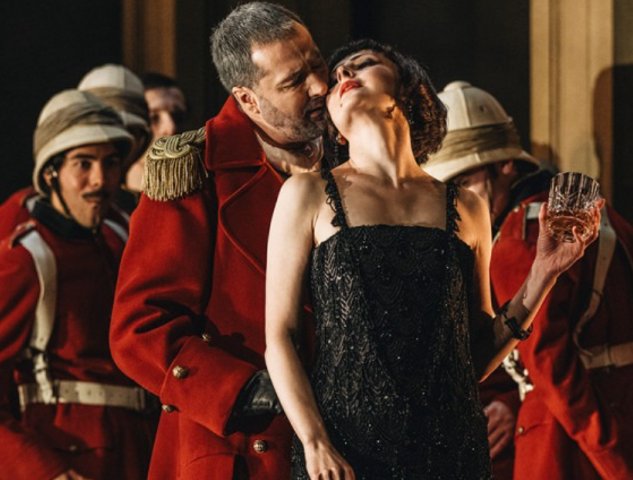
The Deutsche Oper’s mounting of the David McVicar production of Giulio Cesare in Egitto has stood the test of time. First presented over twenty years ago, it still seems grand and full of life. For Rusalka in Chicago and Il Trovatore at the Metropolitan Opera, McVicar used huge insurmountable walls to suggest impenetrability and grandeur. Here, four columns rise up in two rows, angled back for a 3D effect. When the backstage is revealed, it shows the shimmering curls of the Mediterranean’s waves—the blue of the ocean with ships sailing in and out, bringing Caesar and providing his departure.
The wide, fan-shaped opera house is designed to give a full view to every seat, and the audience responds enthusiastically.
The costumes of the guards and military are 19th-century British—representing occupiers, which Caesar chooses not to be. Instead, he wants to leave behind an emboldened Egyptian ruler who is on his side and under his control. Cleopatra uses sex to attract him, and he uses it to secure her. Yet, the romantic moments are few and far between, as revenge, rape, and child-snatching drive the story forward.
This being Handel, the music is often beautiful, and the entire cast is strong. Particular pleasure is afforded by Elena Tsallagova as Cleopatra and Stephanie Wake-Edwards as Cornelia. Cornelia appears first, preceding the severed head of her husband, Pompey. Caesar later remarks that when Ptolemy presented the head to him, the Egyptians had gone too far.
Caesar was a busy man. Ms. Tsallagova makes Cleopatra's distractibility a joy. Trained originally as a dancer and then as a theatrical performer, singing was her third developed talent. This triumvirate makes for a dashing package. She remains completely relaxed, even as she gets rolled up in a cloth to be sneaked into Caesar’s tent.
Stephanie Wake-Edwards has a beautiful voice and a commanding presence as she weeps for her decapitated husband, fears for her kidnapped son, and tries to resist rape.
There is a lot going on stage. The cast continually moves with the story and the rhythms of the music, performed by a baroque orchestra led by specialist Alessandro Quarta.
Handel’s music is perfectly suited to the countertenor voice, and there are roles for three of them in this opera. Christophe Dumaux in the title role was superb.
Giulio Cesare is one of Handel’s masterworks. Having witnessed it at Hudson Hall and Carnegie Hall recently, the comparisons are striking: Hudson Hall’s production was stripped down, grittier, and more fun, while at Carnegie Hall, the music shone in a semi-staged concert. In Berlin, the opera is magisterial, affording great pleasures as both drama and music.