

Estate Sale at Barrington Stage
Galvanic World Premiere of Keelay Gipson Play
By: Charles Giuliano - Jul 10, 2026

Estate Sale
By Keelay Gipson
Directed by Steph Paul
Scenic design, You-Shin Chen; Costumes, Izumi Inaba; Lighting, Reza Behjat; Sound, Bailey Trierweller
Cast: Gillian Glasco (Beauty), Jayson Lee (Executor), Blake Morris (Truth), Christopher B. Portley (Youth)
One act, 70 Minutes
St Germain Stage
Barrington Stage Company
Pittsfield, Mass.
July 30-July 25, 2026
World Premiere
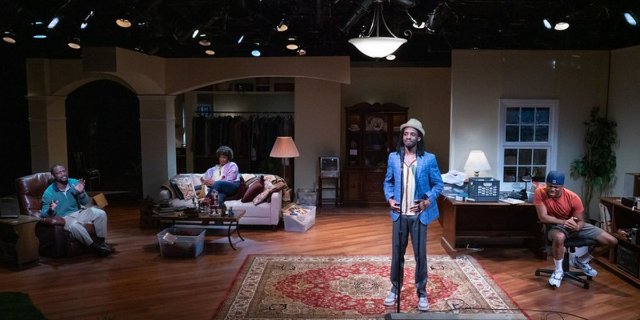
Estate Sale, by Keelay Gipson, a 70-minute, one act play having its world premiere at Barrington Stage Company, begins obliquely. Half of the audience enters from the stage door navigating a clutter of estate sale items. They thread through the urban dwelling designed by You-Shin Chen.
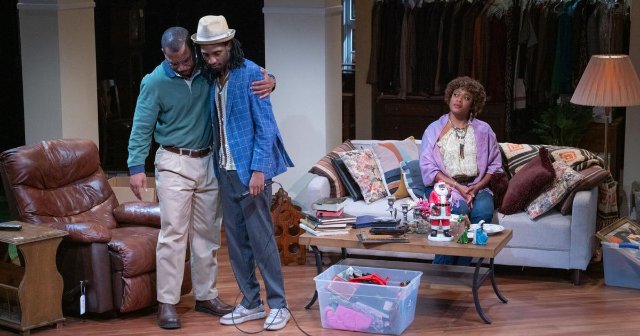
Against a blaring sound track the Executor (Jayson Lee) is wandering about making price tags for the diverse items to be disposed of. An only child of deceased parents he has returned home with the mandate to clear the house and sell it. The task is both pragmatic as well as nostalgic. Initially, he just wants to get rid of this stuff and, until a childhood friend Youth (Christopher B. Portley), arrived was oblivious to their sentimental value. Later the ghosts of his parents appear to him and have a say in what is to be saved or discarded.
In the arc of this play, skillfully written by Gipson and sensitively directed by Steph Paul, a young man, seemingly adrift, finds himself and comes to resolution with the family he left years ago. This is particularly true of the fraught relationship with his father Truth who is played with forceful presence by Blake Morris. His loving and nurturing mother is well performed by the expressive Gillian Glasco.
The drama has an ill-defined beginning as Executor wanders about. The official beginning occurs when he stands before a mike. Using his cell phone, he clicks off the blaring sound track. He then creates a bond with the audience, in the manner of a standup comic, by telling several bad jokes about orphans. In a sense he is one and the humor is self deprecating. At times, as the play evolved, he slipped in and out of the roles of narrator and performer. Through this process he developed palpable synergy with the audience.
Lee is an astonishing actor with a remarkable skill set. With amazingly expressive eyes he can just stare at the audience and command its rapt attention. The costume emphasized a jaunty, casual, comic, African American persona. His short brimmed hat over long, stringy hair, evoked the style made famous by Norman Lear. He wore a plain jacket over what was revealed to be a textured, multi colored, woven shirt.
On every level, Lee is the glue that holds this exquisitely calibrated drama together. The other three actors skillfully support his performance with cameo anecdotes. We learn something of the father and his obsession with cars. One of which was brand new with a very special color. It was quickly stolen and he attempted to replace it but the unique color had been discontinued and could not be matched.
As migrants from the South their hopes and dreams were derailed. Beauty having relocated from Texas with aspirations as an actor and model hit a dead end with rules and customs impossible to overcome. She settled into becoming a wife and mother.
Sorting through all the stuff evokes an unfolding back story. In a charmingly reflective manner the Executor sorts the loose ends of his disheveled life. Humor is a balm for decades of pain.
As seemingly the only buyer a bike is sold to Youth for twenty bucks. There is a similar deal for a set of dishes until the ghost of Beauty objects that they should be saved for a special occasion. Which is absurd, as Executor has no family or even a relationship. The dishes are withdrawn from the sale as is the case with more and more items. In frustration Executor opts to just give it all away.
It appears that Executor has few friends and is mostly a loner. There is an exception focused on a trip to England with his lover. In the end yet again he is alone but with hopeful insight.
The finale comes when he engages with the audience and forces a response. He then announces that the play is over and we may leave or linger as we see fit. I didn’t really want to leave.