

Akram Khan Company at Jacob's Pillow
Thikra: A Night of Remembering
By: Charles Giuliano - Jul 13, 2026
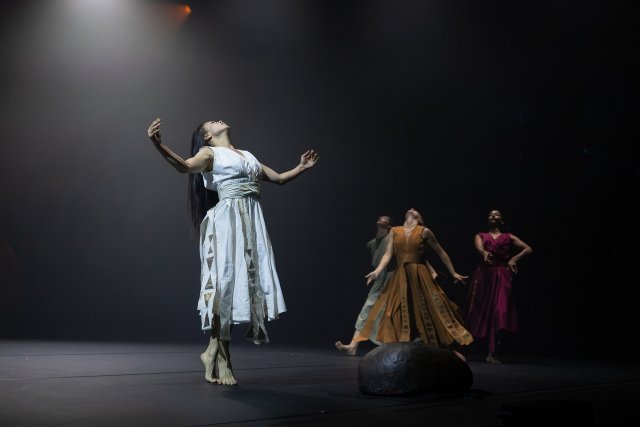
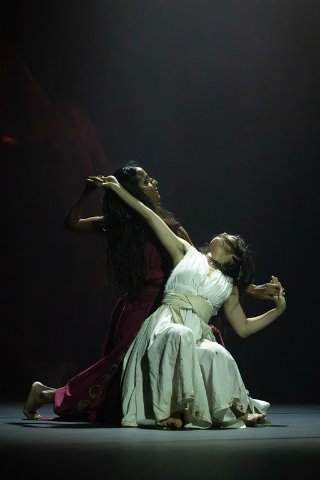
Thikra: A Night of Remembering
Ted Shawn Theatre
Jacob's Pillow
July 8-12. 2026
Akram Khan, director and choreographer
Manal Al Dowayan, visual director, costume and scenography
Manal Al Diowayan and Akram Khan, narrative concept
Mavin Khoo, associate artistic director and coach
Aditya Prakash, music composer & soundscape designer
Gareth Fry, sound designer
Zeynep Kepekli, lighting designer
Imogen Clarke, associate lighting designer
Blue Pieta, dramaturge
Dancers: Laura Bufano, Ching-Ying Chien, Amrita Dashi, Kavya Ganesh, Shreya Kannan, Mythili Prakash, Rahini Shetty, Elpida Skourou, Mei Fei Soo, Lani Yamanaka
Thikra: A Night of Remembering is the final work created by Akram Khan for his 25-year-old British based company. It will be on tour through March, 2027 when the company will disband.
Born in Bangladesh he grew up in Great Britain. At the age of three he began learning traditional dance from his mother and grandmother. While still a child he gave his first performances. He continued study of traditional Indian dance as well as pursuing training in classical Western dance. He has created his own work rooted in heritage as well as with ballet institutions including English National Ballet and the Royal Danish Ballet. He has received numerous awards and is an associate artist of Sadler Wells.
Khan represents the notion that for dance to continue to evolve and remain a vital artform it must embrace and transform traditions. He is unique in functioning and creating both in traditional folk dance as well as classical ballet. His knowledge and work in one tradition informs the other. Rather than refer to this as fusion with wit he prefers the notion of confusion; which may, indeed, inform how we approached Thikra.
It is a collaboration with the renowned artist Manal Al Diowayan who represented Saudi Arabia in the 2024 Venice Biennale. The hour long piece for a company of female dancers was initially set in a desert. It was later adapted to the stage. While Thikra evokes mythology the narrative is the result of the collaboration of its creators.
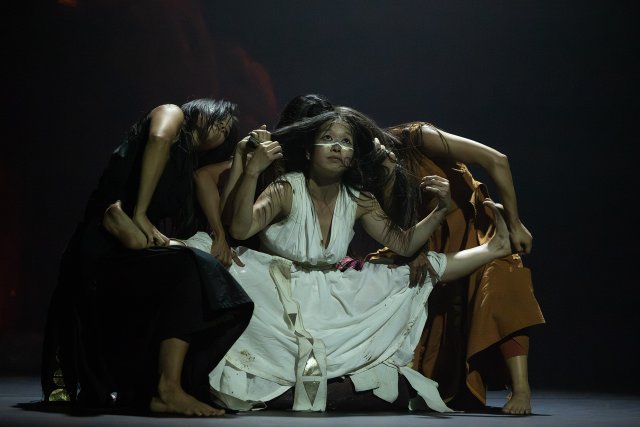
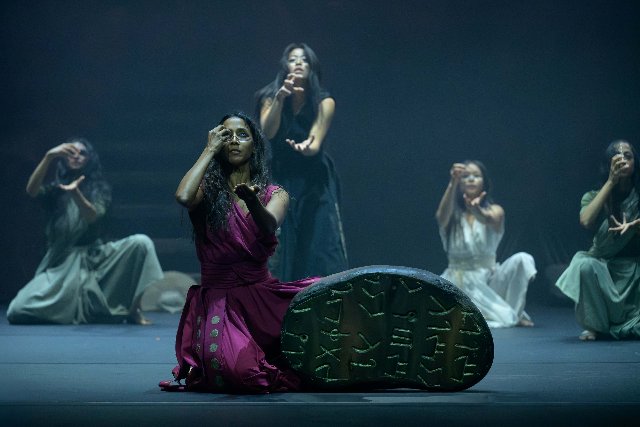
The dance presents the events of a ritual enacted during the night. Consequently, the lighting is dark with the dancers often obscured by shadow. The first image is of a hill with a cave looking down on the stage. From it emerges an ominous figure who descends and approaches a large, hemispherical, dark, smoothly polished stone. There is an inscription on its flat side. Incantation to this sacred object reincarnates the spirit of an Ancestor. She is embodied by Ching-Ying Chien who is dressed in white.
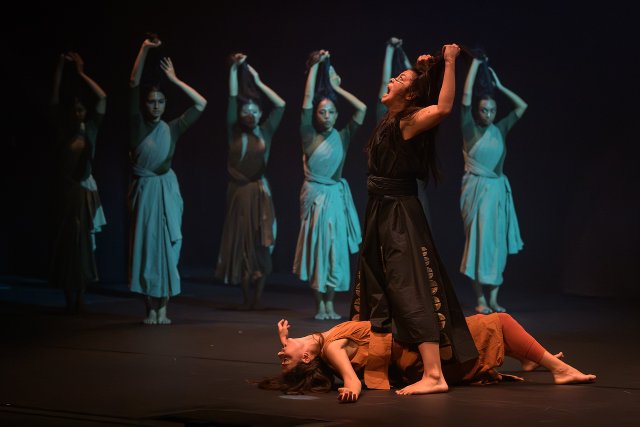
The ten dancers and their roles are color coded. The elder, an ersatz high priestess and sorcerer, is dressed in black. There are twins, one in red and the other in yellow/ gold. Six women in beige/green comprise a chorus. At times their function is to sit and observe which becomes a surrogate for the audience.
While performed by a company of women the piece is surprisingly strident and even violent. The ancestor spirit is abused, deceased and dragged about as a corpse, then revived and subject to more ritualized mistreatment.
The music which conflates traditional and contemporary sources is pulsing, percussive and excessively loud. So much so that earplugs were offered to the audience prior to the performance. While harsh to listen to there is no denying that it energized the dance which is contemporized traditional folk style.
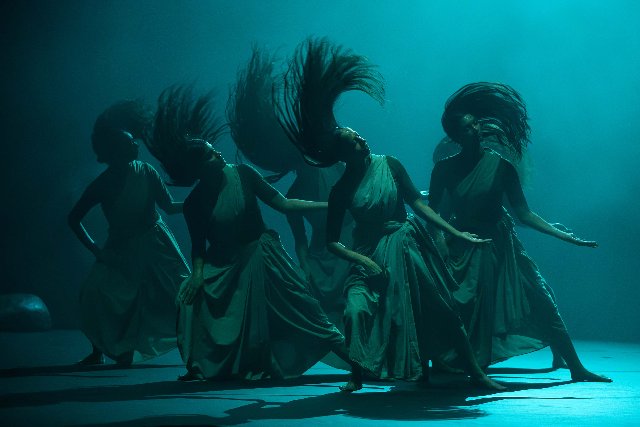
The group frenzy with stomping and tossed hair reminded me of the ritual of Rites of Spring with its theme of sacrifice and renewal. In mythology there is a familiar cycle of death and rebirth.
In Rites the woman to be sacrificed is surrounded as she reacts with a desperate set of ever more evocative movements. There is a similar element in Thikra. The masked chorus surrounds her and forces her also to wear a mask. This she sharply rejects evoking a violent response.
The dance evoked a different tradition with an emphasis of total body movement, dropping, and stomping with expressive use of arms and fingers. Hair is a surprising element of the dance vocabulary. It is tossed with abandon as well as used to pull the Ancestor about and even join couples.
Everything about this piece was daunting and unfamiliar. The need to know and understand was frustrating. There were many questions about what was being seen.
The best approach is to abandon a rational deconstruction and to accept the work on its own terms. Rather than attempt to explain the ritual it is better to report on its palpable, bone crunching, visceral intensity.
As artistic director, Pamela Tatge, commented in opening remarks, it is becoming ever more difficult to present international artists. That makes the experience of an acknowledged, world class artist, all the more rare, cogent and insightful.