

The Prince Part 1 - The Life and Times of Niccolo Machiavelli
Machiavelli Learns His Craft from Others
By: Victor Cordell - Jul 28, 2026
Berkeley-based theater company Central Works will be closing its doors after three decades of producing original works and delighting audiences in its intimate space at Berkeley City Club. Playwriter-Director Gary Graves, who has co-helmed the company for most of that time along with Co-Founder Jan Zvaifler, offers as his swan song six hours worth of history amplified by imputed relationships. The Prince Part 1 & Part 2, reflect on the life and times of Niccolo Machiavelli, a figure who has been the focus in several of Graves’ plays. Though freestanding and interesting on its own, Part 1 acts as a prelude and relates to Machiavelli’s early dealing with ham-fisted leaders. Indeed, it is his counterparts who really drive the action, while Part 2 reveals his evolution as a political strategist.
The Prince Part 2 involves five actors in seven roles, whereas, Part 1 acts fundamentally as a two-hander. While the cast is comprised of three actors, the two-actor first act imagines the relationship between Machiavelli and the radical ascetic priest Jerome Savonarola, who, now under arrest, was the main architect of the Republic of Florence and its de facto leader from 1494-1498. Also, with only two characters played by one actor each, the last two acts could be a separate play, as they ascribe the association between Machiavelli and Cesare Borgia following Savonarola’s downfall.
With the exception of a physical threat by Cesare on Machiavelli, the work contains virtually no dramatic action like sword fights or scaling walls, but it is driven by intense exchanges between the principal character and the two figures who left their marks on the history of northern Italy. Although three-hours long on a bare stage save for occasional props, the play grabs the attention through outstanding acting; interest in the historical moment; and literate writing with taut dialog and diversion with occasional declamation. The complex intrigue among seen and unseen historical figures tantalizes.
That said, Savonarola’s theocratic demands, control, and terror are not depicted as clearly as they could be. For instance, despite his call for destruction of all things ungodly and which inspire pride be destroyed, the consequences of the bonfire of the vanities are not developed. The vertical morality exercised by Savonarola in the name of republicanism differs little from Christian nationalism and its slavish acceptance of the current administration in this country.
At the time of the narrative around the turn of the 16th century, the principal character was about 30 years of age and was a senior bureaucrat, who in the play acts merely as a messenger for political leaders of Florence. Thus, the notion that he should be a stronger adversary to Savonarola and Cesare Borgia in this play would be mistaken. As a political philosopher, Machiavelli would later author The Prince, whose prescription that good outcomes warrant bad deeds became known as Machiavellian. However, that work which is an arid handbook for rulers was not published until 1532, five years after his death and decades after the events of this play. It can also be noted that most who are driven to write are introverts and not people of action.
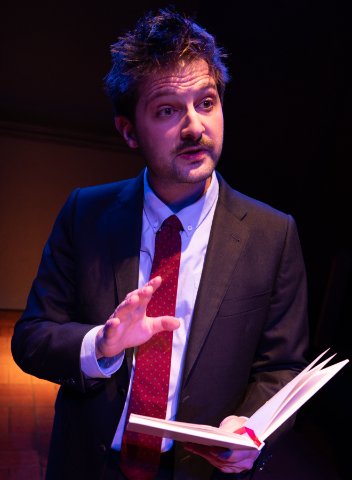
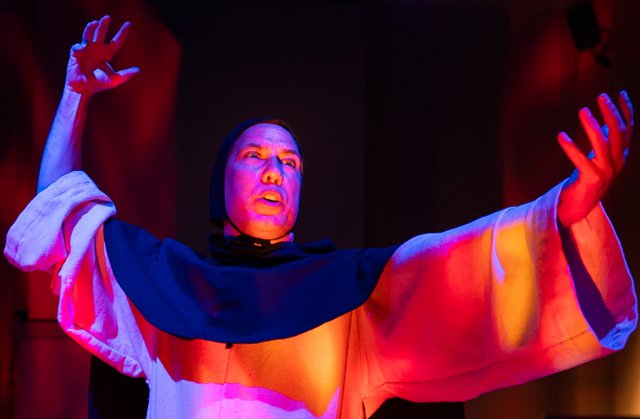
Kevin Singer is outstanding as Niccolo Machiavelli, capturing the nuance of a character who is underpowered but involved in weighty matters as an intermediary representing the governing council of Florence. Although forceful at times, he more often seems curious, uncertain, and even intimidated by Savonarola, played with sanctimony and fiery religious conviction by Mark Farrell.
As the priest, Farrell acts with confident authority as one who always has a spiritual counterpoint to anything that contests his actions. But he is under threat as he has been excommunicated by Pope Alexander VI, whose authority he disputes, in part because the pope acknowledges fathering children by mistresses. So Savonarola remains a cleric and effectively the leader of Florence. But those who Machiavelli represents wish to see Savonarola gone, and the emissary offers the escape.
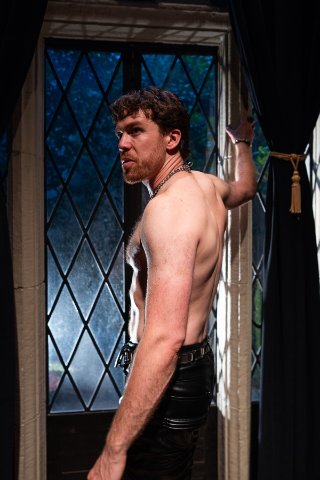
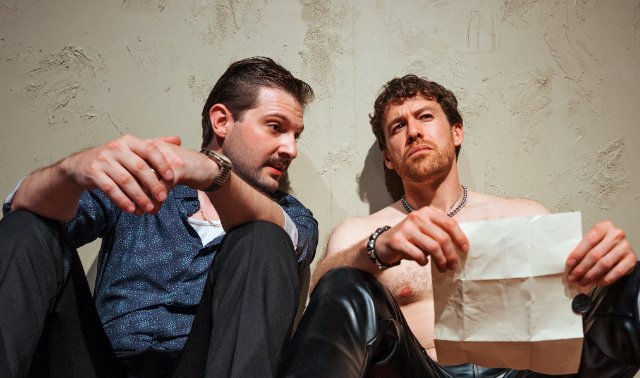
The connection between Machiavelli’s two counterparties in the play is that Cesare Borgia is the son of the pope who has expelled the priest. A feverishly intense Brennan Pickman-Thoon as Cesare dominates Machiavelli by dint of personality, humiliating the weaker man by forcing him to dress as a prostitute for a ball. Cesare also commands military power, but the bureaucrat enters negotiations with a key card noting that Cesare's power relies on his relationship with the Vatican, which could alter should his father be deposed or die.
The Central Works production is simple as most talkathons are, though a detailed soundtrack by Gregory Scharpen enhances the play. The one controversial element concerns the strategic decision on Tammy Berlin’s costuming. Savonarola’s hooded robe appears to be of the period, but Machiavelli is almost always in a contemporary business suit. Cesare also wears modern dress, but his costumes include black latex pants and a flowery shirt that look straight out of a gay leather bar; shirtless (ditto); and a Soviet army tunic. Why all this? I don’t know.
In any event, The Prince Part 1 provides an enticing glimpse into Florentine history from the perspective of a young Machiavelli. It serves as a stimulating prelude to the more expansive Part 2, in which the central figure is more accomplished and interacts with other notables of the period – Lorenzo de Medici, da Vinci, and Michelangelo.
The Prince Part 1 - the life and times of Niccolo Machiavelli, written and directed by Gary Graves is produced by Central Works and plays on its stage at Berkeley City Club, 2315 Durant, Berkeley, CA through September 6, 2026.