

Burst, by Rachel Bublitz
New City Players in South Florida
By: Aaron Krause - Jul 29, 2026


What happens when appearances matter more than reality? Rachel Bublitz's riveting and relevant play, Burst, thoughtfully explores that question.
New City Players’ (NCP) engaging and convincing production of Bublitz’s play has concluded the company’s season.
Burst focuses on a present-day company CEO and takes place in her office during a disastrous night. When Sarah Boyd, founder of Tactix—a California technology startup whose goal is to eliminate plastic from the earth—finds herself facing an aggressive journalist and a wavering chief technology officer, the gap between Tactix’s promises and reality begins to show. The play tackles themes such as corporate responsibility, scientific integrity, the price of ambition, the seduction of big ideas, and the danger of putting appearance over truth.
Bublitz has described her play as a “bullet train…a powerhouse barreling ahead at tremendous speed not noticing if it’s going to crash.” Wisely, director Elizabeth Price keeps NCP’s production moving quickly while slowing down enough to allow audiences to keep up with the story. This production doesn’t immediately vilify Boyd. During her opening monologue, Boyd’s friendliness and enthusiasm are immediately apparent as she describes plastic’s harmful effects on the world. This allows us to empathize with her, even if we disagree with her tactics.
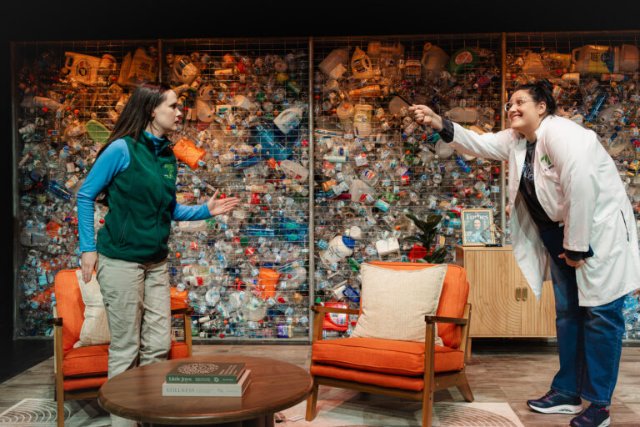
Boyd is image conscious, and her office, as scenic designer Aubrey Rodriguez has rendered it, reflects that. The space is neat and orderly, with seemingly nothing out of place. A framed cover of Forbes magazine featuring Boyd’s photo rests prominently where visitors can easily see it. Soft chairs with pillows and a couple of well-placed plants help establish an inviting, comfortable atmosphere. But what grabs our attention most is a large display case-like structure housing countless items made from plastic. Bottles, laundry detergent containers, and other objects serve as visual reminders of how much plastic many of us use regularly.
Nicole Hulett deftly portrays Boyd as a shapeshifting figure who, in a short amount of time, seamlessly moves among personas as different as Dr. Jekyll, Mr. Hyde, an angel, and Lucifer. With a sharp voice, long dark hair, blazing dark eyes, and red lipstick accentuating her look, Hulett’s fast-talking Boyd appears effortlessly commanding and in complete control. The next second, Hulett’s Boyd morphs into girlish laughter, and not long after, stuns us by suddenly screaming. The hesitating, broken-voiced woman at the end of the play seems like a different person from the composed, friendly character at the beginning.
Hulett’s frequent shifts suggest a woman who performs almost instinctively, carefully controlling how others perceive her moment by moment. Whether she’s charming a reporter, yelling at a colleague, or reminiscing about her past, Hulett’s Boyd seems to prize appearance over truth. At one point, she even declares, “Everything is performative.”
Significantly, Hulett’s Boyd isn’t merely a manipulator. She’s more complicated than that. At the beginning, we sense a charismatic, friendly businesswoman who sincerely welcomes us into her world and invites us to join her mission to improve that world. Her radiant smile and charming voice ingratiate us to her and make us want to believe in her vision. This carefully constructed image, however, begins to crack little by little as reporter Alexis Lyons pokes holes in the meticulously developed universe Boyd has created. Toward the end, that universe seems on the verge of literally collapsing when a rumbling sound suggests an earthquake is imminent. Ultimately, Hulett’s performance reveals that Boyd is not nearly as in control as she initially appears. Why else would she reveal the very undesirable traits that threaten her carefully cultivated image? The tragedy is that she doesn’t just mislead—she’s partly convinced herself that the appearance of change is more important than actual change.
Within Tactix, Chief Technology Officer (CTO) Jennifer Weaver possesses scientific expertise, yet has considerably less influence than Boyd, the person controlling the narrative. Weaver represents the scientific side of Tactix, while Boyd represents the marketing side.
Despite co-founding the company, the CTO can’t even enter parts of Tactix’s campus. This frustrates her, and as Mary Gundlach portrays Weaver, she’s wound as tight as a spring. The performer convincingly conveys tension with her whole body. For instance, she puts her hands up to her face and her voice gets loud when something irritates her. At another point, she bangs repeatedly and hard on a desk, puts her head on it, and starts crying.
Gundlach creates a sympathetic portrait of a smart, yet exasperated woman who co-founded a company but regularly feels powerless despite her high-level position and vast knowledge. At one point, Weaver recites a long scientific name, yet Gundlach says it as easily as though it were part of her everyday speech.
Bublitz has imbued journalist Alexis Lyons with power and aggression without making her openly cruel. To her credit, Dayana Morales honors the character’s depth. As she enters, she smiles, laughs, conveys enthusiasm, and sits with her leg crossed, suggesting she’s a friend who’s seated for a casual encounter. She speaks with awe in her voice, like a starry-eyed fangirl finally getting to meet her hero. Her reddish outfit (costume designer Casey Sacco) accentuates her initial bubbliness. When Lyons is about to leave but has an additional question, she says this charmingly rather than with obvious aggression.
Morales’s portrayal of Lyons often masks doggedness with an easygoing demeanor before she becomes a bulldog. When that happens, her voice gets louder, she leans forward, and lets Boyd know that she means business. As Morales portrays her, Lyons isn’t “some reporter who’s never covered tech, who’s always on fashion or celebrity gossip or whatever,” as Boyd predicted as soon as she heard that a female reporter planned to interview her. Rather, Morales’s Lyons is a knowledgeable journalist who knows how to accomplish her objective without wearing out her welcome early on.
Price and cast members deftly balance intensity with levity without losing focus. At one point, Boyd places the company’s promotional sock on her hand and moves it as though it were a puppet. Price also includes hints that Boyd’s carefully curated world is becoming unstable. Banging sounds accompany lighting transitions. An even more clever use of sound happens late in the play. By this point, Lyons has become more outwardly aggressive in her questioning, and Boyd seems to sense that her world is starting to crack. Why else would she grab Lyons’ notebook and play keep away as though she were a child? It may look amusing, but suddenly the lighting (designer Anabel Herrera), which has turned red, flashes repeatedly. Also, we hear a rumbling sound as though an earthquake were imminent. I wondered whether the plastic display case would come crashing down — a sign of Boyd’s world collapsing right in front of her.
Herrera’s lighting design establishes a contrast between present-day reality, represented by bright, realistic lighting, and Boyd’s memories, represented by dimmer, purplish lighting. The softer glow during Boyd’s recollections suggests a dreamlike world, implying that these memories are shaped not only by Boyd’s actual past but also by how she chooses to remember them.
Overall, the most memorable effects from NCP’s production are the blinking red lights and the rumbling sound growing louder. These suggest Sarah’s carefully constructed world may burst — along with the hopes of people who anticipated real change after hearing Sarah’s promises.
Boyd’s goal is certainly worthwhile. Her downfall comes because she creates an image of progress and that appearance, in her mind, outweighs actual results. Bublitz’s play is a warning against a culture that rewards compelling appearances over actual results.