

Faure's Penelope at Munich Opera
Karkacheva and Jovanovich Star
By: Susan Hall - Aug 01, 2025
As part of its 150th anniversary celebration, the Munich Opera Festival presented Pénélope by Gabriel Fauré—a bold and welcome choice. To champion this rarely performed work, the company brought in Andrea Breth, one of Germany’s most accomplished theater directors. The cast clearly responded to her direction with commitment and nuance.
But the true star of this production is Fauré himself.
Fauré is often unfairly dismissed as a salon composer—refined, delicate, perhaps even decorative. But beneath his gentle demeanor and reputation for kindness lies a composer of meticulous technique and deep emotional power. Both qualities are unmistakably present in Pénélope. Charles Munch, who conducted the Boston Symphony Orchestra for many years, was an enthsuiastic exponent of French music, andperformed both Faure's Requiem and Penelope with the orchestra.
Fauré was no stranger to the grand stage. He traveled to Bayreuth to hear Parsifal and attended a full Ring cycle in Munich. The Wagnerian influence is evident in Pénélope: there are no stand-alone arias, and the music is driven by leitmotifs, particularly for Penelope and Ulysses. Penelope opens wth brooding, dark tones. Ulysses' theme is often climatic presence and particularly intense. Unlike Debussy’s Pelléas et Mélisande, which remains the most frequently performed French opera of the 20th century, Fauré’s Pénélope offers singing throughout the through composed work.
The cellist Pablo Casals, who knew and admired Fauré, once said:
“There is always about his music, as about his person, an air of good fellowship and delicate amiability that show the artist of breeding. He pleases without trifling… His musical temperament expands with singular felicity in the orchestra, where he revels in the subtlest management of exquisite sound values… His music reflects his sense of color and his gift for iridescent effects.”
Ravel and Debussy, remarkable as they are, were offshoots from a central tradition. Fauré, by contrast, was that tradition. His music is profound, surprising in its harmonic turns, and spontaneous—qualities that make Pénélope feel remarkably fresh and emotionally present.
That said, 20th-century French opera remains underrepresented in modern repertoires—Pelléas being a rare exception. Even its admirers admit that little “happens” in Debussy’s work.
But Pénélope is full of action—emotional and narrative. It tells the story of a devoted wife waiting for her long-lost husband. Ulysses, for his part, has spent a year with Circe—not exactly in a hurry to leave—but he longs for home, and home means Penelope.
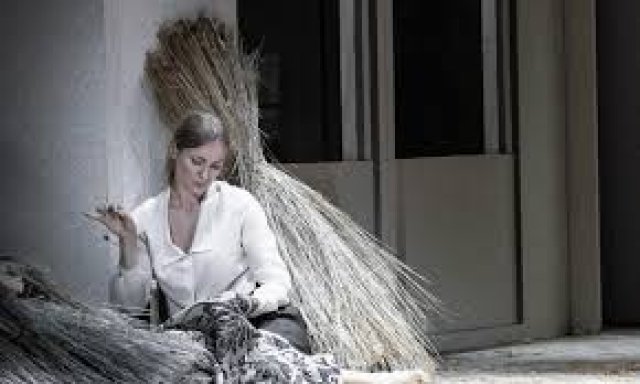
Penelope, ever faithful, sits sewing, fending off aggressive suitors and longing for her husband’s return. This is no passive woman—her character is rich, layered, and emotionally resonant. Fauré wrote the opera for Lucienne Bréval, who created the role. He knew women well (and liked them) It shows in Penelope’s complexity. This difficult role requires both vocal stamina and emotional depth: Penelope is on stage for much of the opera.
Victoria Karkacheva, on the cusp of major international career, sang Penelope with both beauty and intelligence. She captured the character’s inner life—longing, resolve, and strategic cleverness. At moments, one missed Anna Caterina Antonacci’s dramatic grip of the role (as seen in Strasbourg a decade ago), but Karkacheva brought something else: a deep musicality and ability to find meaning in Fauré’s subtle phrasing and unexpected rhythmic entrances.
As Ulysses, Brandon Jovanovich was a strong match. His voice has the power to soar over the orchestra but also the control to whisper with tenderness. His chemistry with Karkacheva brought depth to their reunion.
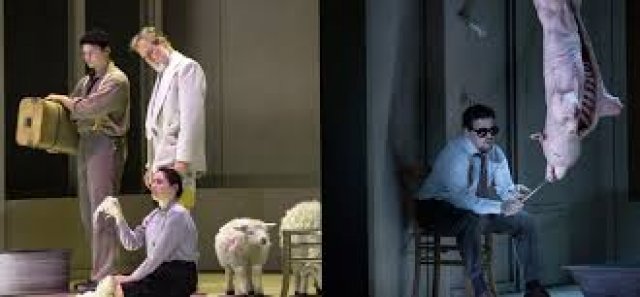
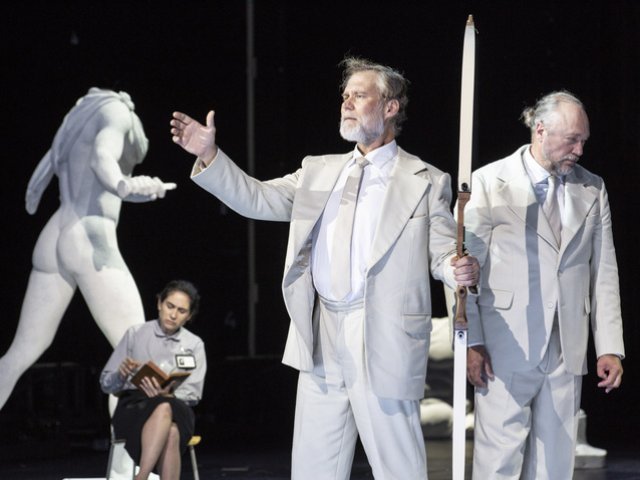
Andrea Breth clearly respected both the music and the demands it places on performers. The staging, however, was ambitious—perhaps overly so. The production spans multiple time periods, uses character doubles, and even features carcasses of meat hanging as a preview of the final bloody carnage. There’s a museum-like set with antique figures and a house with triple rooms. I understood the intent, but at times the visuals felt like a puzzle that demanded too much decoding. Some audience members may have appreciated the complexity more than I did.
Fauré’s music, after all, gives us everything we need. He conveys emotional transformation through orchestral color and vocal texture. The score is rich and subtle, sometimes lush, sometimes deliberately austere—always expressive. Sighing horns summon the past as they fade in the distnace.
Susanna Mälkki conducted with sensitivity, balancing the orchestra’s breadth with the intimacy of the vocal lines. She brought out both the delicacy and the drama in Fauré’s score, creating a seamless integration between stage and pit.
Pénélope is an opera driven by music—music that is complex, moving, and fully capable of captivating an audience. It likely doesn’t need such a layered production to make its case. With two strong leads and a conductor who understands its inner workings, this opera deserves a far more prominent place in the repertoire.