

The Evolution of Music
From Stone Age to Rolling Stones
By: Steven Reed Nelson - Aug 01, 2026
Music has been part of every human society since the earliest days of Homo sapiens, and perhaps long before. Yet the role music plays in human evolution is not obvious. It even puzzled Charles Darwin. In The Descent of Man he wrote: “As neither the enjoyment nor the capacity of producing musical notes are faculties of the least use to man in reference to his daily habits of life, they must be ranked among the most mysterious with which he is endowed.” What in the world does music have to do with the survival of the fittest?
Darwin concluded that for humans, music was all about sex, like birds who emit calls and sing songs in pursuit of a mate, as do many other creatures. But that’s an odd conclusion from someone who lived during the golden age of classical music. It’s hard to imagine that the women in the audience at a concert were breathing heavily, ready to surrender themselves to members of the orchestra. Well, perhaps if the performer was the handsome Hungarian pianist Franz Liszt. He created such a frenzy among his female fans that the poet Heinrich Heine called it “Lisztomania” (more than a century before Beatlemania).
Other evolutionists looked at the role of music in tribal societies, where it was always accompanied by dance. They concluded that its primary function was to foster group solidarity, and in so doing to improve the survival chances of the group and its individual members, whether by cooperating in their daily lives or united in battle. If you’ve been to a rock concert, a rave or any other popular electric music event, especially where there is dancing, it’s easy to see how it’s about both sex and solidarity.
Where did music come from? Its origins have been much explored and debated, often linked by researchers to the origination of language. They do have certain characteristics in common as to how they’re processed by the brain, especially after music incorporated lyrics. But I think music originated long before language. Its genesis is in rhythm, not in words or melody.
Ancient humans lived in a world of rhythm: the beating of their hearts, mating, the sound and feel of their footsteps as they walked or ran (try doing it without rhythm!). Then they became tool makers, chipping stones to form implements for chopping and scraping.
Think about how you perform a repetitive physical task like chopping trees or carrots: it’s always easier to do it rhythmically, your brain and muscles coordinating better to anticipate the timing of the next chop. Our archaic ancestors not only experienced rhythm but produced rhythmic noises while making tools -- chip chip chip -- and using them -- chop chop chop.
At some point in time early humans began deliberately banging stones together to make rhythmic noises, not as a byproduct of work but for their own sake. They began to grunt or chant along. Then others started moving their bodies to the beat, and stomping their feet. A Stone Age rave.
Before going any further, I should clarify just what I think music is, and isn’t. I do not consider songs by birds and whales to be music. Those sounds are musical to be sure, and often beautiful, but not music in the full human sense. Human music has the potential for two or more people to make it together, to sing and play instruments in unison. That requires rhythm, melody and often harmony. We have rhythm, but with very few exceptions, like parrots, animals don’t.
A woodpecker can peck rhythmically for short bursts, for the same reasons we chop rhythmically, but it can’t synchronize its pecking with other woodpeckers, like a drum corps. Bluebirds can sing solo, but they can’t do bluegrass harmonies. Music in its complete sense is an evolved human activity.
Chimpanzees are the animals most closely related to humans. New research published in Current Biology (May 19, 2025) shows that chimpanzees produce rhythmic patterns by banging on the base of large trees, and that these patterns vary from one population of chimps to another. But they don’t play together like a chimp version of The Monkees. Nor did they develop musically beyond tree banging. When humans got rhythm, we got music.
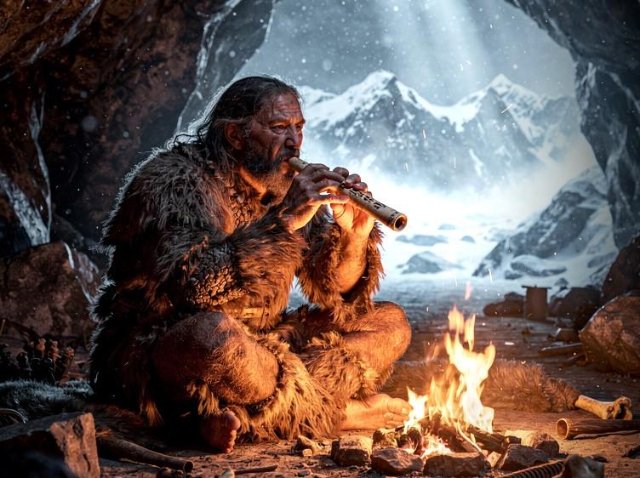
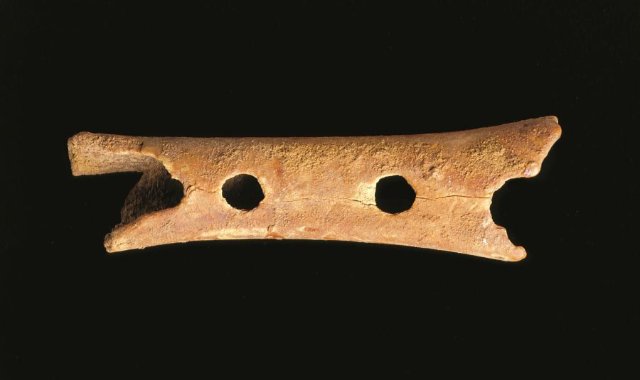
It’s hard to say when melody arose, at first in the form of human chanting, because it left no physical evidence. We do have a Neanderthal flute made from a cave bear bone 60,000 years ago. Before that they may have used hollow reeds or wood, but they were not preserved.
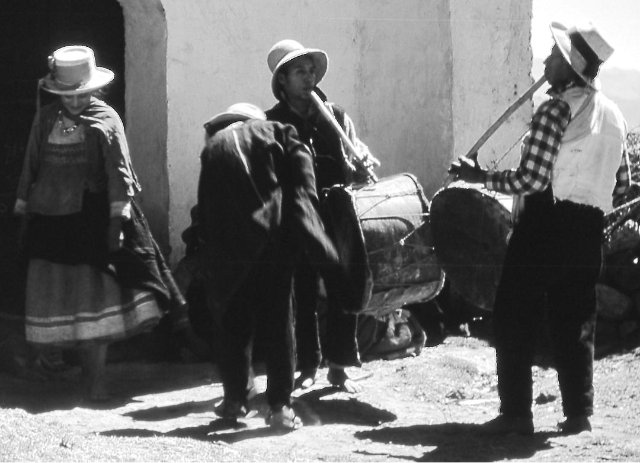
Flute-and-drum is likely the earliest form of instrumental music-making. It can still be heard in the Peruvian Andes, a traditional form of folk music in which a musician carries a large drum he bangs with one hand while playing a long wooden flute with the other. When I lived there, doing anthropological research among descendants of the Incas, hearing the plaintive tootling of flutes and the thumping of drums transported me to an ancient time.
By the classical music era, symphony orchestras played a wide range of artistically-crafted instruments, many still used today. Music was characterized by melody, harmony, tempo and dynamics. Rhythm, the source of music for ancient humans, had largely slipped beneath the aural surface, enabling large groups of musicians to play in unison but only occasionally dominant, like timpani in a symphony finale.
In the 20th century new forms of more rhythmic music began to emerge. The 1920s are often called the Jazz Age, the 1930s the Big Band or Swing Era. These were still acoustic forms of music, but their composers and performers were influenced by the energy of life in the Electric Age, and by the radio and records electricity made possible.
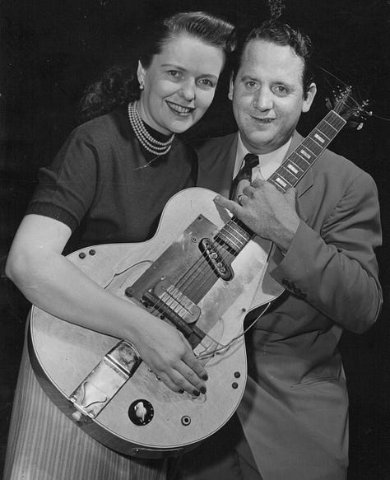
Acoustic guitars were often part of jazz combos and big bands but were hard to hear above the roar of horns, the pounding of pianos and the throbbing of drums. In the 1930s musicians tried to solve this problem by using primitive pickups or playing into a microphone. Then in the 1940s two men – Leo Fender, a skilled technician who couldn’t play the guitar, and Les Paul, a skilled guitarist who couldn’t play the sounds he heard in his head – set out to give a new voice to guitars with electricity.
They created a new kind of instrument, one that did not produce sounds from round or ∫-shaped holes in a hollow wooden body, but was in a sense a powerful input device to control the amplifier and speaker which emit the sounds. Les Paul was a pioneer among the many innovative electric guitar players who produced music the likes of which human ears and brains had never encountered before.
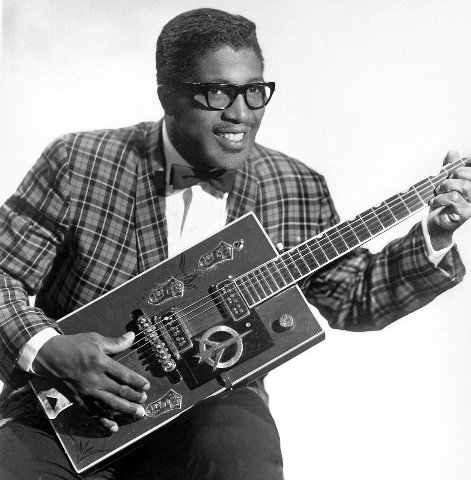
The electric guitar was the main weapon for a rock ‘n’ roll revolution in the 1950s led by Chuck Berry, Bo Diddley, Carl Perkins, Duane Eddy and many others, even country pickers like Chet Atkins, who played on many of Elvis Presley’s early recordings. Bo often played a guitar that hardly looked like one, with its rectangular shape that virtually shouted, this ain’t no acoustic guitar. He didn’t play it like one either. Rhythm was the heart of his sound, “the Bo Diddley beat.” Rhythm is inherent in AC electric current, and is prominent in electric music.
The musical explosion of the 1960s was driven by musicians exploring the new sounds they could wring from their instruments, “guitar gods” like Jimi Hendrix; British blues-rockers Eric Clapton, Jeff Beck and Jimmy Page; surf rocker Dick Dale; electric blues masters like Muddy Waters, John Lee Hooker and B.B. King; and jazz innovator Wes Montgomery. Bob Dylan shockingly went electric. For The Beatles and producer George Martin, and many other artists, the recording studio, with its multiple tracks and electronic devices to control and alter sound, became an instrument in its own right which “Sergeant Pepper taught the band to play.”
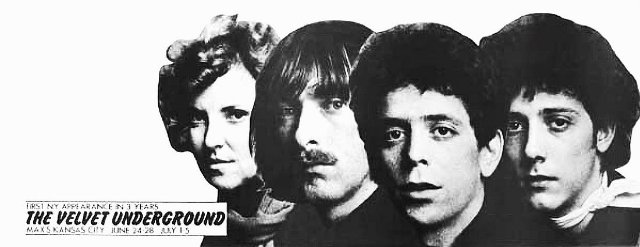
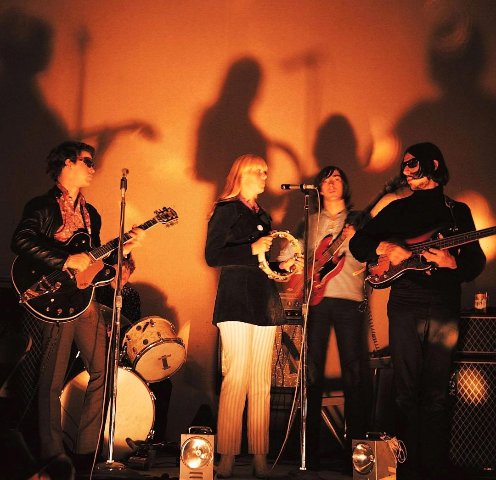
One of the most exciting, experimental and controversial bands of that era was The Velvet Underground, one-time proteges of Andy Warhol. The Velvets brought elements of Fifties rock ‘n’ roll, contemporary avant garde and futuristic electronics into a sound that rocked relentlessly, with uniquely poetic and often dark lyrics. The group was formed by Lou Reed, an aspiring if offbeat songwriter who grew up on Long Island, N.Y., and John Cale, a Welshman with a classical music background who came to the States on a fellowship at Tanglewood funded by Leonard Bernstein.
The first time I saw them play was in April 1966 at the famed club The Village Gate, in a benefit for The Paris Review. According to The New York Times, about a thousand of New York’s literati and glitterati, including Senator Robert Kennedy, attended the event, greeted at the front door by Review editor George Plimpton, the “Paper Lion.” Downstairs, rock bands wailed away, among them The Velvet Underground. Their hypnotic throbbing sound reverberated in my mind for months.
A year later I saw them at a venue called The Boston Tea Party, a psychedelic temple of rock. When they did a twenty-minute rendition of their classic “Sister Ray,” the room and everyone in it vibrated. It was electrifying. By a strange twist of fate, I became the manager of the Tea Party and later produced rock concerts in western Massachusetts, presenting many shows by the VU. They left an indelible mark on the evolution of electric music. Rolling Stone magazine called them “the most influential American rock band of all time.”
In a 1978 interview with the Los Angeles weekly newspaper Open City, Lou explained what he’d experienced with the VU playing a guitar with a fuzz pedal: “You go like this on the fuzz, daaaaaaaaaa – and what happens is that you don’t get just one note like a guitar, you may get eight notes, like daaaaahhhhheeeee…. You start hearing some really strange things…. We used to call it the Cloud, and like, on certain songs, we used to consciously enter the Cloud and you just hear all these funny things. They’re not you, but you know they’re being caused by the guitar, right?”
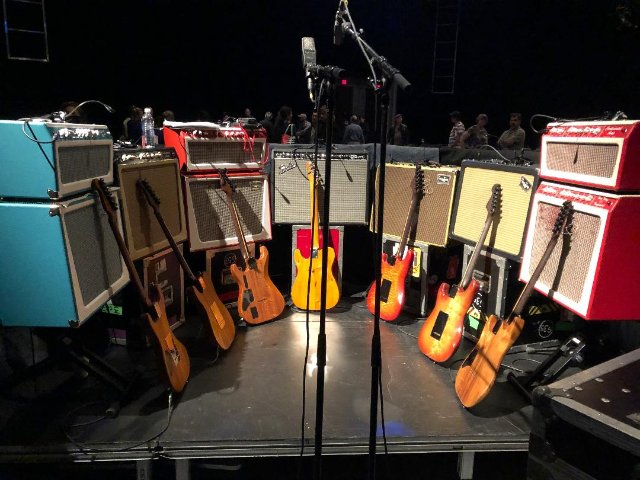
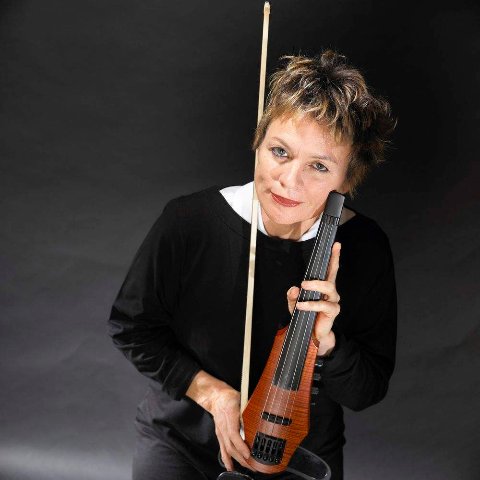
In 2019 I attended a “concert” caused by Lou’s guitars six years after he died, “Laurie Anderson Presents: Lou Reed Drones,” at the Massachusetts Museum of Contemporary Art. Entering a large performance space, I saw seven of his guitars leaning against seven of his amps in a semi-circle. The room resonated with the loud drone of feedback, altered by the location and movement of people present in the space, and manipulated by Lou’s former guitar tech Stewart Hurwood. It was an electrifying night. Lou’s widow Laurie played an electric violin unlike anything Stradivari ever crafted.
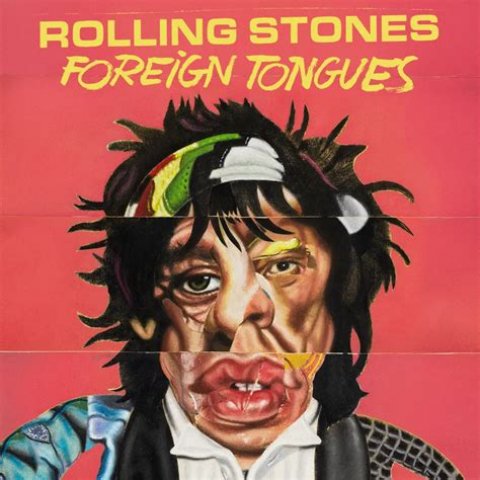
Improbably, one band spans the whole rock era: The Rolling Stones. They began playing together in 1962, but Mick Jagger had a garage band in the 1950s which covered Chuck Berry, Bo Diddley and Little Richard. Their critically-acclaimed new album, Foreign Tongues, released in July 2026, immediately went to #1 on the British charts, as did their first LP in 1964. The latter had a cover of a Chuck Berry tune, as is the last track on Tongues. Their roots are showing.
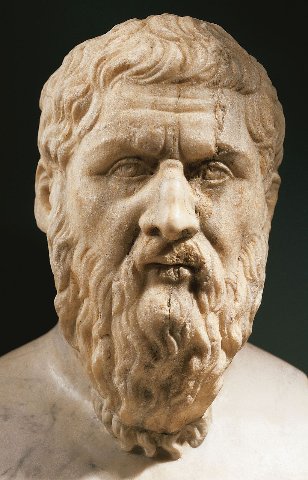
Electric music continues to evolve. Synthesizers swing. Rap is rhyming rhythm. New sounds keep being made and getting heard. From the Stone Age to the Stones, from banging rocks to rocking out: “The beat goes on, the beat goes on / Drums keep pounding rhythm to the brain” (Sonny & Cher). Or as Plato put it 2400 years ago in The Republic: “Rhythm and harmony find their way into the inward places of the soul.”
(Steven Reed Nelson is the author of Fire in a Wire: Electricity Enables Human Evolution Beyond Homo Sapiens and blogs at fireinawire.substack.com).