

Le Comte Ory
Rossini's Comedy Done Right at Merola
By: Victor Cordell - Aug 02, 2025
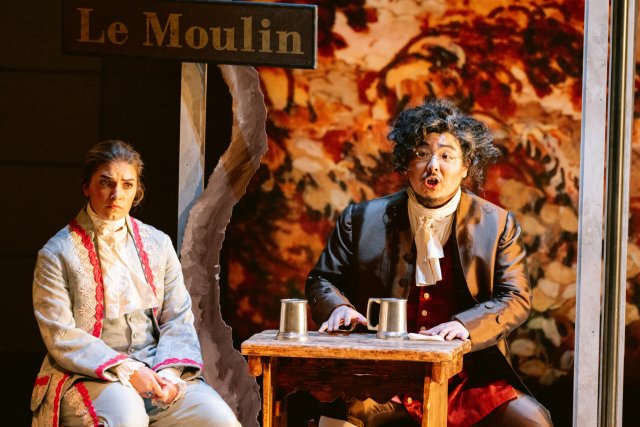
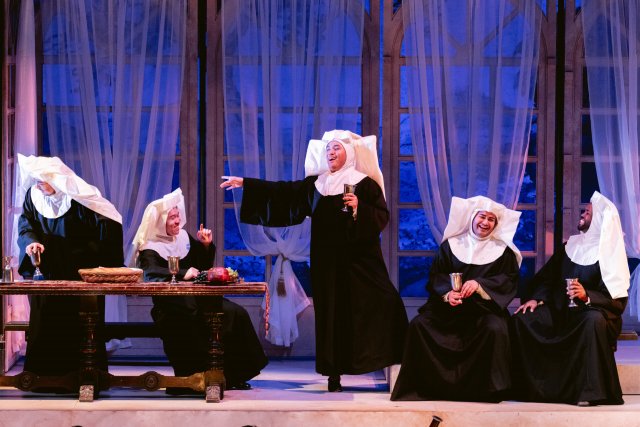
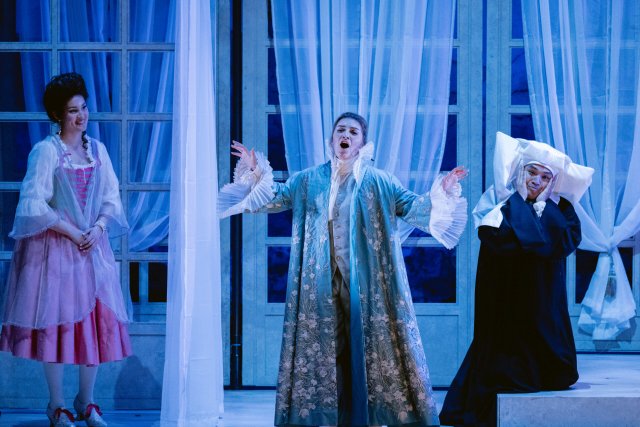
Gioachino Rossini was perhaps the most successful and prolific opera composer of the early 19th century. Retiring from the genre in 1829 at age 39, Le Comte Ory was his penultimate opera and his last comedy. Saucy and sexually suggestive, it may not have passed the censors in his native Italy, but Paris, where he resided for several years, loved racy motifs. Though rarely performed today, it was one of the most successful French language operas of its day.
The Merola Opera Program selected the medieval-themed Le Comte Ory for its summer opera production, which showcases the talents of several principal artists and gives the other Merolini opportunities for extensive choral work and solo snippets. All performers meet the challenges of their roles, with clear, exquisite singing and effective comic acting, including extensive mime during the overtures of both acts.
For those unfamiliar, Merola operates independently but in close partnership with San Francisco Opera in multiple ways, including as an artistic feeder. It is probably the best regarded opera training program in the United States, offering a holistic career curriculum and remarkably providing graduates financial support for five years after program completion.
Rossini’s raucous work reflects a number of the composer’s practices. Full of charm and peppy melodic music, it also becomes a bit repetitive with predictable set piece codas and Rossini crescendos to conclude overtures. In retrospect, he is considered both a genius and a bit of a hack for recycling previously used music (the famous overture to The Barber of Seville was used in two earlier operas). Though it wouldn’t be suspected by the unsuspecting, much of this opera’s music had appeared in a more serious dramma giocoso, Il Viagio a Reims.
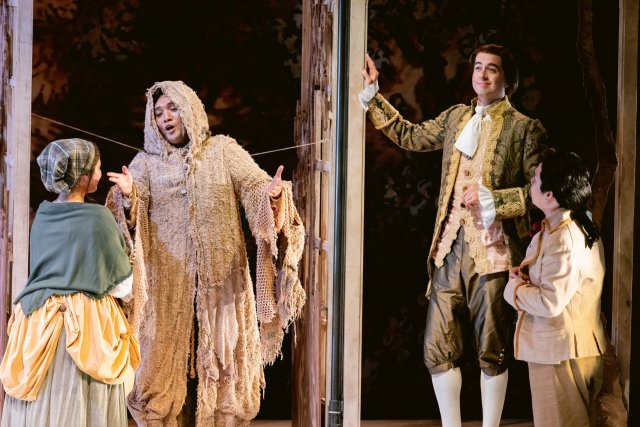
While the plot is thin and somewhat predictable, the payoff is in the character depictions and machinations as moral commentary underlies the farce. The hedonistic title character seeks all forms of pleasure, and opportunities abound as most men from the town are away on Crusades. Learning that the melancholic widow Comtesse Adèle seeks spiritual relief, the comte disguises as a hermit so as to seduce her. But his biggest obstacle turns out to be his own page, Isolier, who also desires Adèle.
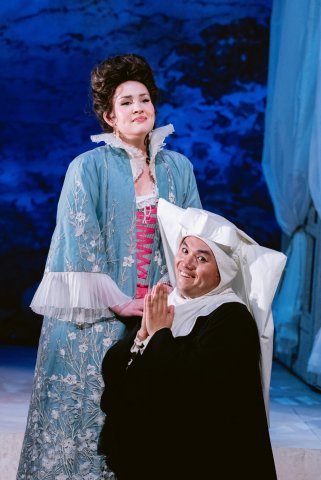
Minghao Liu as Ory not only sings with a classic tenor voice, but exudes charisma as both a singer and actor. He seems to relish being the antagonist and subsuming into the disguises of both the hermit in rags and the habit of a nun. Soprano Eva Rae Martinez is Ory’s quarry, and she hits all of the marks, with a fine coloratura and range to sing the high notes, especially in her “agony” aria.
Another notable turn is made by bass-baritone Wanchun Liang who plays the tutor, Gouverneur. Though Ory’s own page doesn’t recognize him as the hermit, the wizened tutor does. Liang also sings with distinction and manages a rapid patter that is difficult to do in a lower voice.
The final character central to the plot is Isolier, a trousers role performed by mezzo Meg Brilleslyper and sung with clarion purity. On the performance side, she embodies a multi-level gender role as she is a female playing as a male who also disguises as a female to fool his boss. She also participates in a delightful trio with the comte and the comtesse, perhaps the most notable set piece in the opera, “A la faveur de cette nuit obscure.”
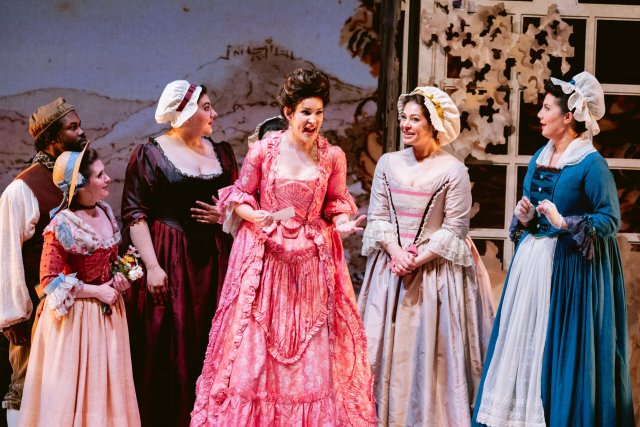
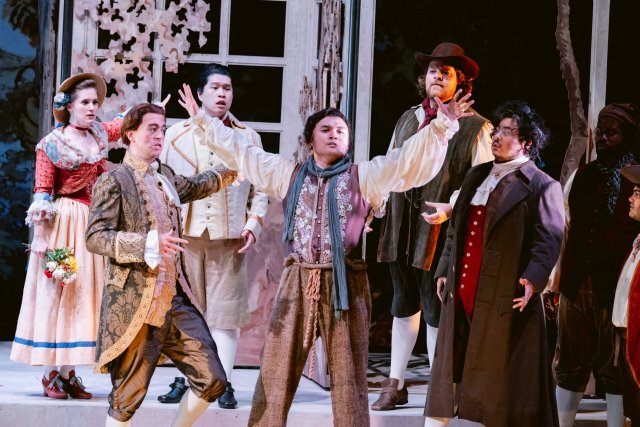
The remaining principals who perform admirably in all respects are mezzo Ariana Maubach as the comtesse’s companion Ragonde and baritone Benjamin Dickerson as Ory’s friend. In addition, the choruses are excellent throughout. The cast is particularly put through its paces at the end of Act 1 with two big ensemble/choruses divided by the news that the town’s men are coming home from war, which sets the stage for the humorous conflicts in Act 2.
Other artistic elements add to the overall effect. The staging is simple as would be expected given the limits of two performances. Meanwhile, the orchestra is superb. Pierre Vallet conducts with pointed precision in tight movement, and the musicians respond accordingly. This is some of Rossini’s finest music, and the orchestra produces a rich sound complemented with an abundance of absolutely accurate pizzicato from the strings.
I do have one bone to pick and that is with the program and supertitles. The lack of identification of characters is pronounced, and there is no excuse for not embellishing the cast listing to include relationships or positions (e.g., Isolier – Ory’s page or Gouverneur – Ory’s tutor), and giving names in the early supertitles to note who the characters are. I was partly at sea, leafing through my program through much of the first act, and even had one of the characters misidentified for over a half an hour.
Le Comte Ory, composed by Gioachino Rossini with libretto by Eugène Scribe and Charles-Gaspard Delestre-Poirson is produced by Merola Opera Program and performed at San Francisco Conservatory of Music, 50 Oak Street, San Francisco, CA through August 2, 2025.