

42nd Street
At Sharon Playhouse
By: Karen Isaacs - Aug 05, 2026
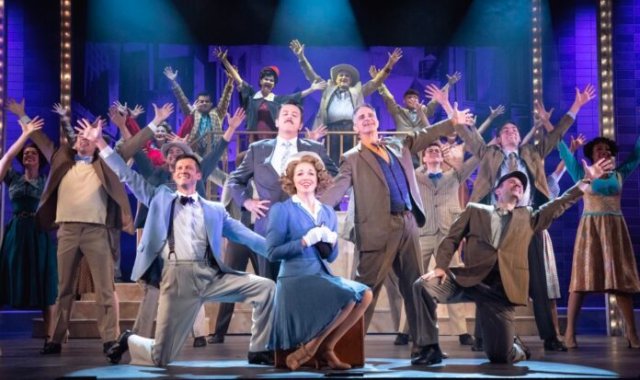
I thoroughly enjoyed Sharon Playhouse’s production of 42nd Street, but I am mindful of its flaws. But despite that, I mentally hummed along and tapped by feet to the old songs by Harry Warren and Al Dubin. Some you know and others will be pleasant surprises.
It’s not the book by Michael Steward and Mark Bramble. Their adaptation of the original 1930s motion picture keeps the most important elements of this backstage story about the naïve young dancer who becomes a star overnight. Does it make total sense? Of course not, but it keeps the plot moving.
For the most part, you can’t blame its failings on the music direction by Eric Thomas Johnson, or the choreography by Amy Van Norstrand
The problem is a chemical unbalance. When the two leads, Ian Black as Billy Lawlor and Gabi Stapula as Peggy Sawyer are front and center you are not riveted on them. Too often your focus shifts to the superb supporting cast, particularly Savannah Stevenson as Dorothy Brock, Michael F. McGuirk as Julian Marsh, Robert Mintz as Andy and Michelle Lemon as Ann Reilly.
To refresh your memory of the story, during the Depression, Peggy Sawyer arrives from Allenton, PA to fulfill her dream of starring on Broadway. She shows up at the audition for a new Julian Marsh show too late, but impresses the leading man, Billy Lawlor, and the other dancers with her talent. But she bumps into Marsh and he orders her out of the theater. Realizing he is one chorus girl short, he asks his right-hand man, Andy, to find one; Andy immediately hires Peggy.
The show is dependent on its aging star, Dorothy Brock, and her “friend” (Abner) who is putting up the money for the show. As rehearsals progress, Peggy bumps into Dorothy during a dance sequence; Dorothy is NOT happy. Peggy and Billy establish a romantic relationship, and we learn that Dorothy is really in love with her old vaudeville partner, Pat Denning, but Abner can’t find out. The show goes out-of-town to Philadelphia; and during the performance someone bumps into Peggy who then bumps into Dorothy who goes down. With a badly broken ankle, it looks like the show will have to close.
But the chorus, Andy, and Billy convince Marsh that Peggy can do the part. Off to Broadway they go to put Peggy through three days of non-stop rehearsals. Opening night comes and as Julian tells her “You’re going out there a youngster, but you’ve got to come back a star!”
All ends happily with Dorothy and Pat get together, Abner may wind up with one of the show’s writers, Maggie, and Peggy and Billy seem on the way to the altar.
What makes this show a hit is the terrific tap dancing choreographed by Van Norstrand and performed by the entire cast. Plus the songs are terrific – from the lesser known “Shadow Waltz” to the more familiar “You’re Getting to Be a Habit with Me,” “I Only Have Eyes for You,” “We’re in the Money,” “Lullaby of Broadway,” “Shuffle Off to Buffalo,” and “About a Quarter to Nine.” They are hummable.
Savannah Stevenson steals the show as Dorothy Brock; her renditions of “Shadow Waltz” and “About a Quarter to Nine” are terrific. The latter song is sung sitting in a wheelchair. It’s simple and it’s perfect. McGuirk also makes a big impression as Julian Marsh, even though he really has only one song, “Lullaby of Broadway,” McGuirk brought out in his portrayal the complicated feelings he develops for Peggy.
Stapula is a terrific dancer and has a sweetness to her voice; Black as Lawlor is good but just seems bland. Also, little connection or chemistry is developed between the two.
But director Carl Andress made some questionable choices. One was the choice that Bert Barry (Rudd Anderson), one of the two writers on the show, should have such a weird voice. Another is how the “before the curtain scenes” are staged. These are the scenes that were played in front of the curtain while scenery was moved behind them. (New stage equipment has made these scenes often unnecessary, but older musicals still have them). The black curtain just didn’t work.
It seemed that many of the production elements didn’t quite live up to Sharon’s reputation – from costumes that seemed to draw from many eras, to a few questionable wigs, a scenic design that was only OK.
Yet, despite these complaints, this is an enjoyable entertainment.
Tickets are available at SharonPlayhouse.org. It runs through Sunday, August 9.