

Manship, Friendship and Hockney, An Exhibition’s Genesis
Rebecca Reynolds, Director of Manship Artists Residency
By: Peter Littlefield - Aug 06, 2026
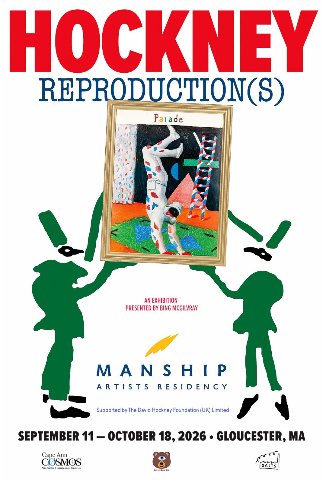
Peter Littlefield: Rebecca, I know that you and a team of collaborators are working very hard on Bing McGilvray’s exhibition “Hockney Reproduction(s),” which will open at Manship Artists Residency September 11. I’ve seen some of the work laid out in the barn, and it’s fascinating. But before we talk about David Hockney and Bing, I think we should begin with the residency program itself, which made the exhibition possible. Manship fosters all kinds of artistic activity. I suspect there are a lot of readers like me who've admired what Manship has been doing for years without ever quite understanding exactly what an artist’s residency is. Tell us a little about Manship and how it began.
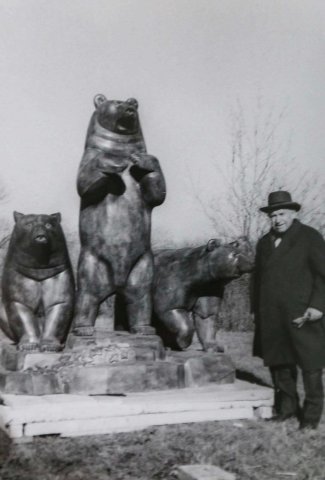
Rebecca Reynolds: I should probably start by saying that long before I moved to Cape Ann in 2001, I had made a direct connection with Paul Manship’s work and Starfield, his summer residence in Lanesville, Gloucester. My relationship began as a graduate student because I just happened to be standing on the street in front of the James Graham Gallery in New York City in 1989 as Manship’s Three Bears sculpture was pulled through their open shop window with a crane, to be moved to the Metropolitan Museum.
And although it would be many years before I learned that the sculpture had originally been installed at Starfield, this experience helped to define my professional path as an art historian specializing in American sculpture. When I moved to Boston and worked at the Museum of Fine Arts, Paul Manship became one of the artists whose work I curated and I came to know his family, particularly his son and daughter-in-law, John Manship and Margaret Cassidy.?
I ended up spending a great deal of time at Starfield, and I came to understand how extraordinary this place was. It wasn't only Paul Manship's home and studio. Designed and developed with his long-time collaborator and friend, architect Eric Gugler, Starfield was at the center of a vibrant creative community of artists, including Walker Hancock, George Demetrios, Virginia Lee Burton, and Leon Kroll, who lived and worked in Lanesville.
After Margaret’s passing in 2012, I spent over three years exploring how to save this historic property for our community.? Could it become a house museum? Could another institution take it on? Eventually it became clear that the best outcome was also the one closest to its past—to continue serving artists as a place where they could live and work. Thanks to funding from the Mass Cultural Council and the generosity of our community, the Founding Board was able to purchase the Manship estate in 2017 and today we have an active artists residency.
Peter: So the Manship Artists Residency started off as an effort to preserve an historic site and its unique landscape, but what you are doing today is not about looking back.
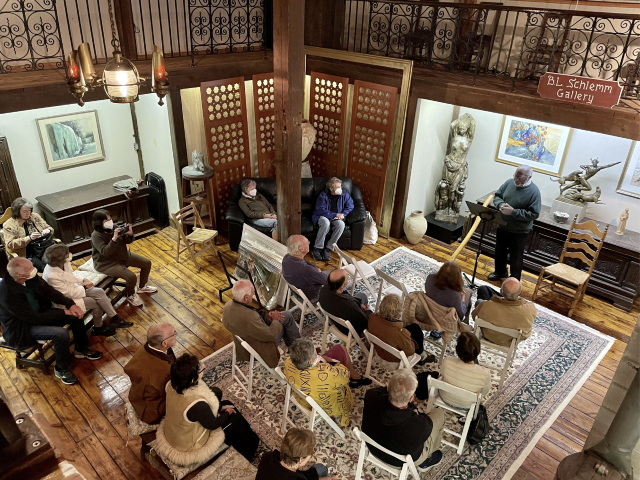
Rebecca: That’s right. Our mission is to support the creative process itself. We provide time and space for artists without any expectations. We don't require them to produce a certain number of paintings or write a certain number of pages, though most are incredibly prolific during their time here. And we don't tell them that they have to offer a public program, though many are eager for the opportunity to share their work with our community. Creative work doesn't flourish under such demands.?
Artists need freedom. They need untrammeled time. They need space to discover where the work wants to go. The Manship Artists Residency is about creating the conditions where that can happen. Artists become immersed in the beauty of the water-filled quarries, the ocean, forests, the changing light, the expansive skies, and the native flora and fauna.?
There's also something harder to describe — a continuity of creative energy. Paul Manship helped introduce Art Deco to America and was a pioneer in his own time, becoming one of the world's most celebrated sculptors. Artists feel that history here and sometimes they respond to it, and indeed, they become part of the Manship legacy.
Peter: It's almost as though the residency becomes part of their process, and the environment a part of their work.
Rebecca: Yes, sometimes it does. What we've discovered is that artists use the place in wonderfully different ways. Some write books here. For instance, the Heirloom Gardner, John Forti, finished his book on gardening as a traditional craft while also taking daily hikes foraging through Dogtown. And Charles Coe, the late poet for whom we are creating a named residency, embraced the solitude of this rural site to work deeply on Purgatory Road, as well as on his family memoir.
The Medusa Reclaimed residency is a wonderful example of how artists have built collaborations here. Collaborators from New Mexico, New York, and elsewhere gathered at the Manship residence over three separate stays to help Gloucester native Brian King evolve his radio play into a fully immersive performance with animation, aerial work, shadow puppetry, a cast of actors, and a live band.
We've also commissioned composers to create new work. Through the first iteration of our Great Marsh Artists Fellowship with Artists for the Great Marsh, composer L.J. White created Great Marsh Songs, working with more than seventy students from the Rockport Public Schools and Endicott College to stage a sold-out performance at Rockport’s Shalin Liu Performance Center in 2023.
We've even welcomed scientists. Their creative process isn't so different from an artist's. They're exploring, asking questions, and solving problems that allow us to look at and experience the world differently. The key is curiosity.
Peter: So the residency itself is really where everything begins. Which brings us to Bing McGilvray. How did this Hockney exhibition grow out of a residency?
Rebecca: Like so many things, it began with a conversation. Manship Co-Founder, Jo-Ann Castano, and I went to visit Bing at his home one day and he showed us this journal in which he was tracing connections between the people in his life. Some relationships had been there for a long time, others were still developing. He made the link between Man-ship and Friend-ship. It seemed appropriate being in Gloucester that this web of kinship would emerge in a place where “ships” have been so central.?
One of Bing’s dreams was to bring artists together in conversation and to recreate something like Dogtown College, a local collaborative founded in 1979 in which ideas cross-pollinated naturally. It was a wonderful vision, but organizing something like that requires an established community committed to the idea. So, I finally asked Bing to just come and be in residence by himself.
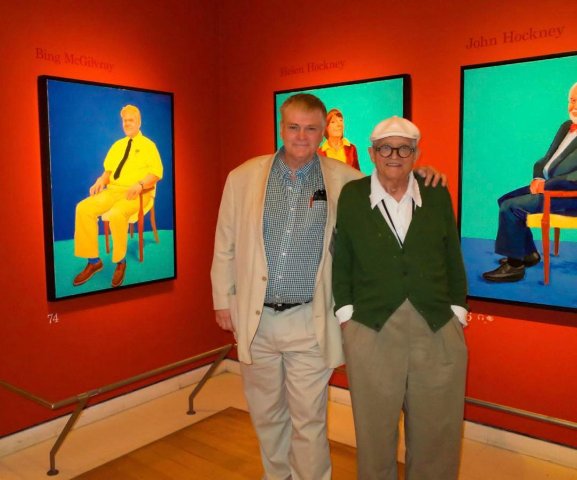
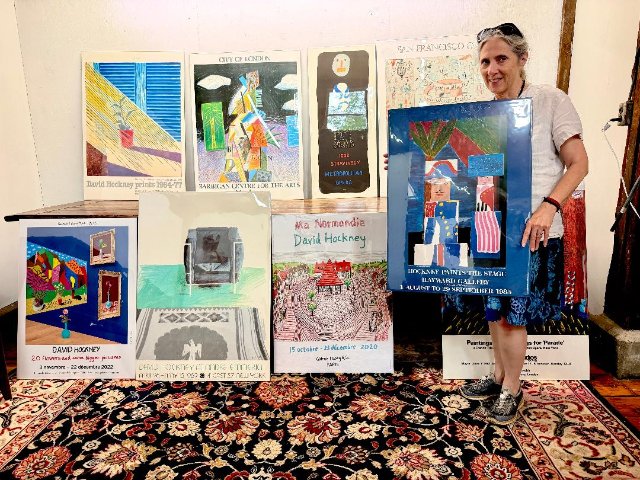
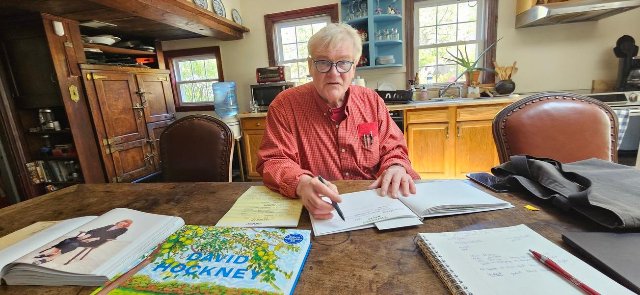
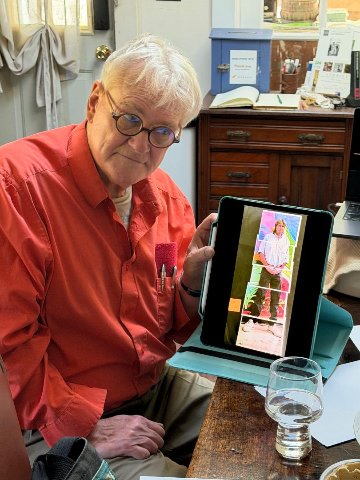
He had this idea about friendship, and you know, the most important friendship of his life and the most impactful one was with?David Hockney. So, he arrived at the residence in May 2025 carrying decades of material connected to his friend David —posters, prints, correspondence, reproductions, faxes, photographs, and memories. Bing turned the house into a working studio and archive. Every day he'd be sorting through another box. This was a look back, not just on individual pieces, but on their?connection to what Bing and what Hockney were doing at the time.
As an art historian, I find this all very exciting because Bing is bringing an insider's view into the discussion about Hockney's creative process and the work he developed over decades. It's so rare to get such a personalized view from someone who was there at key moments in a major figure's evolution as an artist, and here we have Hockney, one of the great artists of our time. Bing is giving us a front row seat.
Peter: It was such a long friendship. It’s interesting to think about what tied them together - a way of seeing things, sense of humor. It’s easy to imagine what Bing got from Hockney, but it’s clear that it went both ways.
Rebecca: Yes, and he wants to share what he learned and experienced. Bing would call me in. "Rebecca, come look at this.” He’d found something that he hadn’t seen in years.? And each art object that resurfaced came with a story.
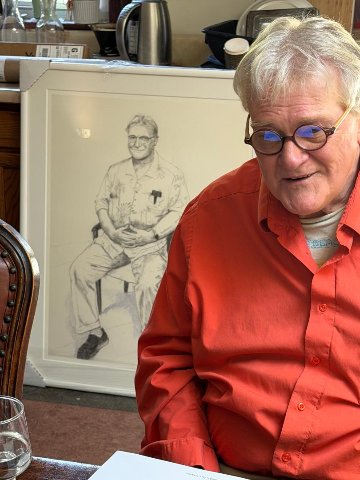
There were playful drawings sent as daily greetings and the portraits that Hockney had made of the youthful and aging Bing.
Bing told me about working at Tower Records in Boston’s Back Bay, where these mysterious faxes from Los Angeles suddenly started arriving in the main office. At first everyone was confused. Then they'd tape the pages together to discover another delightful image from Hockney.
Everyone began to look forward to them. The faxes were incredibly charming and often funny, like little Valentines sent across the country. They weren’t just reproductions. They were gestures of friendship. Bing was one of many Hockney friends who received them.
Peter: And that's really the emotional center of this exhibition, isn't it?
Rebecca: It became very clear that it was. The exhibition became not simply about reproductions but about the relationships that have “reproduced” through Hockney’s involvements as an artist in community and in the art world. And during this past year, to pull this exhibition together, Bing has gathered a team of artists, curators, collectors, writers, and old friends into this living network. It has been a most rewarding experience.
Peter: And so the individuals working together on this exhibition have multiplied.
Rebecca: They have. Richard Benefield, former director of the Hockney Foundation and respected Hockney scholar, became involved almost immediately, offering curatorial guidance as the exhibition developed. Then another mutual friend of Hockney, Charlie Scheips joined, offering to lend rare works like the banners that announced his opera productions. Charlie will also present a talk as part of the robust schedule of public programming. The network continues to expand with more and more
Hockney friends contributing work, expertise, and encouragement.
Hockney’s local fans have also stepped forward to help, all wanting to be a part of Bing’s Team and to participate in the excitement of creating something together that mirrors Hockney’s own love of art and of sharing it with others. Manship Artist Katherine Richmond has stepped in to frame the work and assist Bing with installation. Manship’s Administrative and Operations Manager, artist Ansa Stamper, is coordinating countless details, including the exhibition’s Salts Mill gift shop. Visitors will be able to continue Hockney's lifelong fascination with reproduction by taking beautifully produced books, posters, and printed works home with them.
Peter: Which brings us back to friendship.
Rebecca: Exactly. This exhibition celebrates David Hockney’s extraordinary vision and Bing McGilvray’s decades-long friendship with him. It also celebrates something larger.?Hockney Reproduction(s) celebrates the relationships that make creativity possible. Its foundation has been the trust between friends, through long conversations, and generosity. Through people sharing knowledge and opening doors for one another.
To me, personally, it has been enormously rewarding. I just wish Hockney could have lived to celebrate Bing’s tribute to their friendship, and the gift Hockney’s work has been to so many of us for so long.
Peter: You’ve got a great collection of people working from many different directions. I get a kick out of watching Bing?at the center of it all and?the obvious pleasure he takes - along with a lot of worrying - in working with each one of you. He’s always been a ‘bringer-together’ of people on Cape Ann. He has an influence on our artistic life that reaches beyond any one thing that he does. Is there an artist or writer on this island that he doesn’t know? I’d say the exhibition rises out of all these connections, beginning with David Hockney, who, of course, knew about the exhibition. I think Hockney would have loved it.
Peter Littlefield is a playwright, director and writer who lives in Gloucester