

Wozzeck
A Fine Rendering by West Edge Opera of the Atonal Masterpiece
By: Victor Cordell - Aug 10, 2025
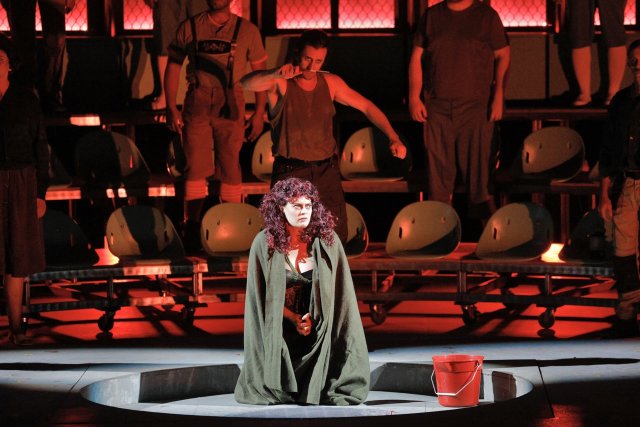
Alban Berg was the greatest disciple of Arnold Schoenberg, who changed the face of serious music with his mathematical approach to composition. Abandoning the mellifluous tonality of using a key-signature in which predominately notes that harmonize are included in the music, Schoenberg advanced the 12-tone method, making atonality a major force in classical music. Among other notable works, Berg responded by creating Wozzeck in 1925, which staked its claim as the first ever atonal opera and became a highly influential work in the genre.
West Edge Opera offers Wozzeck, and in keeping with its whole summer festival program, the production is supported by outstanding singer/actors and compelling creative design led by Director Elkhanah Pulitzer. While the storyline deals with social issues of great importance that resonate a century later, it is hard to think of a more depressing libretto in the repertory. Aficionados who enjoy atonal music will find the musical score and the execution by Jonathan Khuner’s orchestra and the singers to be electrifying. Those who prefer melodiousness may not be as enthralled.
Not only is the musical context of Wozzeck important, but so is the socio-political environment that the Viennese Berg wrote in. Even worse than the indignities forced on Germany by the Allies after World War I, Austria’s empire was dismembered, and like Germany, it was a failed state economically, politically, and socially.
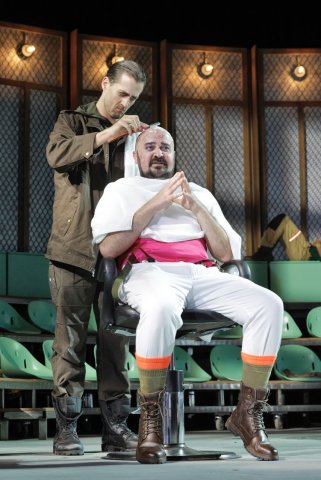
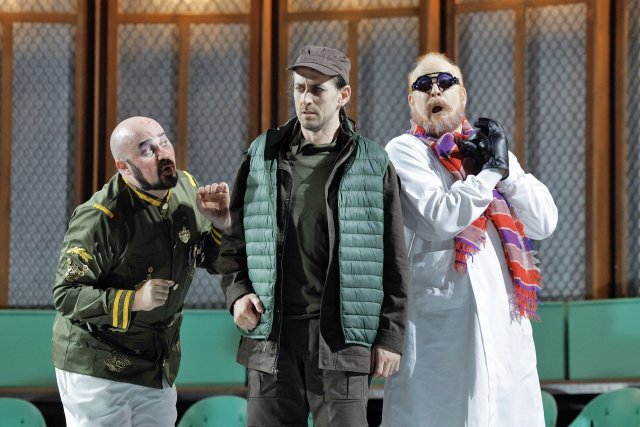
Into this miasma, Berg transfers from theater stage to opera stage Franz Wozzeck, a dour, downbeat, and abused Army soldier portrayed with chilling effect by Hadleigh Adams. His non-conformity, which includes having an illegitimate son by a common-law wife, is vilified by his “Captain” (Spencer Hamlin) who receives extra services from Wozzeck for a pittance. The soldier also receives a small stipend as a subject in the medical experiments of the “Doctor” (Philip Skinner) who should realize that Wozzeck’s dark hallucinations and aberrant behavior signal psychological derangement along the lines of schizophrenia.
But most likely, Berg believed that the system is designed to disadvantage the already impoverished, and that their needs will go unmet. The Doctor complains that Wozzeck piddles in the street, but it is a small example that the poor don’t have the resources to be as virtuous as the rich. Tragedy will befall the powerless Wozzeck and his lover, while those in the professional class blithely march onward.
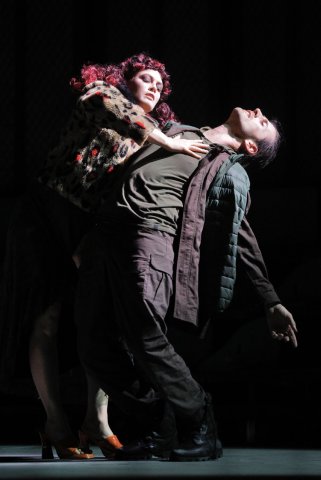
Emma McNairy sizzled a decade ago in the title role of West Edge’s Lulu by Alban Berg. She completes her exquisite command of lead female parts in both of Berg’s operas with her portrayal of Marie, Wozzeck’s common-law wife and lover. Earthy and volatile, her heavily tremoloed, dramatic coloratura voice pierces with raw emotion, and she dominates the action when she is present.
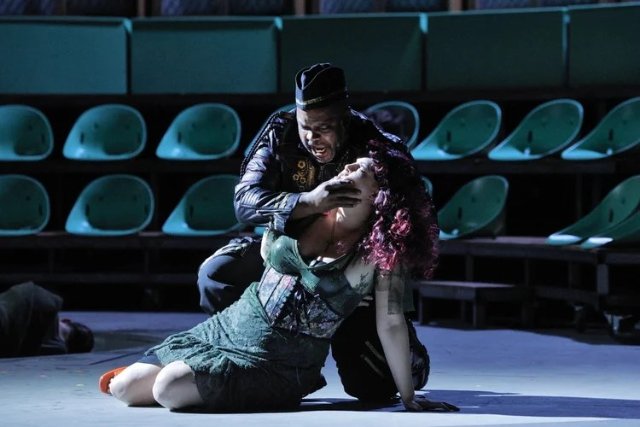
More complexity is depicted in Marie’s character than any other. As a fallen woman, she obsesses on Mary Magdalena and reveals either metaphoric thinking or ESP in a well-delivered soliloquy about a boy who lost his parents. Ultimately, her lust will trigger disaster. Marie will become entranced by the Drum Major (Michael Belle). Wozzeck will learn of their tryst, and his violence will lead to downfall.
In a couple of ways, Berg’s composition seems a bit unusual, but for understandable reasons. Although Hadleigh Adams is a highly accomplished baritone, in depicting the depressed title character, his singing part understandably lacks great expressiveness through most of the opera. An exception is his brief but effective “mad scene” in Act III. Conversely, Spencer Hamlin in the much smaller role as the Captain sings much higher in his range and sets the vocal standard among the male performers with great resonance and power. In a sense, Marie is the central character and McNairy the star. Her vocal part is more interesting than Wozzeck’s, though that is more understandable as she is a more voluble person, and while Wozzeck is mostly reactive, Marie is a moving force.
Tanya Orellana’s staging is unusual, with two concentric arcs of plain, light blue-green chairs dominating the set. The concept is that the stage mirrors the seating of the opera house. We are looking at ourselves, so the events on stage then represent the audience. Although the theme of art imitating life appeals, this particular instance is somewhat disturbing, as the characters in the opera dwell in the netherworld of society. This may be how Berg saw the world around him, and perhaps he would see our world today in the same way as the director seems to imply with this interpretation.
Wozzeck, with music and libretto by Alban Berg and based on the play Woyzeck by Georg Büchner, is produced by West Edge Opera and plays at Oakland Scottish Rite Center, 1547 Lakeside Drive, Oakland, CA through August 17, 2025.