

Orpheus Descending
Flawed but Worthy Play with Strong Treatment
By: Victor Cordell - Aug 11, 2026
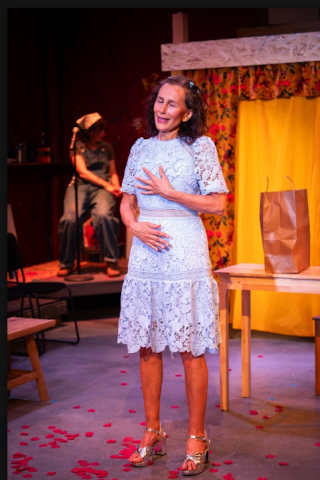
Tennessee Williams reigns as one of America’s greatest playwrights, penning Southern Gothic masterpieces such as A Streetcar Named Desire and Cat on a Hot Tin Roof with indelible characterizations. He also produced a number of near misses, works with elements of greatness but notably flawed. One play generally regarded as such is Orpheus Descending from 1957. While some concerns about this piece would also apply to his greatest plays, those particular to this work include the slow development of the crises and the unexplained diversions involving less important characters. But the central themes are powerful and the results more consequential than in his more popular plays.
Already renowned for the two mentioned above and several more, this was Williams’ second play written for a muse and decades long friend, Anna Magnani, whom he knew from his many years in Rome. But despite its pedigree (the Broadway opening had Cliff Robertson as the title character and Maureen Stapleton as the deceased Italian immigrant’s daughter, Lady), the play didn’t catch on. Nor did the movie, re-titled with words from the play, The Fugitive Kind, despite starring Marlon Brando and Magnani herself, who had won the Academy Award for The Rose Tattoo, the other play that Williams wrote for her. So clearly, there are obstacles to overcome.
Oakland Theater Project offers an unusual treatment of Orpheus Descending. Although I am unaware of the company’s motivation, casting a black man as the title character Val can be construed as color-blind casting, or it could offer another layer of conflict, that of race. Not only is the original text amenable to the latter interpretation (even Val’s guitar is signed by black blues legends), it does make the clashes more urgent and virulent. And several script adaptations clearly relate to making Val black.
Val’s race also adds fire to a vital incident that predates the action of the play. Lady’s father, Papa Romano, had created a vineyard and sold wine to black men at a time when it was illegal in Mississippi. A delegation of men from the town burned the family’s crops, home, and other buildings, and we can assume that they were driven by racism, not to adherence to the law. The father died trying to control the conflagration. Southern justice of the time being what it was, the case wasn’t solved, and Lady, now in an unhappy marriage with an invalid, lives in a community not knowing who all were responsible for her suffering.
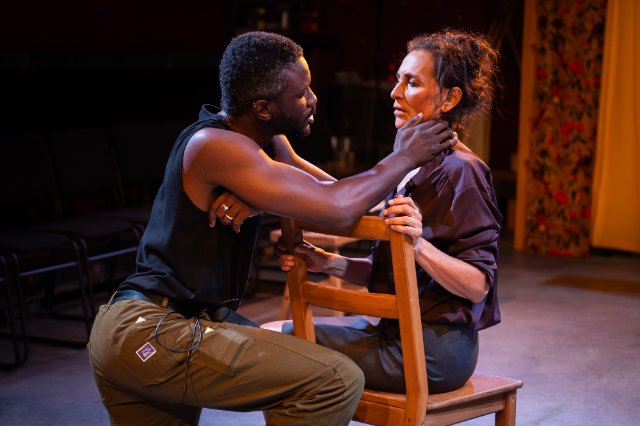
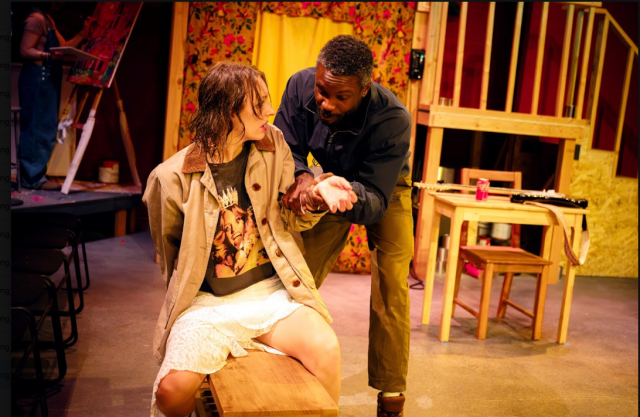
Hunter Bryant is the snakeskin-jacket-wearing, guitar-playing Orpheus figure, Val. On the run from being at the wrong place in New Orleans at the wrong time, his descent is into the hell of a small racist Southern town. The married woman, Lady, who should be unreachable, is his Eurydice.
Bryant is at once charismatic and laconic, earnest and halting, with limited affect (think Marlon Brando), his character saying little more than needs to be said. He does state that he’s just turned 30 and like a snake shedding its skin, he’s leaving the old wild life behind. And though cautious understatement would be de rigeur for a black man in his situation, it doesn’t necessarily make for dramatic theater.
Lady is a different kind of outsider that Lisa Ramirez depicts ably and convincingly as morose and yearning for something more. Her modulated gesticulations draw from her heritage, and she animates her quieter moments with little fidgets of anticipation as she finds herself attracted to Val. Lady runs the general store for her bed ridden husband Jabe, and her loveless marriage makes her susceptible to Val’s appeal. He’s looking for work, and hiring him ensures that they will be together.
The playwright certainly knows the denizens of small Southern towns, and one of the archetypes is Carol Cutrere, the wild child from the county’s most prominent family. Played with gusto by a voluble and magnetic Natalie Pasquinelli, she is an exhibitionist with no filters and shows no restraint. Pasquinelli is absolutely frenetic throughout, though she does take time to show that she has some social consciousness and has also fallen for Val.
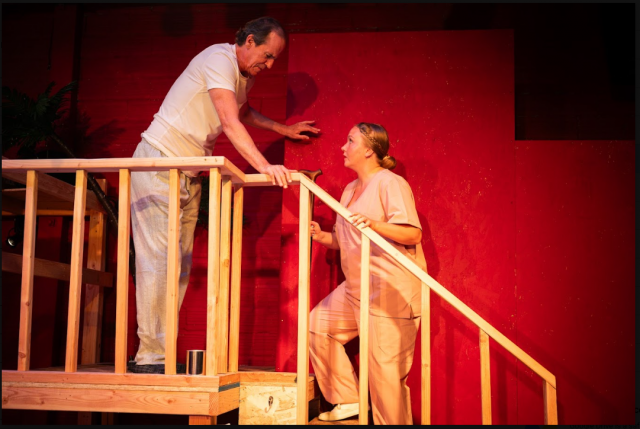
The final major player is the talented Robert Parsons, who imbues three characters with importance, and he does it with distinction. As Jabe, thumping his cane and shaking from illness when he rarely ventures out of bed, is irascible and suspicious of Lady and Val. As the sheriff, Parsons coolly and dispassionately threatens the intruder Val to move on in a manner reserved for blacks in the South. And as David, Lady’s lover from long ago, he is contrite and apologetic.
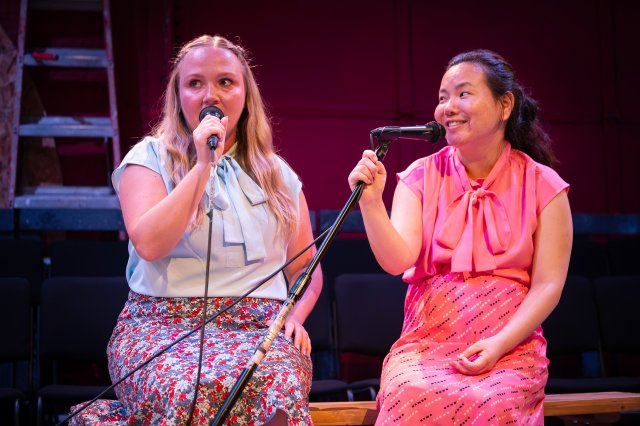
Under Will Detlefsen’s direction, one additional conceit beyond the well-developed racial element includes speaking stage directions, in part to compensate for lacking a representational set of the general store where the action takes place. Also, when two women gossip about the goings on in the town, instead of speaking sub-rosa, they use microphones to amplify their messages. Some of the process of this device was a little clumsy on opening night, leaving some audience members a little confused, but it adds a little spice to the mix.
With regard to the worth of Orpheus Descending compared to his more popular works, I completely weigh in on the positive side, especially with the racial element added. It is full of memorable characters that represent their society well. The stakes and the consequences are considerable with multiple tragic results in the end. And drawing on Greek mythology and layering in symbolism adds more dimensionality to the drama. OTP’s production decisions are a matter of taste and need to be ironed out for clarity but well worth checking out.
Orpheus Descending, written by Tennessee Williams, is produced by Oakland Theater Project and plays at Flax art + design, 1501 Martin Luther King Way, Oakland, CA through August 23, 2026.