

Other Desert Cities
Bridge Across the Pond Theatre in South Florida
By: Aaron Krause - Aug 20, 2026

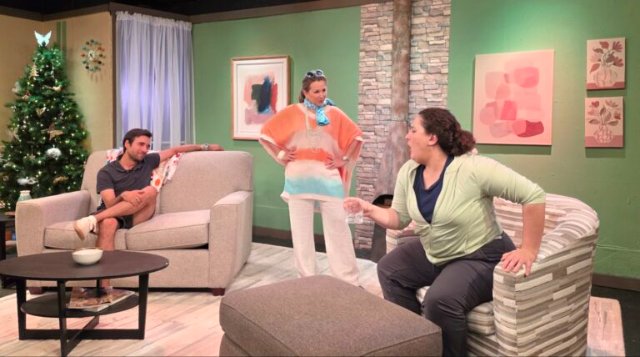
The Wyeths should be celebrating in Jon Robin Baitz's moving, gritty family drama, Other Desert Cities. After all, it's Christmas. But a ghost from their past is haunting them, and it isn't any of the supernatural entities who visited Ebenezer Scrooge in A Christmas Carol. The ghost isn't the Wyeths' son, Henry, but their alleged mistreatment of him during his formative years. The Wyeths’ daughter, Brooke, is about to resurrect that ghost, and that's partly why they're not celebrating.
Certainly, though, Bridge Across the Pond Theatre's current production of Other Desert Cities is cause for celebration. The theater company's production of the show, which will be revived on Broadway this fall, runs through Aug. 30 at Empire Stage’s intimate black box theater in Ft. Lauderdale. Under company co-founder and artistic director Gary Solomons’ strong direction, a small but talented cast makes us believe that their characters are a loving but divided family. The running time is about 140 minutes, including intermission.
Other Desert Cities, which tackles timely themes such as grief, mental illness, family secrets and betrayal, as well as the ethics of storytelling, takes place in 2004 in Palm Springs, Calif., on Christmas and several years later in Seattle during an epilogue. Brooke, a liberal writer, visits her conservative, politically connected parents, Polly and Lyman, for the holidays. She announces she is publishing a tell-all memoir about the presumed tragic suicide of her older brother, Henry, forcing the family to confront a devastating hidden past.
Most of the action takes place over two days, largely in Polly and Lyman’s home. The tight, compressed timeline and mostly one-locale setting create a classic “pressure-cooker” environment in which the characters find themselves trapped together. Tension simmers overnight before boiling over the next day. A shocking revelation concludes the play, one that we will not spoil here.
At the beginning, the family members almost immediately argue. Indeed, Polly instantly puts her daughter on the defensive by questioning how she could stand living amid “those East Coast winters, and in that little village of yours out there on the edge of the sea.” Solomons and his cast leaven the early conflict with warmth and playfulness. Indeed, Polly and Brooke walk into the house, arm in arm, and there’s some laughter and playfulness amid the conflict. This suggests that underneath their proclivity to bicker lies genuine affection. Throughout the production, we see signs of that love in the form of supportive touch and embraces.
Baitz is an acclaimed American playwright and screenwriter celebrated for his sharp dialogue, deep moral complexity, and acute focus on the fractures within American elite families like the Wyeths.
Brooke has a clear objective during her visit to Palm Springs — secure her family’s blessing to publish her memoir. To her credit, Ana Marie Calise clearly understands that objective. Her Brooke seems driven, yet nervous and sensitive. She becomes emotional with little provocation. Peer into her wide dark eyes, and you sense a young woman horrified by her past. Those same eyes shoot accusing glances at her parents during tense moments between them. When Brooke can no longer contain herself, tears well in her eyes before she believably cries and then sobs.
Calise demonstrates that Brooke, who suffered from depression, has made strides toward becoming emotionally stronger. A bright smile forms on her face at times, and she even laughs during the play’s lighter moments. The performer also captures her character’s sarcasm when she drily asks her brother, “Trip, have you ever actually met our parents?” Calise’s Brooke relies on support from her aunt, Silda (Lory Reyes). The two share strong chemistry when the older woman comforts her niece. Calise’s Brooke also appears relaxed during an epilogue set a few years later. For instance, she laughs as she finds her place in the memoir while reading it in a public setting.
As Polly, Michele Verde convincingly carries a confident air about her, holding her head high, moving with purpose, and commanding the stage without upstaging her castmates. Appropriately, she speaks sharply, with authority, and her tone can be eloquent, but it turns bitter without much warning. Verde’s Polly, scowling, sometimes spews venom without necessarily shouting. Rather, it comes out softly yet steadily and bitingly like a serpent. Certainly, it can be difficult to care too much about Polly. That’s not Verde’s fault; Baitz has written her as an arrogant, sometimes mean-spirited woman who feels she needs to be in control at all times. However, through Verde’s strong performance, hints of humanity emerge. Watch as she places her hands on her husband’s shoulders, holds his hands, and kneels by Brooke for comfort. True, she may just be trying to comfort herself through such gestures, but they add up to present a Polly who isn’t entirely an uncaring monster.
Dan Levine, the theater company’s co-founder, delivers a textured performance as Lyman, embodying a character troubled by his past but, at least outwardly, able to live in the moment without it constantly haunting him. With a hint of pride, for instance, the former movie actor fondly remembers being a skilled performer. He is also able to smile at memories. However, his daughter’s impending publication of her memoir unearths painful memories for him, which show in his flustered physical movements and expressions. His emotional pain boils over when he can’t take it anymore and yells at the top of his lungs at his daughter while leaning into her. The scream seems to contain a mix of anger and torment. That shouting voice, however, softens and then breaks with credible vulnerability as Lyman realizes that his daughter intends to publish her memoir. But he has his wife for support, as the couple touch each other during trying moments. Lyman, at times, also retreats to the fireplace. Perhaps he craves not just the literal physical warmth, but emotional comfort. The production’s scenic designer and technical director, Eric Fields, will take over the role for some performances.
Reyes shines as Brooke’s strong-willed aunt Silda, a former alcoholic. The actor lends Silda a sharp edge; she doesn’t hesitate to state her opinions, and she does so with a firm voice. When she’s supportive, her voice softens considerably and takes on a sympathetic quality. She essentially becomes Brooke’s rock when the younger woman feels vulnerable. Reyes also demonstrates deft comic timing during lighter moments. “Jesus, I smell pot,” Silda says loudly, suddenly waking on the couch when she smells it. One of Reyes’ strongest moments comes toward the end, when a revelation leaves Silda stunned. With a knee-jerk reaction, she touches her forehead in disbelief, emits a sound suggesting agony, and quickly leaves the room.
With impressive naturalism, Mark Hernandez plays Trip, Brooke’s brother, as a laid-back, funny reality-television producer. Sitting with his legs crossed or propped on a footrest are just a couple of the actor’s smart acting choices. Often, Trip is the peacekeeper as the arguments between Brooke and her parents grow increasingly heated. But Trip also has strong opinions, and Hernandez’s performance increases in intensity when his character adamantly expresses them.
Under Solomons’ measured direction, cast members convince us that their characters are loving family members who get on each other’s nerves. They also know each other so well they can playfully admonish each other. For instance, Lyman hits his daughter with a newspaper, a gesture that feels playful rather than aggressive. The action feels as organic as the blocking. Solomons adeptly paces the production, including a natural build-up to a shocking revelation.
The director stages touching scenes and humorous moments with equal care. The production’s designers also succeed in creating a physical environment that complements the characters and their world. Preston Bircher’s lighting is mostly bright and realistic, which befits this play’s style and mood. After the lights go dark to open the show, the first object that Bircher illuminates is the family’s Christmas tree. It sits off to the side, and the choice to illuminate it first, accompanied by a carol, acknowledges that while the holiday is part of the family’s world, it’s not foremost on their minds.
Costume designer Anne Solomons outfits the characters in clothes that enhance their characterizations. For instance, Brooke wears black, a color that suggests the depression from which she’s trying to emerge, while Silda’s bright, colorful outfit reinforces her colorful personality.
Fields designed the set depicting the Wyeth Palm Springs home. Set pieces such as a liquor tray, artwork, comfortable-looking furniture and draperies lend the space an upscale feel. The spacious area is neat and orderly, befitting the image-conscious homeowners. Appropriately, the artwork includes family photos as well as black and white pictures that evoke Hollywood. A fireplace rests upstage, offering literal warmth, while also suggesting a respite from the cold, tense atmosphere surrounding the family as Brooke prepares to publish her memoir.
The production ends bittersweetly, with Calise imbuing Brooke with uncertainty yet hope. At its heart, the play is about our pasts creeping up on us, refusing to remain footnotes in history. Brooke’s decision to write about that past and publish it brings it into the present, forcing us to think about our choices and how they may impact us.
In just its third mounting, Bridge Across the Pond Theatre, which brings British and American theater to South Florida, has shown that it can present compelling, polished productions, leaving audiences impressed and in deep thought.
IF YOU GO
WHAT: Bridge Across the Pond Theatre’s production of Other Desert Cities by Jon Robin Baitz.
WHEN: Through Aug. 30.
WHERE: Empire Stage’s intimate black box theater, 1140 N. Flagler Drive in Ft. Lauderdale (two blocks north of Sunrise, east of the railroad tracks).
TICKETS: $33.85. Call (954) 678-1496 or visit https://bridgeacrossthepondtheater.org.