

Ballet Hispánico. New York at Jacob's Pillow
Celebrating Three Latinx Choreographers
By: Charles Giuliano - Aug 25, 2026
Ballet Hispánico New York
Jacob’s Pillow
Ted Shawn Theatre
McCain Stage
August 19-23, 2026
Artistic director and CEO, Eduardo Vilaro
Founder, Tina Ramirez
Company artistic associate, Rodney Hamilton
Ballet mistress, Nicole Duffy Ponsa
Línea Recta (Straight Line) (2016)
Choreography: Annabelle Lopez Ochoa
Music: Eric Vaarzon Morel, Costume Design: Danielle Truss, Lighting Design: Michael Mazzola
Lighting Reconstruction: Dominick Riches
Otra Vez, Otra Vez, Otra Vez (Again, Again, Again) (2019)
Choreography: Stephanie Martinez
Music: Francisco Tárrega & Andrew Vettoretti, Tárrega & Zane Merritt, Dolores Duran, Isolina Carrillo, Los Cuates
Costume Design: Holly Hynes, Set and Lighting Design: Julie Ballard
Tranca (2026)
Choreography: Cassi Abranches
Music: Beto Vilaris, Costume Design: Janaína Castro, Lighting Design: Clifton Taylor
Dancers: Amanda Bacallao, Amir J. Baldwin, Mia Bermudez, Thierry Blannchard, Antonio Cangiano, Francesca Levita, Matthew Mancuso, Dylan Dias McIntyre, Andrea Mish, Kevin Ortiz Lemus, Amanda Ostuni
In 1970 Tina Ramirez founded Ballet Hispanico New York. During her 39 years as Artistic Director, she invited 50 choreographers from diverse backgrounds to provide a modern-day interpretation of Spanish-speaking cultures, drawing on the versatility of her dancers in ballet, modern dance, jazz, ethnic and other dance techniques. Eduardo Vilaro, a former dancer with the company, took over in 2009.
This was the sixth time that the company has appeared in Becket. For the occasion it presented three works choreographed by women. This is consistent with a summer long theme of programming this season.
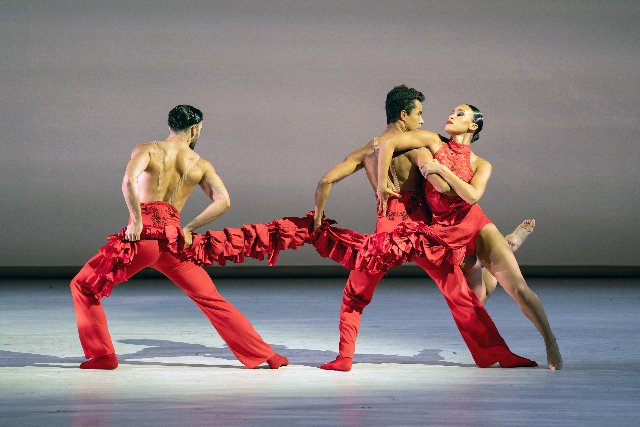
Anabelle Lopez Ochoa, who choreographed Linea Recta is a familiar presence at Jacob’s Pillow. She assumed its position as Contemporary Ballet Director in 2019 the year she was honored with the Jacob’s Pillow Dance Award. The piece is a deconstruction of traditional flamenco with a confluence of ballet and modern dance movements.
The dance begins with a woman in red with her back facing the audience. Behind her is a simulation of a bata de cola the extension of a long skirt. In this instance it is a signifier of flamenco. There is gradual movement in her shoulders as her body begins to move to a sound track of vibrant, passionate flamenco guitar.
When her body turns to the music we see that the costume reveals bare legs with no presence of the traditional skirt that dancers manipulate with dramatic flourishes. This is more of an ironic comment.
While flamenco is notable for sexually animated partnering she is in fact joined by four men. They are bare-chested, a motif of all three dances, revealing chiseled bodied in high-waisted Spanish or toreador pants.
While she interacts with the four men with lifts, turns and arabesques it becomes clear that she is in charge. They are her associates but never partners. This tends to dilute the duende that drives the men.
The four men are joined by four women but none of them wear or flourish a bata de cola. Lopez Ochoa uses the eight dancers to extend the line from folkloric to balletic.
In this interpretation the sonics are sharply altered. Because they are barefooted there is no zapateado, or the staccato sound of clicking heels. Percussion, which is essential to flamenco, is conveyed entirely by the musicians. Because of the use of recorded music there is none of the familiar excitement and energy as dancers and musicians interact and inspire each other. There were no spontaneous shouts of “ole.”
During past performances of the company, in particular an appearance at MASS MoCA, there was the strong presence of social dancing. That single, evening long piece simulated a raucous night club on Saturday night.
This time at Pillow the essence of the company was Ballet Hispanico New York. Clearly the company has a mandate to move in the direction evolving into a mainstream contemporary company. The excellence of the dancers reflects their meticulous training. That was abundantly evident in the next two pieces.
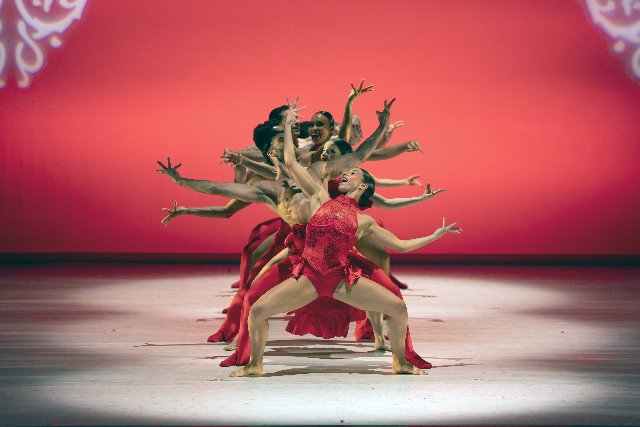
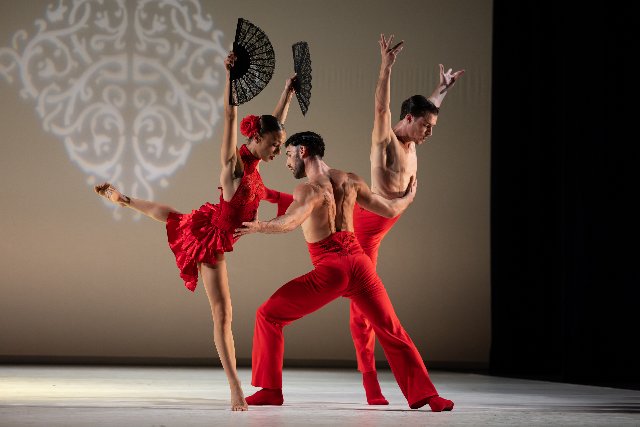
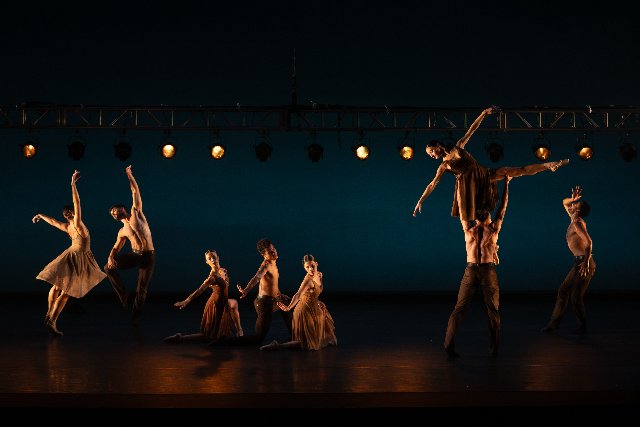
Stephanie Martinez was inspired by a Picasso painting “The Old Guitarist” to create Otra Vez, Otra Vez, Otra Vez (Again, Again, Again). The eight dancers, four men and four women, engage in all possible patterns and partnering. This is motivated by shifting themes of musical genres by six composers. Significantly her ballet was performed on pointe. There was a range of emotion projected but often, with numerous lifts, entrances and exits, the dancers seemed more in their own realm. I never quite connected with Picasso.
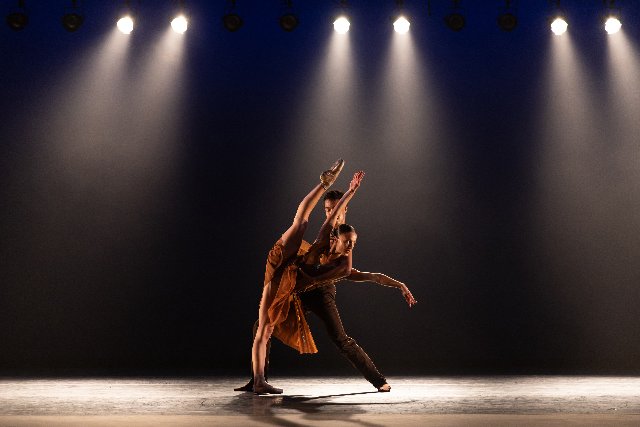
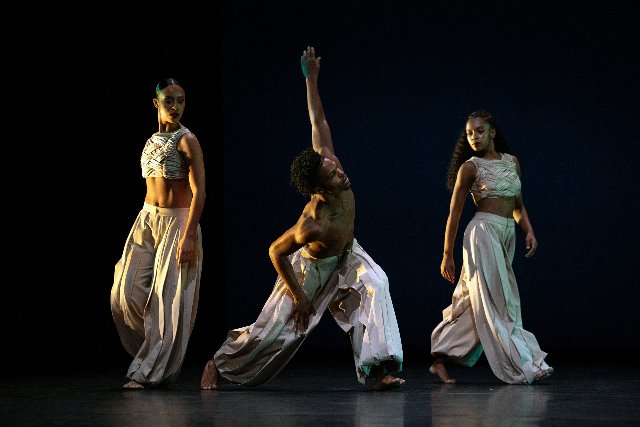
The newest work Tranca (Braid) by the Brazilian, Cassi Abranches, was most remarkable for its range and ambition. Initially the company formed a line then devolved into the weaving patterns suggested by braiding.
The music started with sounds of nature and the essence of wind and water. That evolved into Brazilian music which is notable for its subtle rhythm, and poetic nuance. There was more of a confluence between ballet, modern movement and Latin ballroom dancing. This entailed fancy footwork.
Ending the program in this manner brought the full house to its feet.