

Santa Fe: The City Different - Traveler's Notes
No Other Small American City Has the Quality and Diversity of Santa Fe
By: Victor Cordell - Aug 30, 2025



Now that Travel and Leisure has anointed Santa Fe as the 2025 “Favorite City in the U.S.” and Condé Nast Traveler as the 2024 “2nd Best City,” the secret is out – at least among their readers. But to many, it is still a distant, exotic mirage. My wife, Karin and I, have spent a week per summer in Santa Fe for 15 years (and we’ve visited in several off-seasons as well), primarily for the Santa Fe Opera, for which I’m an invited reviewer, and secondarily for Indian Market. But each year we find new things to do and leave wanting more.
Rather than a typical travelogue narrative, this commentary will be organized by categories and focus in a cryptic fashion on the many firsts, superlatives, and other distinctions that make Santa Fe an unlikely and unique destination that “punches above its weight class” like no other. “The City Different” of 80,000 residents lies an hour from Albuquerque, the 32nd most populous metropolis in the U.S., and 400 miles from the nearest major markets – Denver and Phoenix. Yet, it has far more quality and diversity to offer than cities many times its size.
FURTHER OVERVIEW
- Oldest state capital city in the United States and second oldest city (est. 1598, but area occupied by Native Americans for centuries), after St. Augustine, FL.
- Highest elevation of state capitals – 7,000 ft, and set within beautiful Sangre de Cristo mountains
- Large Mexican-American population there for generations, but also many second-homers, artists, and retirees, especially from Texas, New York, California, and Colorado, plus celebrities.
- Climate is high desert, four seasons. Summer days can be relatively hot (80s) but dry with cool nights, so home air conditioning not essential. Winter is moderately cold with snow but dry and sunny.
HISTORICAL HIGHLIGHTS
- Tewa Peoples settlement around 1050.
- 1610 city formally founded by Spanish conquistadores; 1821 Mexico’s independence from Spain; 1848 New Mexico becomes U.S. territory; 1912 NM becomes 47th U.S. state.
- Flag adopted is yellow with red Zia emblem – Pueblo Indian symbol of sun with four sets of four lines designating cardinal directions, seasons, stages of life, person’s being (body, heart, mind, spirit).
- Terminus of Santa Fe Trail and Atchison, Topeka, and Santa Fe Railroad.
- Civil War Battle of Glorieta Pass fought in Santa Fe County in 1862 carried strategic importance as it ended Confederate hopes of controlling the Southwest
- Though NM voted not to incarcerate Japanese-Americans in WW II, federal government created high security detention facility in Santa Fe
ARTS
- Third largest retail art market in the U.S. after New York City and Los Angeles - Miami has a larger art festival market.
- Home to myriads of artists.
- Canyon Road is the largest concentration of art galleries in the world with over 80 along and near one street. 250 galleries are found in the city in total with other bunches downtown near the Plaza and at the Railyard.
- Genre concentrations are abstract, figurative, and Southwestern contemporary painting and statuary
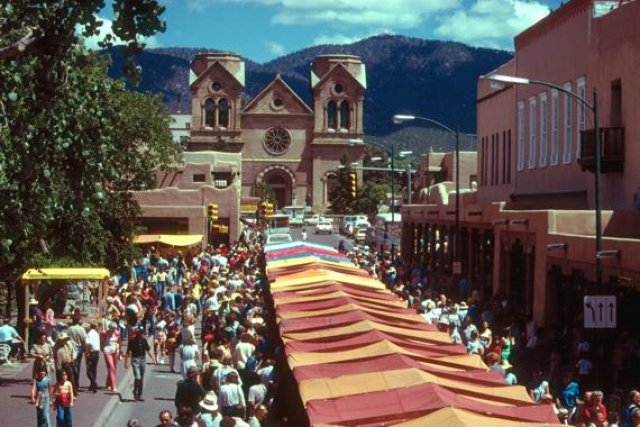
- Santa Fe Indian Market is the oldest, largest of its kind in the world, with Native American vendors from all over North America. Hundreds of kiosks, main wares being jewelry, art, pottery, apparel. Market itself over weekend, but activities through previous week including artist receptions at galleries, thematic films through Smithsonian, panel discussions, galas, award ceremonies.
- International Folk Art Market is the largest in the world
- Traditional Spanish Market – oldest and largest juried art show of its kind in the U.S.
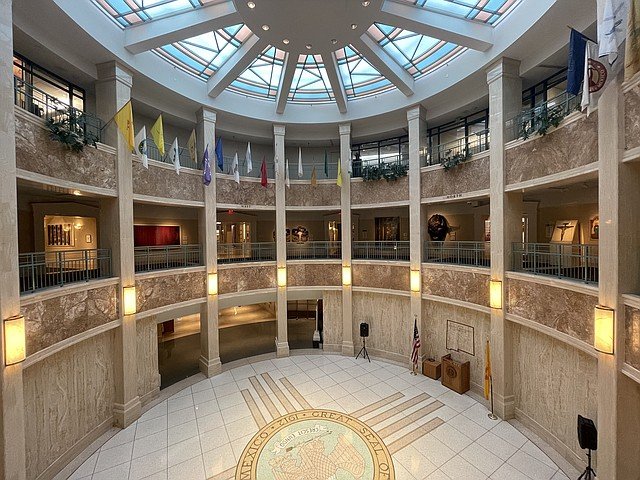
- State capitol building and grounds house over 600 beautiful, curated art pieces by NM artists and is model for other states’ collections and display.
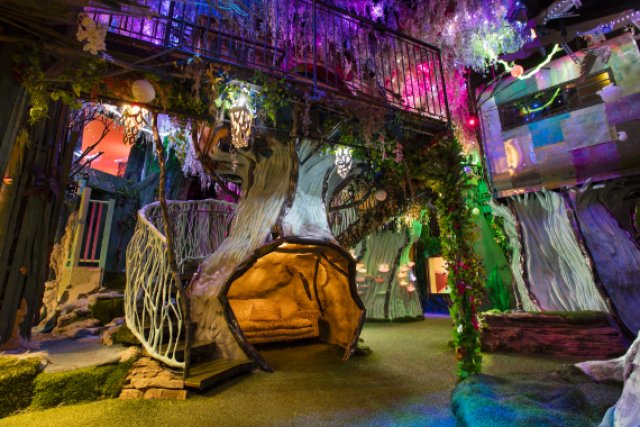
- Meow Wolf House of Eternal Return – This unique immersive visual experience was founded in Santa Fe. Other variations now operate in four major markets, with Los Angeles about to open. Over 250 artists were involved in realizing the concept, which has 70 immersive stations, ranging from a Chinatown street to a darkened room of trees comprised of colored neon tubes. You may find yourself walking through a refrigerator or crawling through a fireplace to get to the next installation.
RETAIL
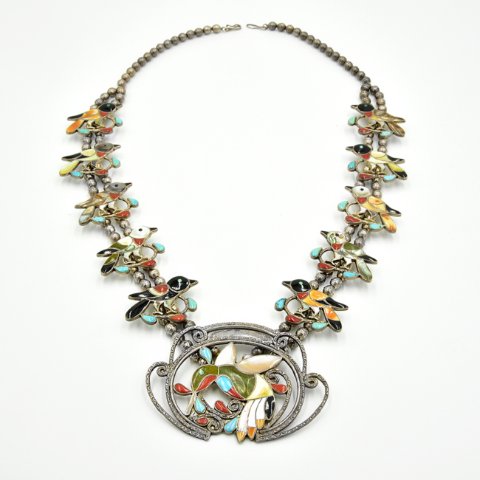
- Jewelry – Especially silver, turquoise, and coral. Traditional and modern western and Native American motifs plus broad contemporary styles. My wife has three statement pendants and a silver Mayan cuff all from Santa Fe or Albuquerque.
- Garments – Stylish Western, Native American, and broad contemporary garments, boots, hats.
- Furniture – Contemporary design and antiques, the latter driven by the estate consignment market.
MUSEUMS
- 20 distinguished museums, several of which are on Museum Hill.
- International Folk Art Museum has largest folk art collection in the world.
- Las Golondrinas – a poor man’s Williamsburg, with 34 historic structures, 500 acres including rare desert wetlands, Spanish/Mexican colonial activities
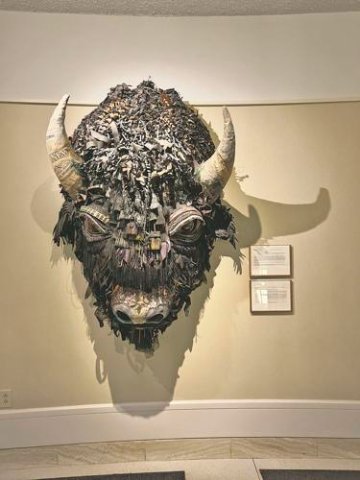
- Several museums related to NM culture, history, Native American and Western contemporary and historic art
- Single-artist museum – Georgia O’Keeffe Museum (expanding to 55,000 sqft museum plus campus). She started movement of artists settling in NM.
SANTA FE OPERA
Like so much else in Santa Fe, it amazes that opera company exists in the world-class form it does.
- Its annual budget ranks in the top 10 in the country, despite having such a tiny home market; being so isolated; and being limited to five productions and eight weeks of summer performances per year.
- Its opera house is among the most innovative in the world (see Architecture).
- Its summer apprenticeship program, which includes behind the scenes creatives as well as singers, is the best of its kind in the country.
- While its ticket prices for good seats at full operas are expensive, its Apprentice Scenes, typically 8 semi-staged extracts from different operas is a tremendous value at $20 per seat.
- The Sangre de Cristo Mountains setting, desert chic ambiance, including tailgating in the parking lot, make for a very special experience.
ARCHITECTURE
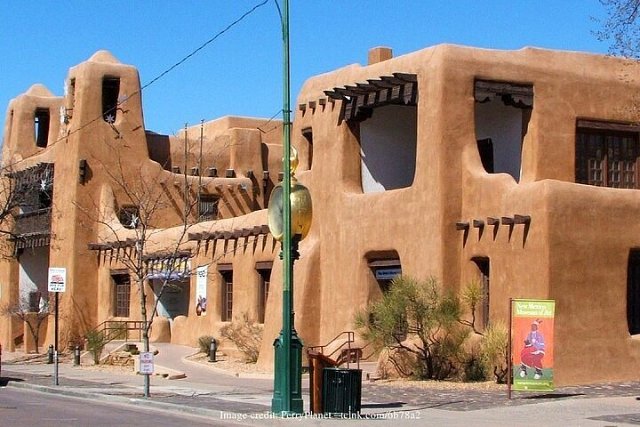
- Most uniform and harmonious that can be found in the U.S. – Virtually all structures are adobe, finished only in earthen colors – virtually all limited to 2-3 stories – Two main styles in housing – Santa Fe, with flat roofs and often with a row of horizontal vigas (full timber beams) protruding from near the top of the structure, which are exposed as ceiling beams inside, plus kiva fireplaces, portals, walled courtyards – Territorial style, with pitched, metal roofs, facilitated by shipping available from railroads arrival
- Plaza – Downtown center, considered one of the best public plazas in the country – vendors on blankets in portal of Palace of Governors; shops, galleries, cafes; music in bandstand; center of all downtown annual festivals and markets
- Palace of Governors is the longest continuously occupied public building in the U.S.
- San Miguel Chapel is the oldest church in the U.S. (est. 1610, rebuilt twice).
- Oldest neighborhood in the U.S. is Barrio de Analco.
- Oldest house in the U.S. is 215 E. De Vargas St. (around 1620, not rebuilt).
- Capitol building - Footprint in shape of Zia, the state emblem that appears on the flag
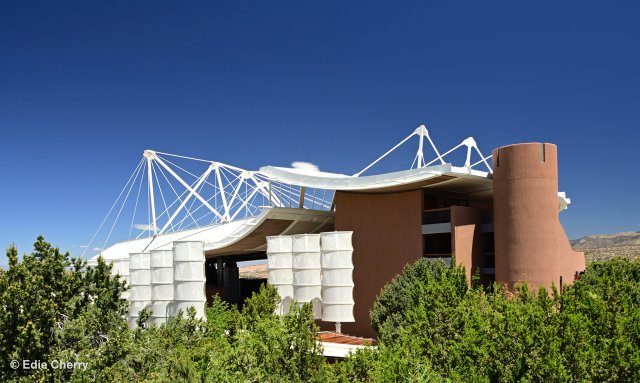
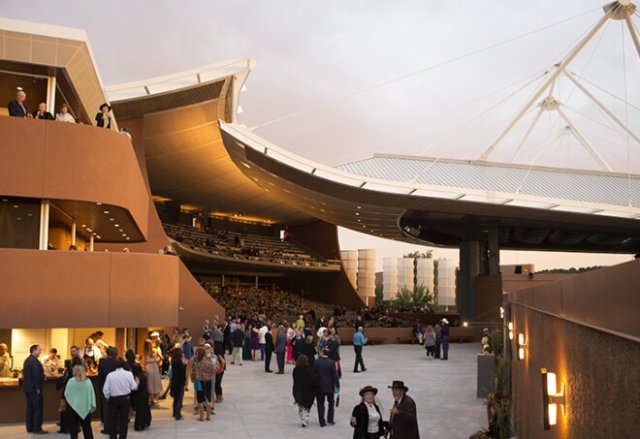
- Santa Fe Opera House – 2,000 seats, similar in size to most great European opera houses with unique design, open to nature on the sides, open backwall to stage, huge acoustic arc as ceiling, wind baffles on windward side, outdoor terraces for intermissions – It can be toured without attending opera.
- Loretto Chapel – Spiral staircase whose lack of support seems to defy physics.
FOOD – CUISINE
- Home of New Mex / Mex cuisine – Distinctions include ingredients like piñon (pine) nuts, blue corn, Hatch chiles, local wild game, cabrito (kid goat), nopales (cactus leaves), cactus pears, abundance of the 3 Sisters (corn, beans, and squash, which are all indigenous only to the Americas) and preparations like sopapillas (puffed triangles of fried dough, often served with honey), layered rather than rolled enchiladas, pozole, green chili cheeseburgers, green chile stew, chile con carne, piñon blue corn pancakes, Frito pie, torta de huevo, huevos rancheros NM-style, gorditas, chiles rellenos northern style, stuffed sopapillas, calabacitas, squash blossoms, panochas, biscochitos.
- Birthplace of contemporary Southwestern cuisine – Mark Miller of Coyote Café is godfather of this fusion of American, Mexican, Native American, and cowboy cuisines.
- Official state question – “Red or Green?” Other acceptable answer being Christmas, meaning you’ll have both red and green chile sauce.
FOOD – RESTAURANTS
Befitting a major tourism destination, Santa Fe is blessed with an abundance of restaurant options with a raft of James Beard Award designees. This list is just a beginning and represents only restaurants that I’ve eaten at.
- Fine Dining – Sazon, Martín’s, Geronimo, The Compound, Zacatlan, Pink Adobe
- Mexican – Escondido (innovative regional fusion), The Shed, Tomasita, La Choza
- Casual Brunch – Clofoutis, Dolina’s, The Pantry, New York Deli, Jambo Bobcat Bite
- Other Notable Ethnic – Alkemé (fine Asian fusion), Jambo (African, Caribbean), El Farol (Spanish tapas – also Santa Fe’s oldest restaurant and center of local flamenco culture).
OUTDOOR ACTIVITIES AND INDULGENCES
- Sports - Hiking offers the greatest general interest and variety, but there is also snow skiing just out of town, rafting on the Rio Grande, horseback riding, and more. For those who yearn for beaches and a large variety of golfing, Santa Fe is not the right choice.
- Spas – The city rates in this category as well. Several in-town hotels have significant spas, while outside of town, full-service destination spa resorts Ten Thousand Waves, Ojo, and Ojo Caliente have beautiful, extensive grounds including multiple outdoor pools.
- Festivals - Besides arts festivals already mentioned, Chamber Music (50 years old, destination festival having internationally known musicians), International Literary, Beer and Food, Wine and Chile, Wine, and Renaissance Faire festivals and more.
DAY TRIPS
A wide variety of options are available which enhance the Santa Fe experience. Apologies for formatting issues below. It must be a poltergeist.
- TAOS - 1 ¼ hrs drive
- Taos Pueblo – UNESCO site - living community, continuously inhabited over 1,000 years with rich cultural history
- Earthship – Important off-grid community not subject to normal building codes, with homes made of recycled materials like car tires, soda bottles using solar power, recycled gray water
- All things Kit Carson
- Arts community like a mini Santa Fe
- Scenic drive along the beginnings of the Rio Grande with wineries en route
- ALBUQUERQUE – 1 hr drive
- Old Town
- Sandia tram – longest gondola ride in U.S.
- Hot air balloon rides and festival
- Museums
- Wine tasting – esp. Gruet sparkling (best value in category), others mostly in Old Town
- Movie and TV production tours
- TURQUOISE TRAIL – ½ hr drive
- Old western towns Madrid, Cerrillos
- Jewelry, arts retailers
- CHIMAYO – ½ hr drive
- Sanctuario de Chimayo – Renowned pilgrimage site. Small, charming, primitive church with best and worst of religious sites – Nice touch with wall of pictures of locals who served in military – Dirt floor with well for taking dirt said to have healing powers – Wall of canes said to be left by those whose lameness was claimed to be healed at Chimayo.
- Rancho de Chimayo Restaurant – most historic and respected Mexican restaurant in northern NM
- LOS ALAMOS 3/4 hr drive
- Bradbury Science Museum – History of Atom Bomb, created in Los Alamos
- History Museum – Housed in structures used during the Manhattan Project
- ABAQUIU 1 ¼ hr drive
-
- Georgia O’Keeffe Home and Studio
- Ghost Ranch
-