

Eureka Day
Marin/Aurora's Masterful Revival of Tony Award Winner Commissioned by Aurora
By: Victor Cordell - Sep 05, 2025


I can’t remember the last time at a play that I laughed so hard that I cried. And amid a drama-driven narrative replete with messages that resonate with timeliness and relevance. The central issue concerns the politics of vaccinations. As this country suffers from a benighted, anti-science administration with a Secretary of Health and Human Services who fires esteemed scientists wholesale and replaces them with political hacks, the considerations could not be more chilling. But first, the setup…..
Jonathan Spector’s brilliant Eureka Day was commissioned and premiered at Berkeley’s Aurora Theatre in 2018. Since then, it has gone to New York not once, but twice, and its recent Broadway run resulted in the 2024 Tony Award for Best Revival of a Play. The present iteration is produced by Marin Theatre in cooperation with Aurora, with the latter’s Artistic Director Josh Costello directing, as he did the original. This version is spectacular, with the vibrant script supported by exemplary acting and direction.
Eureka Day is a fictional private school in Berkeley that deals with socio-political issues common to the Bay Area. The matter of the moment is a mumps outbreak and how to deal with it. But more than dealing with the public health challenge is how to construct messages. Does the school board say that it is following the guidance of public health officials or take responsibility itself? Then there is the issue of dealing with those who don’t agree with the solution in a society that is becoming more bifurcated, driven by political persuasion. Already, a group of parents has said that if all students at the school aren’t immunized that they are pulling their kids out, which could cause the school to close. Conversely, a group of anti-vaxxers could take the opposite position, rejecting any mandate, and bringing down the school.
Against this backdrop, an omnium gatherum of Berzerkeley types seek a solution. The board chair is Don, who is played hyper and over-the-top by Howard Swain. Don is a smiling bull, charging through problems, hushing people’s objections, and playing to the goodwill of others in hopes of getting them to band together.
The nemesis to agreement is the emotional Suzanne, who smiles and engages when she thinks things are going her way, but who can be prickly when threatened. Her fixed North Star is that corporate cabals drive bad decisions in health care. An anti-vaxxer, she represents a class of people who are among the least susceptible to accepting fact. She lost a child shortly after a vaccination, and though doctors attributed the death to other factors, Suzanne cannot be dissuaded from her conclusion. Her position reflects the real-life examples of those who conclude causality based on correlation. Studies have debunked theories that vaccines cause autism and that breast implants cause cancer, but particularly those people with correlated personal experiences are often unwilling to give in to evidence that doesn’t conform with their biases.
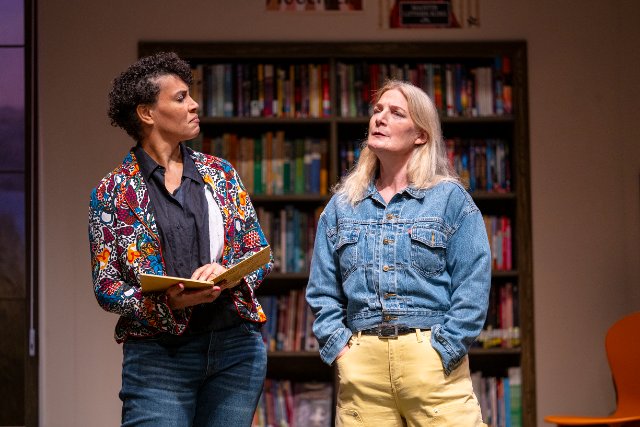
Leontyne Mbele-Mbong is Carina, a new board-member and a black woman whose reserve and quiet reflection belie firm convictions that surprise and bring her into conflict with Suzanne, who also makes some wrong and prejudiced assumptions about Carina.
A critical issue in the management ethos of the school is the by-laws mandate that the board rule by consensus, so that when Carina calls for a vote, she is gently rebuked and told that the board doesn’t vote but must rule by consensus. However, while the accepted definition of consensus is general agreement, it is interpreted by the board as unanimity. Thus, one contrary member is able to veto the wishes of the other four members.
The two remaining board members are having an affair. Eli (Teddy Spencer) is the rare type that you find almost only in the Bay Area. Employee Number 10 at Facebook, he is one of those grotesquely rich youths whose wealth is attributed to the random luck of having been hired by a company that thrived and remunerated early employees largely in shares of stock. While he seems carefree and non-aligned, he will have a personal experience that will crystalize his position. Meiko (Charisse Loriaux) is often quiet and moody and also unpredictable.
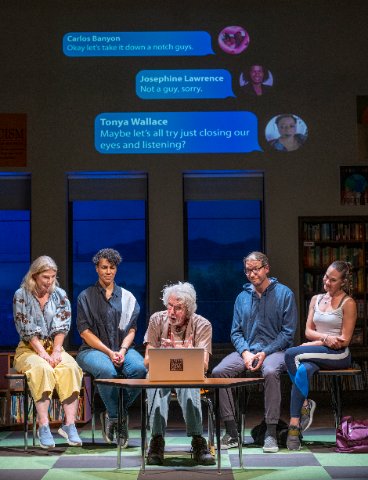
The hilarity in the scenario comes when the board creates a “community activated conversation” to discuss the mumps options. The board meets in person but parents join in virtually, and the chat bubbles of the virtual attendees scroll on projections. They come so fast and are so screamingly funny that it is challenging to also pay attention to what the live performers are saying. It is an unimaginably well-designed and executed sequence with one big laugh after another for several minutes.
The parents are in a totally different universe than the board, and all the archetypes are there. People get insulting (“THESE ARE THE FACTS …..” or “You’re a real c***” or “I said the IDEA was idiotic, not her”). Some make corrections (“I think you mean f***, not duck”). Others get totally off task (about a former school family - “I think they moved to Vancouver” “No, I’m sure they moved to Montreal” “I visited them and I assure you it’s Vancouver”). Even the lame brain who does nothing but flash the thumbs up icon after every several comments prompts considerable laughter.
One element that makes the play work is that diverse opinions are given voice. However, the political correctness of granting equal play to all points of view comes with a downside. When positions based on faith or fantasy rather than facts are aired, they are likely to be adopted by others who are easily persuadable. This gives rise to even more unreasoned thinking which cannot make us a stronger nation.
Eureka Day, written by Jonathan Spector, is produced by Marin Theatre in partnership with Aurora Theatre Company, and plays on Marin Theatre’s stage at 397 Miller Ave., Mill Valley, CA through September 21, 2025.