

Indecent
Center Rep's Compelling Paean to Paula Vogel's Allegory on Humanity and Acceptance
By: Victor Cordell - Sep 15, 2025
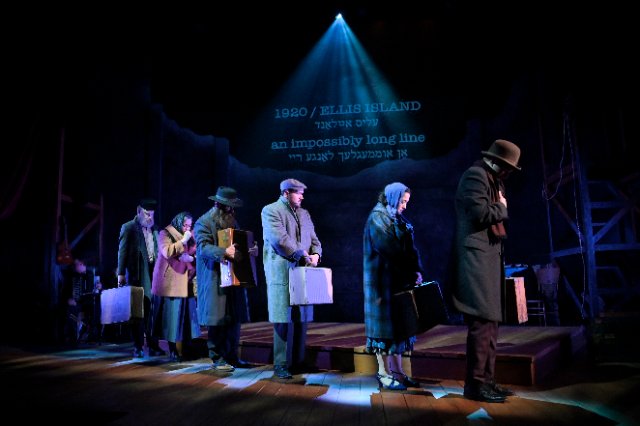

A common concern among minority-group populations that receives nary a thought from the majority population is how its people are presented in entertainment and media. Whether Black, Latino, Jewish, or other, there is particular concern when it is someone of their own ethnic group who is depicting them in a bad light.
In 1906, Polish Jew Sholem Asch wrote the Yiddish-language play God of Vengeance. A table reading was hosted by Poland’s most distinguished living Yiddish intellectual, Isaac Peretz, who at the end of the reading was so offended by the portrayal of fellow Jews that he said “Burn it Asch, burn it.”
In 2015, Paula Vogel wrote the metatheatrical play Indecent, which tells the dramatic history of the evolution of God of Vengeance and its impact on society and on its playwright. Written with pathos and reverence for its characters and her culture, Vogel insightfully integrates scenes from Asch’s play into her own, cleverly and seamlessly as a piecemeal play-within-a-play.
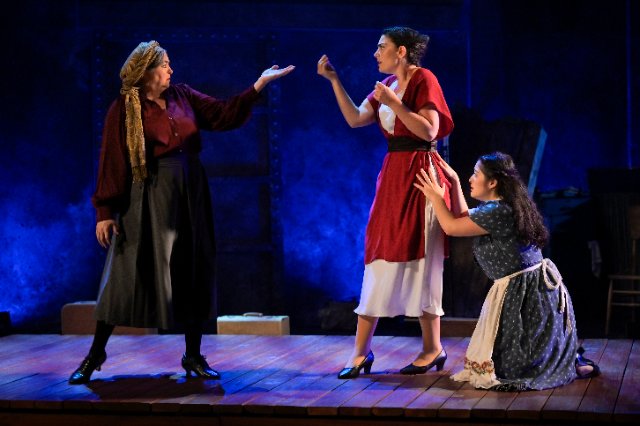
What made God of Vengeance so controversial in the Jewish community? It was innovative and daring beyond its time but in the opinions of many, its portrayals were blasphemous and disparaging. Not only is the male lead a Jewish brothel owner who tries to buy respectability by his financial contributions to the synagogue, but in the end, he desecrates a Torah and consigns his own daughter to his brothel because of having a lesbian affair with one of his prostitutes.
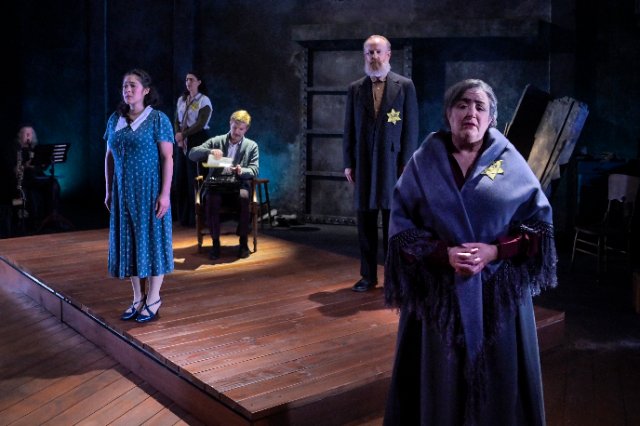
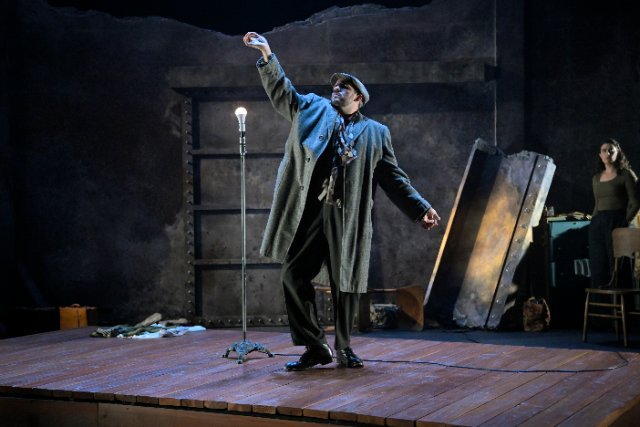
Starting with the Pulitzer Prize and Tony Award winning play, the incredibly potent and distinguished production of Indecent at Center Rep excels on every dimension and should not be missed. Elizabeth Carter directs with consummate skill, marshaling all of her creative resources. The feel of authenticity is palpable, highlighted by the breadth of costume design (Brooke Kesler); the often targeted and sepia-tinged lighting (Spense Matubang); and haunting klezmer music (Timothy Fletcher). Useful projections (Lyle Barrere) complement the dialog to identify the frequent time, location, and language shifts.
A fine ensemble of actors, all but one in multiple roles, perform admirably. Of particular acting note is that of Adam KuveNeimann, primarily as the younger Sholem Asch, gentle, yet assertive in his self-belief and in his play that he feels tells a side of his community’s life that needs to be told. When Asch assembles his entourage, the inexperienced Lemml would become his traveling stage manager. Played with great touch by Vincent Randazzo, Lemml would begin in a humble and halting fashion, later becoming demonstrative and challenging his mentor. Michelle Drexler’s elan shows as various sharp-edged characters and as the loving prostitute Manke who loves Rivke, the daughter of the brothel owner.
Despite condemnations and discouragement from his close circle, Asch took God of Vengeance on the road. It was well received in Yiddish and in translation in the cultural capitals of Europe.
Though Asch would live mostly in the U.S. as a safe haven free of pogroms from 1914 onward, his adopted home would become a major source of his discontent. Only when the controversial play premiered in the sanctimonious United States in 1923 did participants in the production suffer legal repercussions for travesties like showing the first same-sex kiss on the American stage. Unlike in Europe, he had to make eviscerating changes to the play to placate criticism, and eventually he became so disconsolate that he would remove the play from the market so that it couldn’t be performed. Later, he would re-emigrate to England to avoid prosecution from the House Un-American Activities Committee.
Vogel incorporates Asch’s work into her own in such a smooth manner that it becomes difficult to disentangle them. It feels that Asch’s drama and convictions are Vogel’s own and that the two plays are really one riveting story.
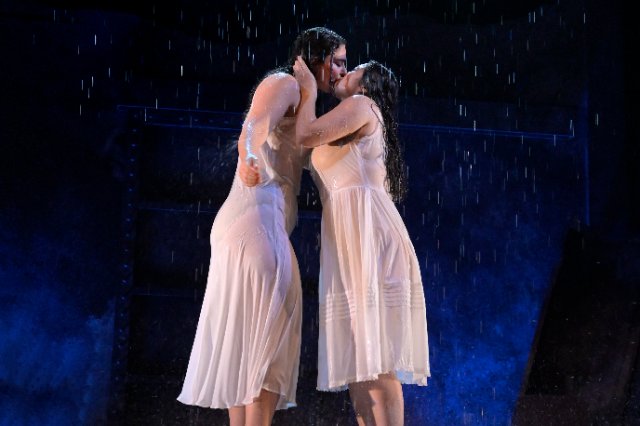
As introduced earlier, a number of messages resound, starting with the humanity of the lesbian relationship of the two women. Perhaps the signature scene from God of Vengeance is the rain scene in which the two young women share a loving embrace that is regarded as a Romeo and Juliet scene for lesbians, which is beautifully presented in this production, even with “rain” falling on the two women. But beyond the particulars of the women, this sequence is a plea for acceptance that equally applies to Christians accepting Jews in their midst, and, dare we say, political conservatives accepting liberals in their midst.
Another notion is the hypocrisy of false piety which persists across religions and national boundaries. It particularly plagues this country now, as purported Christians from the religious right act in ways antithetical to Christ’s preaching and make deals with the Devil to enhance their power, not their righteousness. In doing so, they are undermining the very democracy that enabled their religious freedom. Do they not realize that the revolution often devours its own children?
Paula Vogel’s poignant Indecent reminds us not that “it” could happen here but that it is happening here.
Indecent, written by Paula Vogel, is produced by Center Repertory Theatre and Yiddish Theatre Ensemble, and plays at Lesher Center for the Arts, 1601 Civic Drive, Walnut Creek, CA through September 28, 2025.