

The Weekend: A Stockbridge Story by Ben Diskant
World Premiere at Barrington Stage
By: Charles Giuliano - Sep 22, 2025

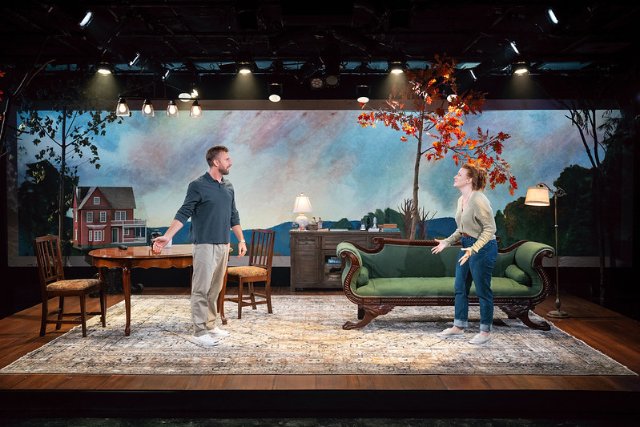




The Weekend: A Stockbridge Story
By Ben Diskant
Directed by Alan Paul
St. Germain Stage
36 Linden Street, Pittsfield, Mass.
September 16 through October 12
Cast: Bill Army, Sasha Diamond, Molly Jobe and Ben Rosenfield
Scenic design by Wilson Chin, Costume design by Ricky Reynoso, Lighting design by Amina Alexander, Sound design and original composition by Fabian Obispo.
There is nothing more sublime than autumn in the Berkshires. Tanglewood is shuttered so the tourists and summer folk have left us in peace. Some return as weekenders for fall foliage and temperate weather. For most of us it’s the best time of year from now until Christmas.
It’s shoulder season for the arts. With deft serendipity Alan Paul, artistic director of Barrington Stage has maxed on that bucolic euphoria by going local with The Weekend: A Stockbridge Story by Ben Diskant. It is being given a world premiere directed by Paul.
There are predictable snickers and gasps as the audience responds to many Berkshire signifiers from apple pie allegedly baked (a point of contention) at Taft’s Farm, to the dangerous intersection in Stockbridge viewed from the porch of Red Lion Inn, to glimpses of James Taylor in a canoe on the Stockbridge Bowl. A battered old copy of “Sweet Baby James” is a prominent prop. It contains a trove of long lost love letters.
Ben Diskant has created a somewhat muddled play about writing a play. Its “author” is Allan (Ben Rosenfield) a failed writer. His faltering career and romantic pratfalls are sheltered by protective but domineering older brother Tom (Bill Army). His wife Beth (Molly Jobe) is struggling to save a marriage in which she feels overwhelmed by his gangbusters career as an attorney, cases, and commitment to Allan. Jordan (Sasha Diamond), a Stockbridge native, is the estranged love of Allan’s life.
The characters double as narrators revealing their actions and motivations to the audience. There are also time frames and flash backs. The action of creating the play is set in the present than reverts to events between 1996 then further back by a decade. These time changes are indicated by dates projected onto the set. There is a bit of three card monte for the audience to grasp the quick deal shuffle. One doesn’t always fully grasp who’s on first.
To follow the narrative it’s essential to grasp the characters. Alan is weak, dependent and dominated by Tom who is overplayed as way too Alpha and strident. Beth is a pliant floater fluttering in the prop wash of her husband’s jet-stream. We sense some parity when they first met but that was slowly crushed. Here we might cue up “A Weekend in the Country” from Sondheim’s “A Little Night Music.”
Getting out of the city is what Beth hopes will provide an opportunity to win back her husband without all the urban distractions. That plan disintegrates when Tom insists on including his younger brother. It’s his birthday and they will celebrate with Taft’s apple pie in the country.
Leaving town is a New Yorker trope that Diskant explores. Tom would like to own a car, perhaps a Porsche, which he can easily afford. But the cost of a garage in Manhattan is utterly obscene. They will head uptown and borrow a short from her parents. The point is made that she has extended family while Tom has only Allan.
Their parents died when they were young and for a time they lived in Naples, Florida with their grandparents. Tom was brilliant and thriving with full scholarship to Harvard, then Columbia Law, and all the right clerking gigs. Still young he has made partner.
The fragile, sensitive Allan was potentially a gifted writer. A graduate of U Mass. Amherst he got a gig at a publishing house but burned out reading manuscripts of better authors. Tom rescued him with a clerk position at his law firm.
Beth has seized on a rare window of opportunity. A case scheduled for months was quickly settled. They head for her parents’ recently renovated cottage on Mahkeenac Lake (pronounced: Mah-Kee-Nac). Jordan, Allan’s old girfriend, lives next door in the last of the original cottages. There’s a riff about real estate, ecology, and how the rich exploit the poor. Though the privileged provide jobs for workers who no longer can afford to live in the vicinity. Perpetrators comprise most of the theatre’s audience.
Jordan had returned home to care for her ailing father. They had endured the cacophony of renovation while she has become engaged to Mark, the contractor who has a couple of kids. She wants to sell the house and move on. Seeing Allan, however, stirs the embers and further disrupts the serenity of a weekend in the country.
Her parents were forced to marry at 18 in what she is convinced was a loveless relationship. Her Mom OD’d a few years back. Jordan refused to make the same mistake. She proposes a five year hiatus while they find themselves. He will write a great novel and she will explore the American West with her camera. Neither plan goes well.
”We need to grow up!! Both of us,” She says. “You’ve never been with anyone else. Go collect your stories, make mistakes. And if you’ve met someone else, good. No, not good, but… good, then that’s what’s supposed to happen. I want us to look at each other certain this is right.
“Let’s meet… five years from today. May 22, 1991. I’ll be in New York City…11:00 AM. Sharp. The fountain at Lincoln Center.”
That didn’t happen but couldah, shouldah, sort of. Allan was there but not really. We leave you to find out.
The scenic design by Wilson Chin was simple and effective. The stage was bookended by birch trees and sprigs of bright foliage. There was a panoramic banner of the mountainous lakefront. An ersatz remodelled cottage was a prop on a stand behind the author at his laptop. Chairs doubled as a car. As usual much was made with little space.
The costume designs by Ricky Reynoso were a disaster. Beth was drab in jeans and non-descript tops. But Jordan could not have been more nerdy and unattractive. She was dressed as a country girl in tight black, thigh-length pants and hiking boots. Reflecting changing periods she wore an assortment of unflattering tops. In terms of romance there was no frosting on her cake.
______________________________________________________________________
The Sunday matinee opening represented a rite of passage for Barrington Stage Company. For the last time the press was greeted by the long term, ebullient, witty and charming flack, Charlie Siedenburg. He has long been regarded by scribes who dealt with him as the best of his ilk. I asked why in his prime (61) he is leaving us. With impish sotto voce he told me that he had been offered a position and opportunity closer to home. Recently he produced “Fiddler on the Roof” at the College of Staten Island’s Williamson Theatre. The production that exemplified both “tradition” and “family,” was selected to launch the revival of College of Staten Island’s Summer Theatre. That has evolved into a full time position. He describes it as closer to home and not a 300 miles drive to Pittsfield.