

The Answer in a Steaming Bowl
Finding China in Its Food
By: Cheng Tong - Sep 29, 2025
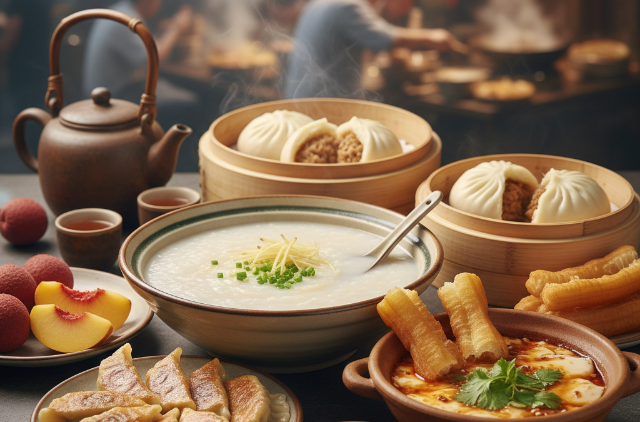
Of all the questions I have received since returning from my recent trip to China, one has been asked more than any other: “What did you eat?” It is a simple question, but the answer is anything but. To simply list the dishes would be to miss the point entirely. The food I ate was not just a series of meals; it was a direct experience of culture, community, and a philosophy of nourishment that is profoundly different from our own. It was a lesson I was eager to capture, taking pictures of my meals not just as a tourist, but as a grandfather wanting to show my grandchildren what “real” Chinese food truly is, far removed from the Americanized versions they know.
The lessons began each morning on the street, amidst the symphony of the city waking up. The air, thick with billowing steam and the chatter of neighbors, was an invitation. My day often started with a jianbing, a masterful creation of street food artistry. I’d watch, mesmerized, as a vendor poured a thin layer of millet batter onto a sizzling circular griddle, cracked an egg over it, and painted it with a complex, spicy, and savory sauce. With a flourish of scallions, lettuce, and a folded piece of impossibly crispy cracker tucked inside, it was transformed into a perfect, burrito-like parcel of contrasting textures. This wasn’t just breakfast; it was a transfer of warm, vibrant energy—qi —to start the day, all for about ten yuan, the equivalent of a dollar and a half.
Some mornings called for something softer, like a bowl of silken doufu pudding, served not as a sweet dessert but swimming in a savory, cilantro-laced soup. Into this, I would break apart a youtiao, a deep-fried dough stick that, despite its cooking method, is impossibly light and airy. The same youtiao could find its way into a comforting bowl of congee, or rice porridge, simmering with slivers of warming ginger. The act of pushing the crisp pieces of dough into the yielding softness of the porridge was a lesson in texture itself. Other days, breakfast was a fluffy steamed bun called a baozi, a puffy light cloud that could be held in one hand, filled with either savory pork or sweet red bean paste. Sometimes steamed, sometimes pan-fried on the bottom for a delightful textural surprise, they were a perfect, portable meal.
This principle of harmony is woven into the very fabric of Chinese dining. Meals are deeply communal and family-oriented affairs, often lasting for hours. The guiding principle is man man chi , “eat slowly,” a gentle reminder to savor both the food and the company. A table would be filled with shared plates: glistening stir-fried vegetables with a hint of chili, delicate salads of doufu skins with crisp cucumber and cilantro, and bowls of noodles or steamed rice. This balance is a core tenet of Taoist thought and Traditional Chinese Medicine, visible on every plate. It’s the crisp coolness of cucumber against the yielding texture of the doufu skins; the savory depth of soy balanced by the sharp tang of black vinegar in a noodle sauce; the interplay of colors, flavors, and temperatures that seek to create a whole, harmonious experience rather than a single, dominant taste. A bowl of noodles (mian) was never just noodles; it was a canvas upon which to create my own balance with sesame paste, pickled vegetables, and, in my case, a generous spoonful of chili oil for a fiery kick.
My diet is primarily vegetarian, a practice I find aligns with my spiritual path. Travel, however, sometimes presents us with delicious transgressions. I must confess that on this trip, I succumbed to the allure of duck and braised pork belly. The experience was a reminder that sometimes, to fully embrace a culture, one must partake in its most beloved traditions. And while I don’t believe I am destined for hell for this particular lapse, I will say that the rich, fragrant, and unimaginably tender meat was almost worth the risk.
From such rich indulgence, one might pivot to the simplest of pleasures. China introduced me to the profound joy of the perfect egg tart. With its flaky, buttery crust and a center of shimmering, just-set custard that was sweet but never cloying, it became a favorite treat. A late afternoon meal might be light, a recognition that the body does not always need a feast. Some fresh fruit—a juicy peach or pear—and a single, perfect egg tart was often enough, a small moment of sweet contemplation accompanied by a cup of tea, which was a constant, welcome companion to every meal and every moment in between.
My journey culminated in a final, memorable meal before I boarded my plane in Beijing. In the bustling airport, I sat down to a single plate piled high with about twenty-five egg and chive dumplings. They were humble, common, yet perfectly executed. With a small dish of chili dipping sauce, I ate each one slowly, mindfully. It was more than a meal to prepare for a long flight; it was a final, authentic taste of the country I was leaving, a last communion. I was so completely nourished, so utterly satisfied, that the two meals served on the fourteen-hour flight to Los Angeles went entirely untouched.
So, when my students ask what I ate, the answer is this: I ate warmth and energy on a bustling street corner. I ate harmony and balance from shared plates. I ate history in a piece of braised pork belly and mindfulness in a simple egg tart. And in my last meal, I ate a final, perfect memory. I ate China, and I returned full.