

La Traviata
Avery Boettcher's Performance Highlights Livermore Valley's Outstanding Production
By: Victor Cordell - Sep 30, 2025
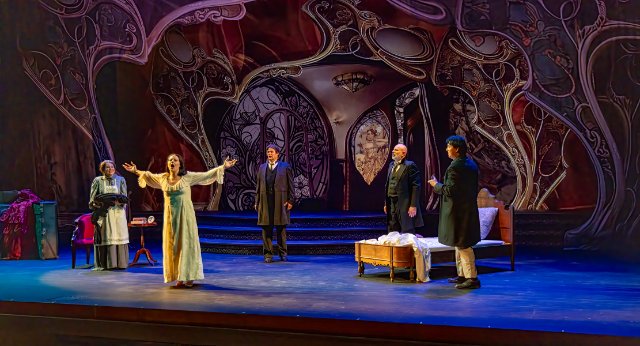
Opera aficionados speak of war horses, those dozen or so operas that receive an inordinate number of productions. Why are they so often presented? Because they are esteemed by old timers and accessible to dabblers as a result of compelling plot lines; dynamic characters; theatrical grandeur; and most importantly, a beautiful score with soaring arias, ensembles, and choruses. As a result, these select few draw audience and pay the rent. La Traviata, composed by Giuseppe Verdi and with libretto by Francesco Maria Piave, is the epitome of a war horse and wonderful to enjoy in all respects.
This being my ninth Traviata (yes, I keep records), and a traditional one at that, I was not particularly enthused about attending and having to review. In the haze of hundreds of operas and thousands of plays over the decades, I can’t say that I remember with great detail the versions that I saw at The Met, San Francisco Opera, Warsaw Opera (in Polish!), and elsewhere.
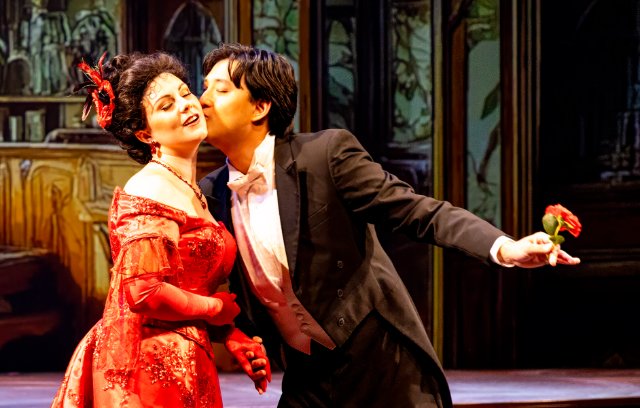
What I will say is that while some have been more opulent, I have no memory of having been any more enthralled than I am with this Livermore Valley Opera production. While it can stand tall on most dimensions, the difference maker is the performance of Avery Boettcher as Violetta. If there is more that can be offered in performing this role, I’d like to know what it is. Although she is still young, it appears to be time for her to appear on the biggest stages.
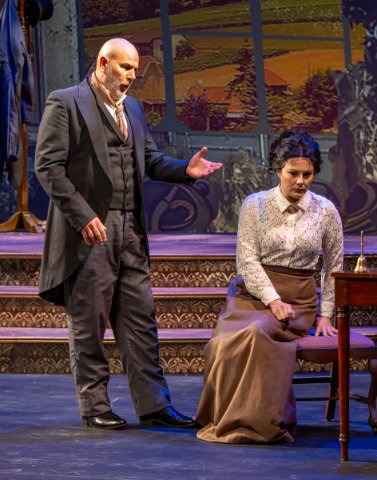
The central story is of Violetta, a courtesan loved by Alfredo who comes from a high social class. When they are poised to marry, his father, Giorgio intervenes because of the irreparable social damage that would befall the family. Violetta sacrifices her love and her hopes in deference to the father’s wishes.
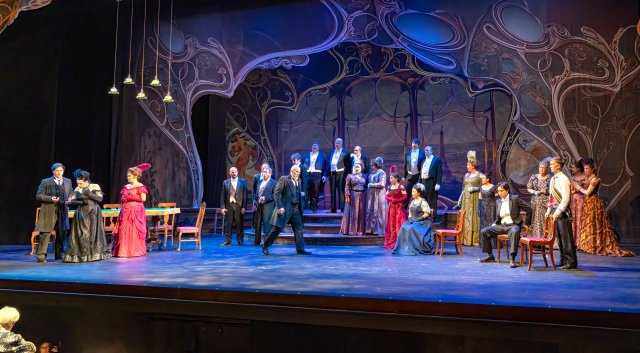
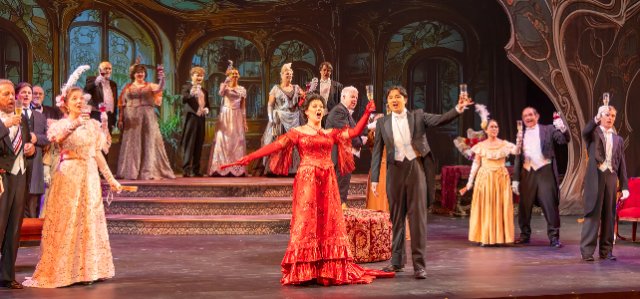
Few operas include two lavish party scenes, and Traviata even opens with one. Immediately, the audience is delighted by one of the signature pieces from the opera, the lively brindisi, or drinking song “Libiamo ne’ lieti calici” (“Let's drink from the joyful cups”) which starts as Alfredo’s tenor aria, later joined by the soprano, Violetta. It is followed by the enchanting love duet “Un di felice” (“One day, happy”). This is a remarkably demanding opening for both leads that requires them to be in full voice at the start and sets expectations for the opera. But despite the luxuriance of the parties, the remainder is very intimate
Brad Bickhardt as Alfredo displays a warm and wonderfully mellifluous voice that has all of the coloration required for this lyric role. He excels in intimate scenes when caressing the music, but what the tenor does not evidence is the volume to power through spirited arias and to meet the needs of larger opera houses.
Violetta’s role demands versatility of the highest order, having lyric, coloratura, and dramatic elements. Boettcher has it all. Her lyric voice is velvety and smooth, but she navigates demanding leaps, runs, and coloratura trills with precision and ease, notably in her brilliant “Sempre libira” (“Always free”). And when extreme emotion is demanded, her volume and upper range exhibit control and fill the house. The artist also masters the various moods of the role, as Violetta alternates among giddy, loving, vulnerable, gloomy, and despairing.
The third major character is Giorgio, a complex person whose priority is to defend his family, even if it damages Violetta. The audience may resent but understand his interference, and as he evolves, he becomes more sympathetic. Giorgio is performed by Krassen Karagiozov who brings a lustrous, authoritative, and booming baritone voice to the role. The warmth and depth of his voice is in evidence in early acts, particularly when he is trying to lure the alienated Alfredo back to the fold in his hallmark aria “Di Provenza al mar” (“Who erased the sea and the land of Provence from your heart”). Toward the conclusion of the opera, he must call on the higher end of his range which he does with great success. By this time, but too late, Giorgio realizes Violetta’s goodness and regrets that he has stood in the way of her union with Alfredo.
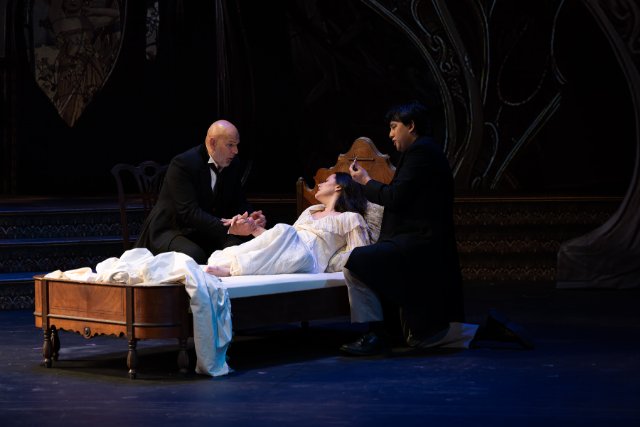
Violetta continues to have highlights throughout, and Boettcher meets every challenge vocally and with impassioned acting, leading to her finale “Gran Dio!...morir sì giovane” (“Great God!...to die so young”). Two examples of opera conventions that outsiders occasionally deride occur here – that she can possibly take so long to die and that she can vocally ring the rafters when she’s dying of consumption. We opera lovers endorse both. The music and the performance are both magnificent.
Apart from the trio of main characters, the secondary principals are a little uneven. Notwithstanding, the always reliable bass Kirk Eichelberger as Dottore Grenvil delivers his small singing part with great resonance. Both male and female voices show well in the chorus, and the strings-dominant orchestra delivers the score with a lush sound. Conductor Alexander Katsman controls the varied tempos and dynamics of Verdi’s rapturous score with precision and sensitivity.
La Traviata, with music by Giuseppe Verdi and libretto by Francesco Maria Piave, based on the novel La Dame aux Camélias by Alexander Dumas fils, is produced by Livermore Valley Opera and plays at Bankhead Theater, 2400 First Street, Livermore, CA through October 5, 2025.