

Park Avenue Armory Hosts 11,000 Strings
Composer G.F. Haas Imagines Space
By: Susan Hall - Oct 05, 2025
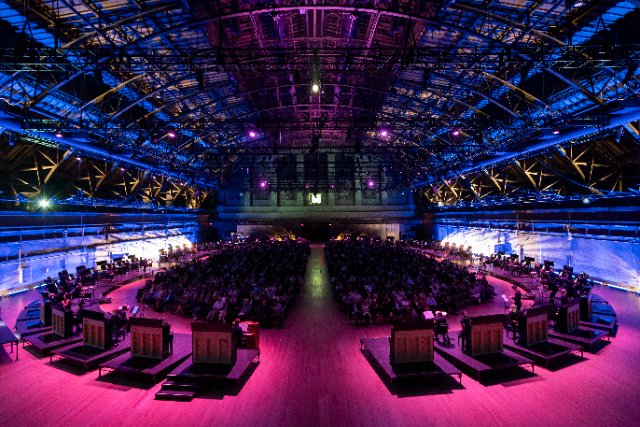
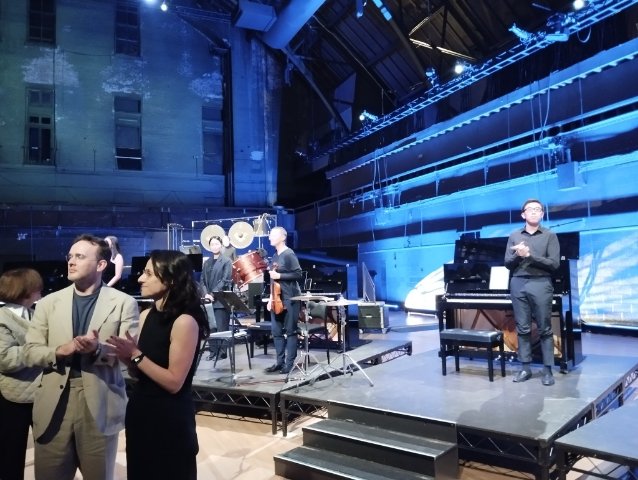
Fifty pianists march single file into the 55,000-square-foot Drill Hall of the Park Avenue Armory and take their seats at fifty Hailun upright pianos. The piano tops are open, suggesting that sounds may soon emerge. The instruments form an ellipse on a slightly raised platform. Among them are twenty-five players from the Klangforum Wien, who erupt in sound—joined by a harpsichord and by agitated, apprehensive tones from strings, vibes, brass, woodwinds, and other instruments played by members of the ensemble. Two percussion clusters hold the promise of Lou Harrison–style hand-made instruments. The echo and reverberate in their own way. A spotlight plays across the Armory walls.
Into this highly unusual concert space comes a fundamental and very conventional C-major chord. That is the sendoff. For a little over an hour, we are transported to other worlds. Our seating, with 1,353 neighbors inside the ellipse of pianos and instruments—some of us back to back—feels like the embrace of a pod, a vessel in which we can safely rocket into a wild adventure.
Sound is the star. The space between two sounds is the subject. It sends the listener into outer space.
The conductor is a timer on smartphones, kept beside the iPad score on each music stand. Steve Jobs never imagined the iPhone as a conductor, but here it synchronizes the instrumentalists perfectly.
Each piano is tuned a smidgeon higher than the one before it. This smidgeon cannot be detected by the human ear. Since there are one hundred of these smidgeons in an eight-note octave, if the first piano is tuned to C, the last is tuned to G—fifty smidgeons above the C.
These smidgeons are called “cents” by musicians, and the composer notes his satisfaction in creating a work framed by a perfect fifth—the distance between C and G.
G is also the second overtone of C, the first a C an octave above. The human ear hears overtones.
Mr. Haas does not like to be called a spectralist—a style of composition dependent on overtones. He prefers the term microtonality. Nonetheless, one of the first things he observes about this piece is the overtone. Haas notes that one of the most touching moments in audience discussion came when a listener said they had expected dissonance and found consonance instead. It may be that the fifth spanned by the two outermost pianos contributes to that sense of order and pleasure.
Math and music go hand in hand, but math does not deliver a lethal blow to 11,000 strings. It makes the music. It enhances and entrances. The sounds are so close to each other that the human ear cannot hear them bump up and scratch. Yet these sounds subtly contribute to texture.
The seventeenth-century logarithm that dictates the spacing between tones is evident everywhere. Textures are not only the province of the keyboard performers—including a thunderous rush up the keyboard toward the end of the piece, when the pianists donned gloves to protect their hands. The violinist and cellist in the group before me did double duty, stroking a cymbal with a bow, and the flutist stood to beat hand drums. The pianist was a wannabe recitalist from the Manhattan School of Music and loving every minute of the group performance.
Yet I kept thinking I was hearing one sound—not one note, but a unified sound that enraptured me. I wondered what mystery managed to hold the work together. I think it is the overtones of the serially different piano tunings, and their emission into such a vast space, that make the piece one. And the composer's special sensibility.
The Park Avenue Armory is the perfect producer. Hailun Pianos of Ningbo, China ships the fifty instruments around the world for their indispensable role in the production of this work.
Continuing at the Armory through October 7.