

Letter from Brooklyn
Ruckus Manhattan at the Brooklyn Museum
By: Patricia Hills - Oct 08, 2025
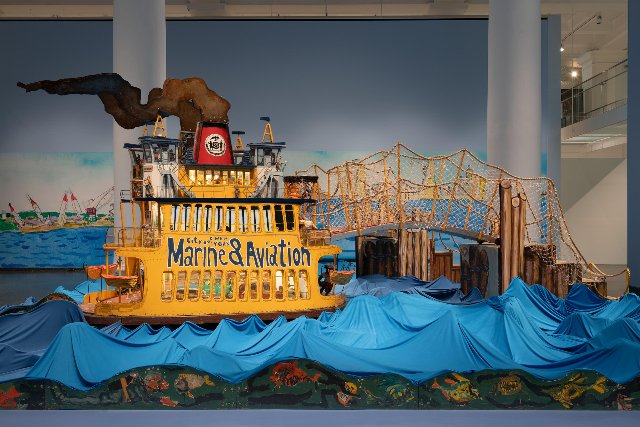

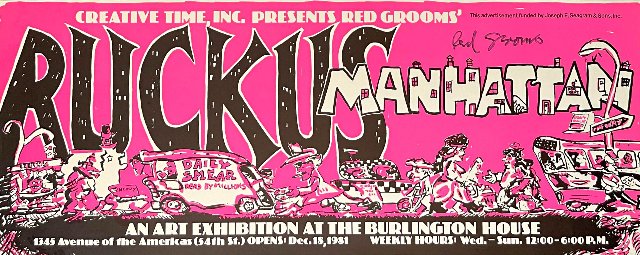
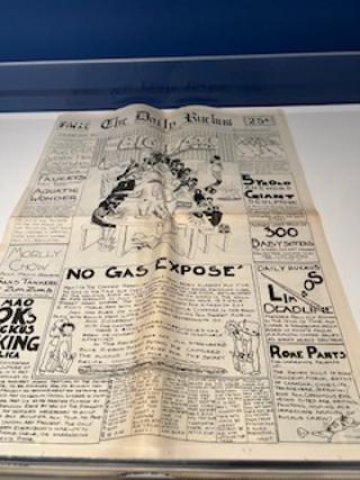
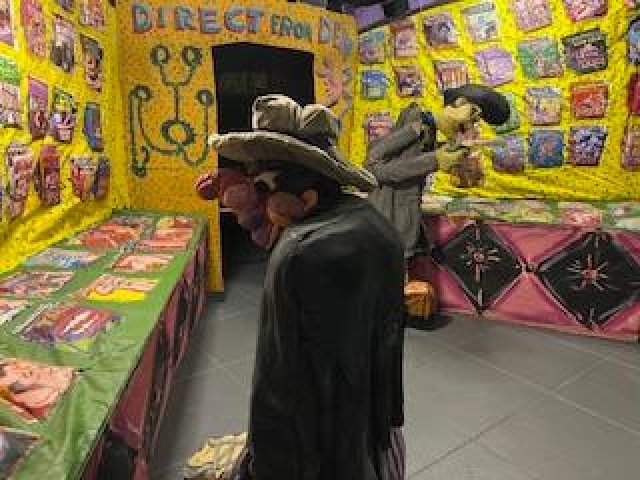
Reds, yellows, bright blues come blasting at visitors entering the first room of the Brooklyn Museum’s recent exhibition “Red Grooms, Mimi Gross, and The Ruckus Construction Co.” It’s a room that sings out. In a second much smaller area we experience the opposite in the cramped immersive space called 42nd Street Porno Bookstore (1976). Here we see on stands and tacked to the walls, posters and magazines with cover drawings of silly pornographic subjects. Life-sized leering stuffed manikins designed to replicate licentious old men hover over the books and rudely block our view of the magazines. It’s a hoot, even if claustrophobic.
I was there at the Brooklyn Museum to experience Ruckus Manhattan with a group of New York art historians and curators one late afternoon in September. The curator Kimberli Gant conducted us through the large spaces at the center of the Brooklyn Museum’s first floor. Mimi Gross joined us to answer questions and parry with Gant over the construction of the various pieces.
What we were seeing in Brooklyn are but the sections of Ruckus Manhattan that the Museum owns and has stored in its storage facilities for decades. The first room contains Dame of the Narrows (1975), a small replica of the Staten Island Ferry (which had to be restored), sitting among blue triangles of undulating fabric (freshly made to substitute for the deteriorating original cloth). The other Museum-owned installation is 42nd Street Porno Bookstore (1976). Yet a third darkened space features the hour-long 1976 film of the making of the 47-foot long diorama, The Subway, another piece of the series not owned by the Museum. It has a soundtrack. according to Gant, that combines “jazz, zydeco, funk-soul and poetry recited by Mimi and Red, along with ambient city noise.” The film is a montage of speeded up images that underscore the spontaneity of the making of the piece.
As big as the Brooklyn show is, these installations are but sections of the larger series project Ruckus Manhattan—a diorama of funky city buildings representing the swath of land from Bowling Green to 57th Street. And which covered 6,400 square feet when first shown in Manhattan’s Financial District in 1975. In the words of the recent Brooklyn Museum’s press release: “the vibrant installation [of Ruckus Manhattan] satirized the city with a dynamic mix of painting, sculpture, performance, and puppetry. From a high-heeled Statue of Liberty to a Financial District in flames, Ruckus Manhattan’s visual metaphors captured the chaos, corruption, sexuality, and creativity of 1970s NYC.”
As Julie Schneider points out in her art review for Hyperallergic (August 11, 2025), the art has a background. Yes, it does. Ruckus Manhattan was constructed at a time, 1975-78, when New York City was going to hell. The city was bankrupt, crime exploded, homeless people were sleeping in subway corridors, and there was a failure of leadership in City Hall. I was affected as well—being “furloughed” from my teaching position at one of the City University colleges. I escaped in 1978 with my family to Boston where I had been offered a teaching job.
The show reflects the spirit of the 1960s counterculture which had survived into the 1970s. Men still had long hair and wore sandals. Women sported sexy dresses. Communes were still the thing. Graffiti art was slapped on every subway in the city and soon became legit as an art movement. Art galleries sprung up in the East Village, and a satiric view of the absurdities of the politics of urban squalor lived on in Mad magazine and the cartoons of Robert Crumb’s “Keep On Truckin.”
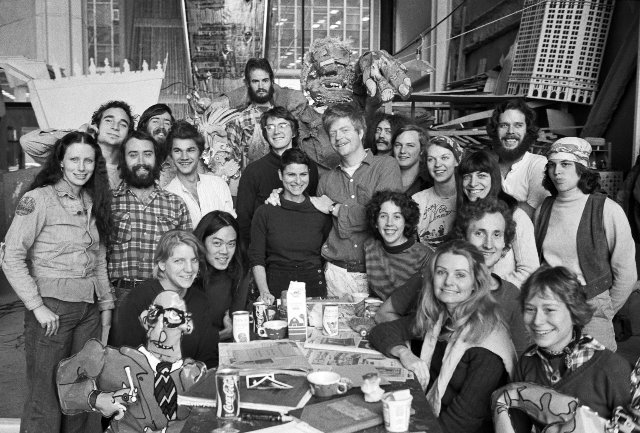
And who was the Ruckus Construction Company? They included not only Mimi Gross and Red Grooms but also a gathering of some thirty or so artists and engineers who worked as a collective, tirelessly constructing and painting—often behind plate-glass windows at 88 Pine Street and Marlborough Gallery for passersby to see. To its credit the Brooklyn Museums names them all on one of its wall labels. That’s a good example of “Inclusion” (of D.E.I. fame).
So, see the show, on view until early June 2026. But maybe leave the kids at home.
………………
For more information see: https://www.brooklynmuseum.org/exhibitions/ruckus-manhattan