

Ma Rainey's Black Bottom
Wilson Play Opens Yale Rep Season
By: Karen Isaacs - Oct 22, 2026
April 1984, I was in the audience at the Yale Rep for the opening night of a world premier play by a new playwright, August Wilson. Little did we know that Ma Rainey’s Black Bottom would change the theatrical world. August Wilson was a major talent who would go on to write what he called “The American Cycle” – 10 plays each set in a different decade of the 20th century that explored the experience of African Americans, particularly African American men.
Now Yale Rep is presenting an outstanding revival of the play through Saturday, Oct. 24.
Ma Rainey not only announced his arrival but revealed some of the techniques that Wilson used in all his plays: A focus on the average man, dialogue that sounds like jazz riffs, naturalness in conversations. Certain aspects of his work had yet to be revealed, particularly references to mystical forces, but we saw that in Fences which had its world premiere at Yale Rep in 1987.
Ma Rainey is set in Chicago, the only play not set in the hill neighborhood of Pittsburgh. It’s 1927 and blues singer Ma Rainey, who bills herself as the Mother of the Blues, is in a recording studio. The studio makes what were known as “race” records – sold exclusively in African American neighborhoods.
Wilson introduces the play with the two characters who control everything – the white owner of the record label (Sturdyvant) and Ma Rainey’s white manager (Irvin). This quickly establishes the pecking order.
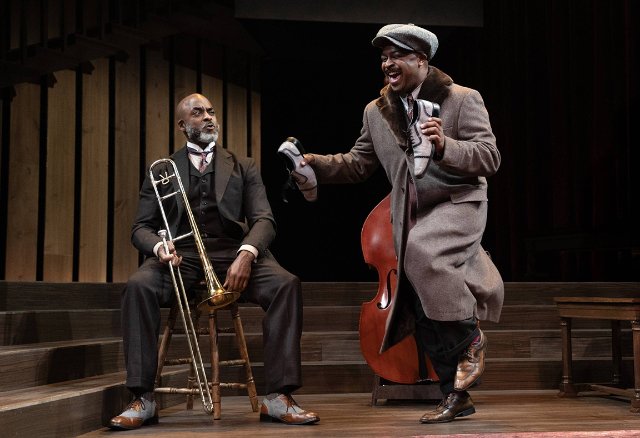
The play focuses on the four musicians hired for the session. Three are long time members of her band – Cutler, the leader and trombonist; Slow Drag, the bassist; and Toledo, the pianist. Also in the group is the trumpet player Levee – talented, ambitious, vain and easily angered. He’s also the youngest and considers himself a ladies’ man. They wait in the musician’s room for Ma Rainey to arrive; she is not only late but nearly gets arrested over a minor traffic accident and an altercation with the police officer. Irvin smooths everything over.
Levee, an outstanding Jimmie J. J. Jeter, drives much of the action in the play. It is his temper, his ambition, and his scars from his past, that dominates the room. He is planning for his own band, he believes the Sturdyvant will let him record his compositions but also underwrite the band; he is still railing against the system that diminishes all African Americans. Jeter’s performance simmers with this underground anger; like hot lava flowing beneath the surface. He ignores what he doesn’t want to see, plunges in recklessly, and is convinced he is right.
Like any good band, the other three members are the counterpoint. Toledo, a fine Dion Graham, is the counterpoint to Levee’s denial of religion and God. The only one who can read, Toledo quietly debates Levee. Terence Archie, as Cutler is the old-timer who knows that when push comes to shove, it is Ma Rainey who is in charge. Ray Anthony Thomas is fine as Slow Drag, who may appear to be the quietest of the four, is the steadying force.
Many in the cast have appeared in other Wilson plays; director Timonthy Douglas has not only directed nine of Wilson plays, including the world premier of the final play in the cycle, Radio Golf at Yale Rep, but he was a first year acting student at the Drama School when Ma Rainey debuted.
His direction is on target – he allows Wilson’s dialogue to reverberate with the audience without slowing the pace of the play. Like most Wilson’s plays, this is ladened with dialogue and can easily drag as the characters engage in extended conversations that often seem to go nowhere. He and his production team make fine use of the University Theater stage with action on multiple levels: the control booth that symbolically looks over the musicians, the side room where Ma Rainey waits, and the band room center stage with the recording microphones behind it. The scenic design by Richard Lee is equaled by the period costume design by Toni-Leslie James and the sound design by Robert Salerno.
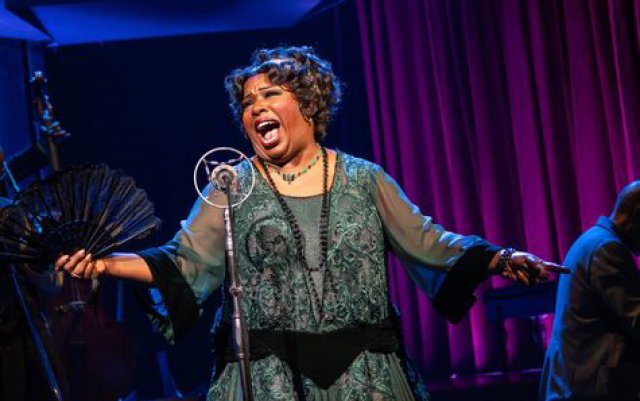
Let’s not slight Maiesha McQueen as Ma Rainey. First, she has a terrific voice; her background includes appearances in Broadway musicals and opera. When she stands at the microphone and finally sings her signature song the audience erupts in applause. McQueen gives Ma Rainey both dignity (she knows her worth), assurance, and a sense of realism; she understands her limited power and knows how and when to use it.
The secondary plot centers on two members of Ma Rainey’s entourage: her nephew, Sylvester who she insists will speak the introduction to the song, despite a stutter, and her newest girlfriend, the flirty Dussie Mae. Brittany Antoinette Davis and Mark Yards, both acting students are fine in the parts, capturing Dussie Mae’s interest in money, and Sylvester’s lack of polish.
One can question if the explosive ending is really necessary? Its explosiveness, though possibly inevitable, seems out of character for Wilson.
You will leave the theater, as I did 40 years ago, awed by Wilson’s talent, as well as that of the cast and production team. You will also leave wondering how much society has really changed in the last 100 years. For tickets, visit YaleRep.org.
This content is courtesy of Shore Publications and Zip06.com