

Spunk by Zora Neale Hurston
World Premiere at Yale Rep
By: Karen Isaacs - Oct 23, 2025
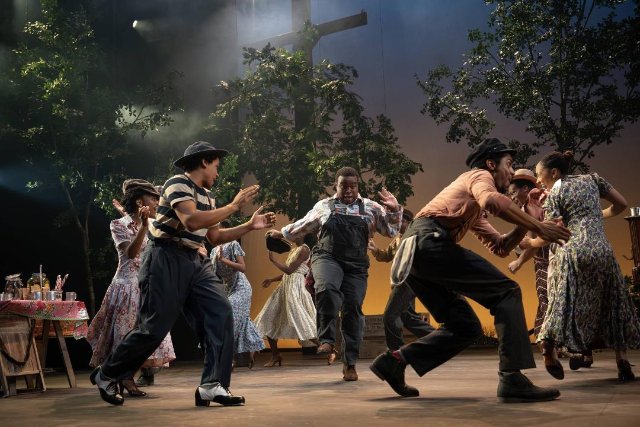
Spunk by Zora Neale Hurston, getting a very belated world premiere full production at the Yale Rep, was written in 1935, but was not found until 1997 in the Library of Congress. The musical play is based on a short story of the same title that Hurston wrote and published in 1925. (Ironically, in the 1980s, director George C. Wolfe adapted the short story and two others into a play, Spunk: Three Tales by Zora Neale Hurston, that had a production off-Broadway in 1991.) The lively Yale Rep production runs through Saturday, Oct. 25.
Zora Neale Hurston wrote short stories, novels, and plays. But she was also an ethnographic researcher, folklorist, and cultural anthropologist who published academic articles and taught at several universities. She was a major figure of the Harlem Renaissance – that period between the wars when music, art, dance, and literature flourished in Harlem – but whose works were forgotten for many years.
Spunk uses a combination of Hurston’s skills to tell the story of Spunk and the residents of a black-incorporated town in central Florida in 1935. She uses her playwrighting and academic skills to focus on the people and the music of the town. The play is teeming with songs, most of which are folk songs, though the Yale production includes a few new songs and others with new lyrics. But these were the songs that Hurston discovered in her research.
Though Hurston was talented, her work was criticized by other Black writers for its use of dialects, which were considered demeaning and stereotypical. In addition, her conservative politics – she felt that the New Deal social programs created dependency and criticized the Supreme Court’s Brown vs. the Board of Education in the 1950s as unnecessary – were not appreciated.
This play is not heavy on plot. The story is relatively simple. Spunk – a handsome and charismatic young man – arrives in the town with his guitar and soon all the locals are smitten with him. The men admire his skill in handling the most dangerous saw at the local mill; the women are attracted to his good looks and charm. But Spunk has eyes only for Evalina; unfortunately, she is married to Jim, whose father, Hodge Bishop, practices the black arts. When Jim comes after Spunk with a knife, Spunk shoots him. Hodge then announces he has “put his mark” on Spunk.
All this occurs in the first half of the play. It is so jammed packed with music and action that you might wonder where it will go in the second half. And that is one of the difficulties Hurston faced and did not conquer. The second half gets bogged down.
While the original story had an unhappy ending, in her musical version, Hurston made it a happy ending.
Director Tamilla Woodard and choreographer nicHi douglas have done all they could to hide the problems with the show. It is best if you just sit back and enjoy the songs, the dancing, and the fine performances.
Hurston included in the play the activities the residents used to build community – the card game Pitch, croquet, and the toe party, in which men select their partners for the evening by viewing only their toes.
The play opens with a gang of men singing as they shovel and pick ax the hard soil. While it isn’t clear if this is just a work gang or a prison chain gang, it is through the song and their talk that we start hearing about Spunk. We then move to the town, which has gathered to party, play, and gossip; everyone knows everyone and their business. Spunk is the center of attention, with several women vying for him —Ruby in particular. The scene is filled with songs and dancing.
As the story moves along, that is the feature – everyone is always present and ready to comment.
Yale has assembled a fine cast – from J. Quinton Johnson as Spunk and Kimber Elayne Sprawl as Evalina, to Kimberly Marable as Ruby and Jennifer Bayardelle as Mrs. Watson. The cast gives these somewhat generic characters individuality.
Hurston wrote the language that she heard during her research, so the characters speak in a vernacular that some may find difficult to understand. But even if you don’t understand every word, the story still comes through clearly.
Hurston’s work is worth discovering, and Spunk offers a picture of people who, despite the restrictions and prejudices that surrounded them in white society, built a vibrant community.
Tickets are available at YaleRep.org.
This content is courtesy of Shore Publications and Zip06.com