

Manon
Jules Massenet as His Lyrical Best
By: Victor Cordell - Oct 23, 2026
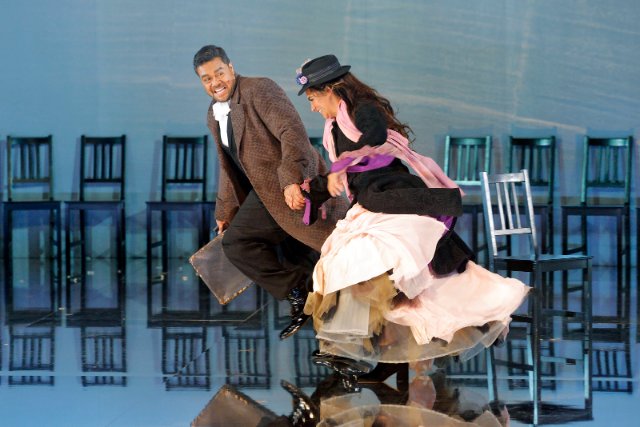
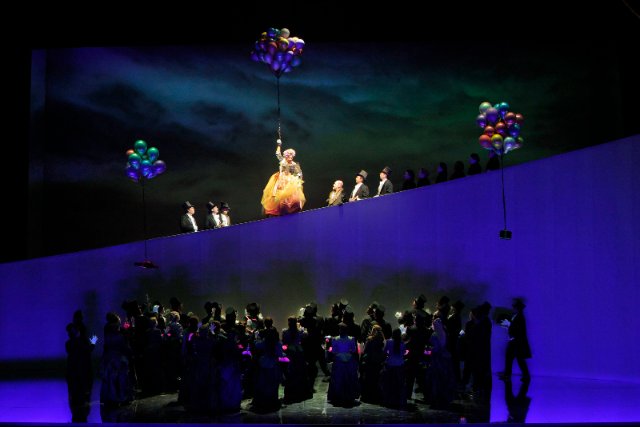
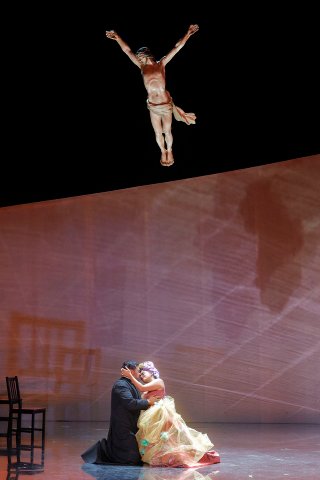
It’s too long. Act One drags, yet life altering events fly by in a flash and without prologue. The drama is clunky and inexplicable at times, but that’s French opera for you. Situations are too reminiscent of La Traviata (though Manon’s source material is earlier). Finally, the austere set is comprised of a bleak, white tapered wall. The verdict?
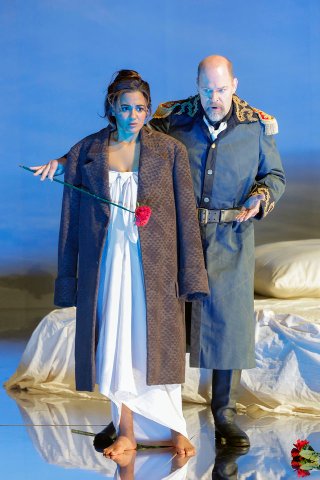
Though flawed, and what isn’t, Manon is a masterpiece. Along with Werther, it deservedly remains one of the composer’s two most popular operas. Massenet mastered melody, so the music enchants throughout, and the characters captivate. What’s more, the San Francisco Opera production is a delight. And in this realization, the lead couple own their roles. They both spark and sparkle with uncommon chemistry, perhaps because they’re married in real life and get to have extra rehearsal time together in their lodgings!
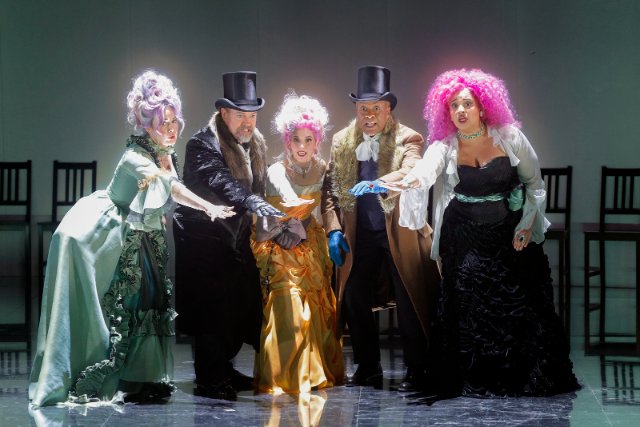
While Massenet and his librettists may have faltered in their dramatic thrust, they have produced one of opera’s great femme fatale lead characters with multiple dimensions, or at least evolution. The young Manon, who was to be sent to a convent because of her reckless behavior as an adolescent, shows impulsiveness as she quickly accedes to Chevalier des Grieux’s hasty marriage proposal and runs off with him. She admits to her envy of rich young women adorned in jewelry, evidenced by a bright, delightful acapella mezzo trio. But her quest for riches is not likely to be fulfilled in her arrangement with des Grieux.
Buffeted by conflicting desires, she allows her betrothed to be abducted in return for the promise of marriage into great wealth. But in another about-face, she ultimately returns to des Grieux driven by what would appear to be a genuine reflection of love, and she seeks redemption.
Former Adler Fellow, Amina Edris returns to SF Opera as one of the great contemporary interpreters of this role, which she has performed around the world. In voice and action, she captures every aspect of Manon with precision from the flighty ingenue looking to escape a doleful future to the tragic lover.
Her voice possesses a warm timbre and vibrato throughout her range, navigating the coloratura elements with relish, especially when she trumpets her new-found high-society notoriety in the famed “Je marche sur tous les chemins” (“I walk all the streets”) and the following gavotte “Obéissons quand leur voix appelle” (“Obey when their voices call”) in Act 3. The role demands lyric lushness which Edris provides, but not the power that a dramatic soprano role would. Indeed, in her duets she doesn’t quite maintain the desired volume balance with the tenor.
Like his wife, Pene Pati was also a well-loved Adler Fellow who has taken on many title roles especially in some of Europe’s top houses. A tenor of the highest order, his voice excels in its strength, enthusiasm, and clarity, without the strained or pinched sound of many others in this voice range. His acting meets opera’s highest demands, with his passionate best directed at Manon, from gambling party scenes to unrestrained love to near violent rejection and ultimate tragedy. The composer also endows this role with a number of melodious arias, the most memorable being the lament he conquers when entering the religious world and leaving his love behind, “Ah fuyez douce image” (“Oh vanish sweet memory”).
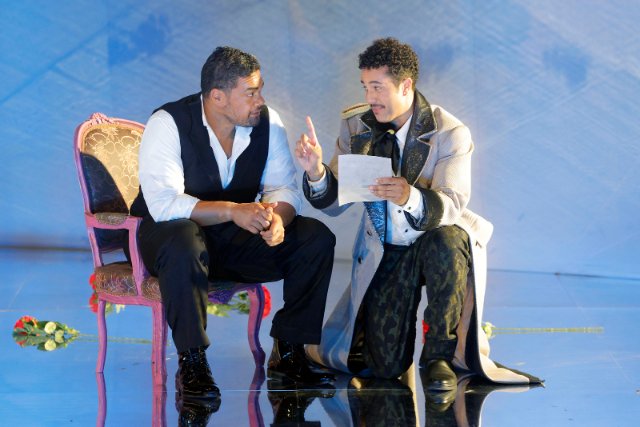
Massenet offers more than just show-stopping arias for the lovers. A strong chorus and ensemble pieces, including a foreboding quartet and duets for the lovers, play a large role. Secondary characters are significant, all of which are male. Most notable is the Comte des Grieux, the Chevalier’s inconsolable and interfering father, akin to Traviata’s Giorgio Germont. Portrayed by James Cresswell, the compelling bass displays particular ease and volume consistency throughout his range while maintaining model diction.
Back to the staging which can make a significant difference in the vibrancy and appeal of an opera. Like Maya Lin’s gash, as the Viet Nam War Memorial was often derisively called, it may take a while for the viewer to respect Director Vincent Boussard and Set Designer Vincent Lemaire’s minimalistic set.
But in the end, it works brilliantly as a versatile canvas. Variously imbued with light, shadow, reflection, and projection, and while occasionally set off by symbolic props and rich splashes of color, the formerly empty space fills the eye with everything from balloons to crucifixion symbols. A parapet running the length of the wall at one time displays a cityscape of Paris and acts as a linear platform for crowds. And when the gargantuan chorus floods the stage, it is not lost in the scenery but looks and acts as an organic whole. A final mention goes to Boussard again, who is also responsible for the sumptuous costume design which adds another stunning visual element.
Manon, composed by Jules Massenet with libretto by Henri Meilhac and Philippe Gille, is produced by San Francisco Opera and plays at War Memorial Opera House, 301 Van Ness Ave., San Francisco, CA through November 1, 2026.