

The Mountaintop by Katori Hall
Splendid Regional Production at Palm Beach Dramaworks
By: Aaron Krause - Oct 28, 2025
The weary activist enters and pauses. He catches his breath, coughs, and exhales, as though he’s had a long day. While it’s nighttime at the start of Katori Hall’s Olivier Award-winning poetic play, The Mountaintop, in April 1968, Dr. Martin Luther King Jr.’s ordeal is just beginning—and it’s about to pivot from realism to something more mysterious. In Palm Beach Dramaworks’ (PBD) powerful professional production, which runs through Nov. 9 in PBD’s intimate theater in West Palm Beach, that shift is seamless yet profoundly moving. The runtime is about an hour and 45 minutes without intermission.
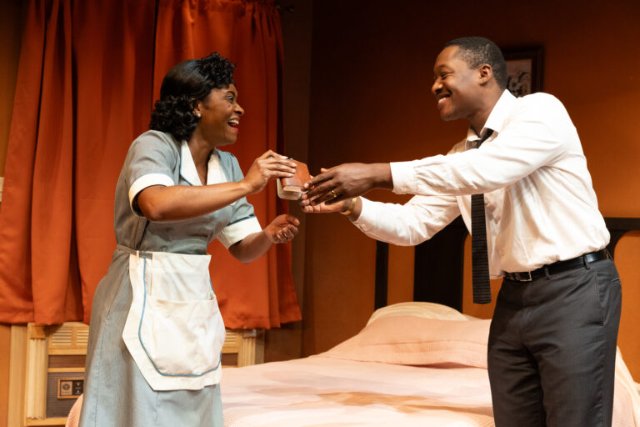
Early in the play, in Room 306 of the Lorraine Motel in Memphis, Hall introduces us to the two central characters: King (a phenomenal Christopher Marquis Lindsay, making his PBD debut) and Camae (the immensely talented, award-winning South Florida stage veteran Rita Cole), a beautiful and mystifying motel maid who brings him the coffee he ordered. At first, their interaction is laid-back and lighthearted. They tease each other good-naturedly, flirt, and Camae reveals herself to be sassy, seductive, and assertive.
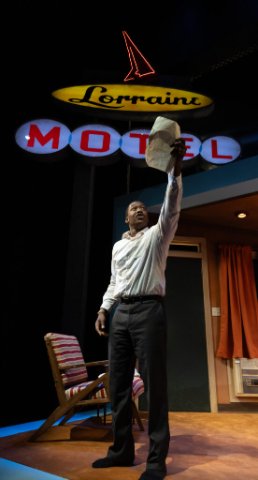
Hall subtly shifts the story in an unexpected way that deepens our understanding of Camae. But before she fully enters the action, Hall paints King in a manner that challenges the typical pedestalized view. King notes several times throughout The Mountaintop that he’s “just a man.” Wisely, the playwright doesn’t merely tell us this; she shows us. In PBD’s first-rate production, we keenly see him in action, starting from when he enters the motel room and pauses to breathe.
Understandably, King may be a bit winded at this point. The play begins with him returning to his motel room after delivering his now-famous “I’ve Been to the Mountaintop” speech to frustrated sanitation workers. During the address, the famed preacher and activist called for unity, economic action, boycotts, and nonviolent protest, while challenging the country to live up to its ideals. A storm raged outside that night in Memphis, perhaps symbolizing the metaphorical storm in King’s life and work, with thunder punctuating certain moments of the speech. Perhaps prophetically, King hints that while he has glimpsed the “promised land” (racial equality) from the “mountaintop,” like the Biblical Moses, he may not live long enough to see these goals fully realized.
Hall wisely omits most of the speech from her tightly written play, providing just enough exposition to orient the audience—including that the story unfolds the night before King’s assassination at age 39.
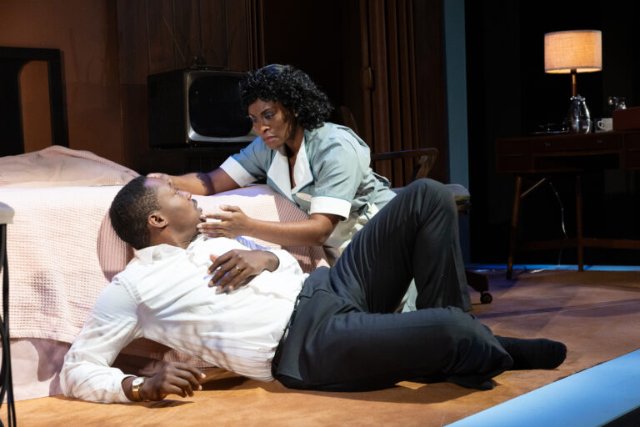
In PBD’s production, directed with precision and sensitivity by Belinda Boyd, the actors demonstrate strong chemistry, and their performances are spontaneous, vivid, varied, and nuanced. They don’t only speak—they listen intently and display genuine compassion. Additionally, the performers navigate the play’s tonal shifts seamlessly.
From the moment their characters meet, an obvious attraction develops. Laughter, cheerfulness, and humor characterize their relationship, with a laid-back aura surrounding them. Camae flirts, and King blushes. At one point, their heads move slowly toward each other, as though about to kiss. “I don't want no kiss from you, 'cause you ain' brushed yo teeth,” Camae says bluntly. She calls him “Preacher Kang,” a comical mispronunciation of “King.” She also reveals more of King’s human imperfections: his socks have holes, his feet “smell,” and he smokes.
Hall, a fine actor with classical credits, hints at King’s character even before he appears onstage. In his signature booming, preacher-like voice, he asks an offstage friend to bring him cigarettes. Shortly afterward, King is on the phone ordering room service, smiling pleasantly and conveying charm. Hall captures King’s graceful, polished demeanor without mimicry, even naturally pronouncing certain words as King did.
While deftly conveying calm, Hall equally portrays King’s vulnerability. With a vulnerable, almost falsetto-like voice, he asks his wife Coretta (he calls her “Corey”) to pick up the phone after he calls. Around that same time, Hall’s King sheds real tears, and Camae sympathetically soothes him. Later, when King struggles to breathe and drops to the floor, Camae holds him, rocking him gently and seemingly whispering “shhh.”
King isn’t the only one experiencing emotional pain. Camae also needs comforting, and Cole, as she has countless times, portrays anguish with intensity yet naturalism. We hear it in her expressive voice and see it in her vivid, lifelike facial expressions. Cole brilliantly contrasts such moments with endearing playfulness, assertiveness, and sass that makes us laugh, never rendering Camae unlikable. Yes, she curses, but without malevolent intent.
Boyd ensures every moment, every beat, feels purposeful. Subtle stage business, small gestures, and facial expressions enhance the naturalness of the performances. Genny Wynn’s lighting design, Roger Arnold’s sound design, and Adam J. Thompson’s projection design differentiate realistic moments from scenes imbued with mystery. Authentic-sounding thunder punctuates intense moments, echoing the storm outside during King’s speech.
The actors, wearing costume designer Brian O'Keefe's period-appropriate clothing, perform on Nikolas Serrano’s detailed period depiction of Room 306 of the Lorraine Motel. James Earl Ray pleaded guilty to assassinating King while he stood on the porch of the room on April 4, 1968, though conspiracy theories persist.
While Hall based The Mountaintop on actual events, interactions between King and Camae are entirely fictional. Hall has said her grandmother forbade her mother, Carrie Mae Golden, from attending King’s speech, a decision her mother regretted for life. To symbolically place her mother in the same room with King, Hall named the maid Camae, short for Carrie Mae.
The play, which reimagines the final hours of King’s life, is a fantasia—a supernatural, often surreal theatrical piece blending fantasy with historical drama. It sensitively addresses themes such as humanizing a historical icon, the weight of legacy and mortality, the duality of public and private life, fear, hope, and the struggle for social justice.
Without revealing details, projection design allows King a glimpse of how others beyond his lifetime will “pass on the baton”—a motif symbolizing the ongoing responsibility to advance social justice and racial equality.
Ultimately, the play reminds us that King, despite his heroic deeds, was a common man—an ordinary person who did extraordinary things. In that sense, the play reminds us that the work for justice continues, and each of us has the capacity to carry forward the work King began.
IF YOU GO
WHAT: Palm Beach Dramaworks’ splendid production of Katori Hall’s creative and moving fantasia, The Mountaintop.
WHEN: Through Nov. 9. Performances are 2 p.m. Wednesday, Thursday, Saturday, and Sunday, as well as 7:30 p.m. Wednesday, Thursday, Friday, and Saturday.
WHERE: 201 Clematis St. in West Palm Beach.
TICKETS: $95. Call (561) 514-4042 or visit www.palmbeachdramaworks.org.