

Part Three Conspiracy
The True North
By: Gregory Light - Oct 28, 2026
(Toronto 1982)
Irritating, irksome, infuriating England.
Plonk. Plonk. Plonk. 'Ahrrgh!!'
Joey had fixed the leak in the roof on the back extension twice. But, slipping into the kitchen for a cup of tea, he now found a mini rainfall in progress; vertical columns of rust-coloured water drops making their way from ceiling to floor in three separate spots. The newspaper, a sweater, and the sugar bowl. The sink, of course, was dry as were the kitchen plants he had promised Joanna he would water.
'I’ll fix you tomorrow,” he told the leaks, sliding pots beneath them. ‘After I call the landlord sunning in Ibiza.’ Fat chance, he thought.
He dug to the bottom of the sugar bowl for dry crystals and stirred them into his mug. He went back to the bedroom, sat down at his desk, and put a fresh sheet of paper into his typewriter. 'Fucking England,' he muttered and began typing.
England often received a battering when Joey was angry. And not simply because of its continuing nod to class and colonial superiority, or the dire rule of Margaret Thatcher. Both got under his skin. Mainly he pilloried the country because of McDougal. For some ugly reason, the same citadel of democracy and bureaucracy that had forced him to run a six-month gauntlet of document hunting to prove he was Church-of-England-legitimate progeny of a U.K. grandparent had also allowed George bloody McDougal to sail breezily into the land without the tiniest of hitches. While Joey knew his own legitimacy was farcical, and racist (thank you for your white Bristol birth, grandpa), the authority of McDougal’s admission was based purely on the supremacy of corporate power.
'George doesn't even have roots in this island,' Joey said to Joanna bitterly. 'His great-grandfather lifted the name.'
George's forebears were Polish. But in 1890 when his great-grandfather landed in Montreal, a penniless immigrant, he had assumed his reception would improve if he adopted a "new world" name; confidently choosing that of then Prime Minister, John A. Macdonald. His pronunciation, however, was so bad, that after the fourth attempt, the official wrote down "McDougal" and curtly waved him on to the next stage of the immigration process.
'But keep it to yourself, eh Edwards,' George had said shyly after relating the story.
'Why? Are you ashamed of it?'
'Polish? Sure I am. Wouldn't you be?'
‘No.’
Poor, pathetic George. Joey wondered what made him tick. Ten years later he was still mooning over Sally?she whose main preoccupation had been tracking down her deserter ex-husband. McDougal had finally unearthed the guy, high on acid and hepatitis in a basement flat in Scarborough. His reward? A sobbing Sally's promise to marry George despite his Polish background.
Joey still had chilling memories of the wedding reception. A terrified George cornered him under an apple tree at the far end of the lawn, shoved another glass of champagne in his hand and rambled on about how nobody believed in love anymore.
‘I mean true love, man,’ he said grabbing Joey’s arm for emphasis. ‘Real love. Genuine love.’ Joey nodded, not sure whether George was referring to Sally or himself.
Six months later they were separated. Sally's "ex" decided he wanted her back, and without a word to George, she left one evening while he was taking a pee. A year later he heard she had returned to the States, her man taking advantage of a full pardon by President Carter. Lacking the will to contest it, divorce followed quickly. George was crushed, insisting he would never forget her.
Zzzz-i-i-i-pppp! Joey ripped the sheet of paper out of his typewriter; a paragraph but so bad it warranted the whole page being destroyed. He heaved a sigh exasperation and leaned back. The week-old, ketchup-smeared cutting from The Times (Thursday, February 25th, 1982), taped to the shade of his desk lamp, blinked at him ardently. "Incredible! Unbelievable!" Remnants of his reaction upon first reading the short piece filtered back. What had once excited him, now depressed him. Completing and submitting his piece to The Guardian by the week in which Canada's Constitution was to be finally repatriated, seemed increasingly remote. Progress was slow enough without having to check out the story hanging on his lampshade. But how could he ignore it?
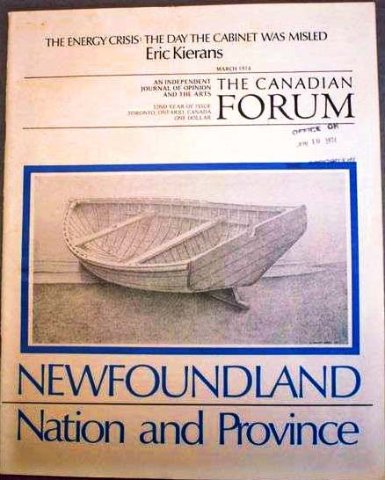
Joey shivered. He'd never felt so fearful about an article; not since his unlikely career had been launched after he sold a revised version of his "Waiting for Godot" essay to The Canadian Forum. Even stranger was the blizzard of nasty letters he had received from outraged readers, including two mayors and a federal MP. Those had been daunting days. Not so much for the controversy as the sudden change in his life, blowing him along a path he'd neither anticipated nor was sure he wanted. Godot and the universe had tossed him high in the air.
It was Higgins’ doing. The tall, lanky professor was ecstatic about the essay from the moment he read it and, without permission, bundled it off to an editor he knew at the "Forum". Joey knew nothing until the beginning of the fall term when Higgins sprung it on him in the library.
'You'll have to change it a bit. Largely minor stuff. Cut a?'
'What are you talking about?'
'Your essay.' Higgins looked perplexed. 'Didn't you get my note?' Joey shook his head. 'They want to publish it. Mind you there's no money, but the prestige is substantial.'
Prestige was fine but, as Joey was to learn, notoriety travelled further.
It was not so much the essay's idiosyncratic format that sparked the outrage as the image it bellowed. Joey had depicted the great Canadian Mosaic as a colourful medley of violence and Canada’s first people as the thin moulding into which the other cultures burrowed and set up camp.
A massage parlour scandal eventually vanquished his notoriety, but not before he had received a steady stream of requests for essays, articles, and opinion pieces. Somehow, his insight-through-chance method became so popular that the only attempt he made to write a straightforward essay met with hostile contempt from the editor who had commissioned it. He wrote back, angrily saying that he didn't think the joke was in good taste, demanding the article as previously contracted. Bewildered and hurt Joey spent the next two days tossing his penny, haphazardly threading together an article on high school alcoholism using Molson beer labels as section titles. It was a hit.
Within a few years of leaving university, Joey was able to earn a small income from the sale of his "aleatory essays", or what the more avant-garde magazines referred to as "performances". "Your words perform," one New York editor told him. Then, to reinforce this idea, five short pieces he had written on American Civilization, constructed from sayings he had found on coffee mugs and which, using his penny, he had organized into dialogues, were published in The Village Voice under the title "Five Easy Pieces". Two months later they were performed under the same title in an off-off-Broadway loft. Actors dressed as coffee mugs. The night Joey attended, four irate members of the audience who had lined up an hour early for their tickets, thinking the show was a stage version of the Jack Nicholson film, started heckling.
'What is this bullshit? This doesn't have Nicholson in it!'
'And what's with these fucking coffee cups?'
'Hey, Jack ... Jack! Are you back there, man?'
'Please sit down and be quiet.'
From a dark corner at the back, Joey laughed. He would have preferred Nicholson as well.
In the fall of 1976, two months after he and Joanna were married, a Toronto production of the same show was briefly mounted at the Factory Theatre Lab. Joey quickly dug up Canadian coffee cup graffiti and, for the performance, two of the mugs sported bright red maple leaves. It didn't work. The two reviews that did come out, hated it, and the audience never materialized. It did, however, help him land a semi-regular position as the weekly theatre critic for a local newspaper. It had been the sixth paper he had approached with the idea of a theatre column. Most had laughed in his face.
'Are you kidding?'
'People are beginning to read about theatre now. Canadian theatre is very popular.'
'My readers don't read. They pick over the ads for burger specials at Dominion and Loblaws. If I didn't get cheaper postal rates, I wouldn't write a thing.'
The editor of the sixth paper took him on as a last resort. For the past four months he had been sinking deep in financial quicksand; circulation at its lowest level for three years. In a last-gasp attempt, he was filling the pages with articles on anything and everything, no matter how weird. And a column on Canadian theatre was definitely weird. Within six weeks, the paper made a surprising return to health and, as no one was quite sure why, an order to keep the "winning formula" came down from the owner. Not only was Joey's position secure, he could also write whatever he wished; tone, form and material constrained only by the space requirements of Honest Ed’s and Woolworth’s ads.
Joey took up the challenge with gusto, allocating the task of assessing artistic quality to his penny. To remain in good standing with the theatre community, he devised a system of tosses that meant, in all probability, two-thirds of the shows he covered received good reviews. His focus on detail and his capacity for inventive writing were greatly sharpened when he found he had to write a rave about a terrible play or, conversely, slam a truly excellent play. In one case, he spent half the review glowing about the comfortable seating and easy access to the exits, and in another—a brilliant comedy—he complained bitterly of the company's decision to perform the play when the Leafs were playing.
Nevertheless, rumour on the dramatic grapevine referred to him as the most perceptive critic in Toronto, meaning "alternative" Toronto. His area was strictly "Canadian" plays, which in the bizarre logic of his country, meant "alternative", "experimental", or "fringe". He devoted an entire column to it. The next day he was fired. When he stormed into the editor's office, screaming that the action was censorship, he was met with a bewildered look of surprise.
'What are you talking about?'
'Come off it, Frank, you know damn well!'
Frank was five years older than Joey and over the last eight months, they'd established a close working relationship. Whenever Joey was in the office, they followed their strictly observed custom of going out for a few beers, the tab picked up by the paper, although the paper was never the topic of conversation. Joey had zero interest in the rest of the business and Frank liked to forget as many column inches as the beer would soak up. Joey's reviews were never discussed. He handed his copy to the secretary and, except for typos it was, specials on chicken wings permitting, published as written.
'I swear, Joey, I didn't even read your last column.'
'So why then? It can't be the money. Not on what you pay me.'
'Don't you read the programs of the plays you cover?'
'Sure, I read them. Half the review comes from them.'
'Did you read the one on Hanging About?'
'Hanging About wasn't a play. It was a joke, cashing in on your "tits and ass" audience.' After he'd seen it, Joey had been fearful his penny might demand a glowing critique of the show. Especially after the third head in a row. But the fourth was a tail.
'Did you read the program?'
Yeah. Still have it. There's a photo of one of the actresses in the buff on the cover. The best part of the whole production.'
‘Did you catch the name of the stage manager?'
'Come on, Frank. The stage manager? I can't be expected to mention everyone.'
'Oblanski.'
'You're kidding!' Joey sucked in a deep breath. 'Oblanski? Why is he stage-managing a revue? He's got enough headaches with this rag.'
'Oblanski's nephew Oblanski. A nineteen-year-old kid who got the job because his uncle, our dear publisher, put up half the money, money he is about to lose because of terrible reviews.'
'Mine wasn't that bad.'
'You savaged it. Cockroach bait, whatever that means.'
'Well, how was I supposed to know Oblanski was involved? Why didn't he tell me?'
'Because he didn't know we ran a theatre column. And now that he does, he wants it out. I'm lucky to still have my job. Hell, Edwards, it's not a goddamn art magazine we're running here. It's a business.'
'Yeah, well you're making a big mistake, Frank. You were onto a winner. Wait and see how the circulation drops.'
To Joey's chagrin, the subsequent increases in circulation proved his column had not been an integral factor of the "winning formula". To make matters even more desperate, a few months earlier, Joanna had been accepted to finish her master’s in urban planning. It meant saying goodbye to her full-time position as a researcher for the Ontario Provincial government and, grants and loans outstanding, a drastic drop in their collective income. They had discussed the situation when Joanna had first made her application and Joey had assured her that he was more than capable of picking up the slack. 'As a dishwasher if necessary.' Naturally, when he'd said that, he hadn't anticipated having to do it. He had hoped to be earning a decent living through his writing when Joanna resumed her studies. Wrong!
The summer before Joanna was to begin, Joey pounded the newspaper and magazine circuit again, broadening his spectrum to include art, literature, film, and dance. Nothing. No one was interested.
In late August, under some gentle persuasion from Joanna, Joey surrendered to a fit of temporary madness and approached Higgins about work as a teaching assistant. Higgins was delighted, promising to do whatever he could, warning Joey, however, that finances were very tight and it didn't pay well.
'My needs are not great. I just need a few hours to write.'
'I was going to ask about that. I followed your theatre column with great interest. Very perceptive and original.'
'I was axed.'
'What?' Higgins snorted, 'Your column was the best thing they had.'
'Artistic differences with the publisher.'
'Just as well you're out of it, then. I'll cancel my subscription.' Trust Higgins, Joey thought, to buy a subscription to the local traffic-accident-and-meat-special rag when it was given out free in the shops. 'My wife won't like it. She swears it’s a shopper's bible.'
'Yeah, well, thanks for the support.'
'Anytime,' Higgins said, shutting the door behind Joey. Then he opened it again and shouted down the hall after Joey, 'About the work, I'll let you know the results within a week,' as if Joey had left a urine sample. What was he dying of?
A week before Joanna was due to begin her post-grad work, Joey finally landed a job, through Frank's connections, as the editor of Video Circus, a small trade magazine in the emerging video industry. The hours were abysmal, and the pay was not much better, but he was desperate. And the video industry was wide open for something different. Then, a week after Joanna started her post-grad work, Higgins came through with a job. Research assistant. Again, the money was not great, but the work was almost perfect. Essentially, it required Joey continue doing what he was doing; writing whatever he wanted. ‘The department could use a bit of a cultural shake-up,’ Higgins had said, ‘keep your head down, don’t bother me too much and write. Publish. And you’ll go far.’ Which was what Joey did. His Video Circus pieces and his academic papers were essentially indistinguishable. The former was not a peer-reviewed journal, but the readership was a hundred-fold larger. And apparently more respected by his university colleagues. It did not hurt that Marshall McLuhan was just down the street and commented favourably.
Exploiting this new reputation, the following summer, Joanna, Amy, and he took off for a new home. England. Alighting at Heathrow, his mind wandered. Here he was. In the land of George V. He stood weary and lost in a static queue in front of passport control, holding firmly onto two heavy cases.
'You can put them down,' Joanna said, shifting the half-awake Amy in her arms. 'We're not moving.'
He lowered the bags and kicked them, inch by inch, towards a lone inspector some two hundred and fifty people ahead. In the queue beside him, British passport holders slipped swiftly through, barely a hesitation in their stride. In a third queue, EEC nationals shot through the same six inspectors even more quickly. In the "Others" line, Joey sat down on one of his cases, the reference to Her Majesty the Queen’s request in his passport to allow the bearer to pass freely without let or hindrance giggling in his head.
'How quickly they forget,' he mumbled. Two hours of cramped sleep under his belt and he was seriously questioning this move to London. It made sense in terms of Joanna's studies, a Doctorate at King's College London, the expert-in-his-field professor, tradition, resources, and the British Museum. And Joey did have work, a teaching position at North London Polytechnic. Something about performance studies. Facilitated by a friend of a colleague of Higgins and supported by his assistantship at the University of Toronto, a list of academic publications, a contributing editor position with Video Circus, and his Village Voice pieces. Even his theatre column was looked upon favourably.
All so exciting. But for how long? Did they have "others" lines at the supermarket here? In public washrooms? Joanna tapped him on the shoulder, and he rose, pushed the two bags a total of three feet and sat down again. Was this experience to be fundamentally Soviet in nature?
The queue jumped another two feet. They had been in line for almost an hour. Amy was awake now and had to go to the bathroom. All that toilet training for nought. A moment later, she began to cry.
'What's wrong?'
'She's peed.'
'So?'
'So, you know how she hates to wet her pants.' Joanna cooed into Amy's ear.
'Tell her it's okay in England.' He turned to help soothe her. But with little sleep, no patience and a sobbing daughter, Joey suddenly fell over the larger bag, his face crashing into the metal snaps of the smaller case. 'Damn!' he said. His fingers dabbed blood from his lip.
'It isn't serious,' Joanna said examining his mouth.
Joey straightened the bags, his mind seething. All right, Britain. So that's the way you want to play it. Hardball. One thing was certain, no more servile preference for heads from his penny. No more pandering to a doddering Monarchy. Tails will assert itself!
Five, tick-filled notebooks later, Joey leaned back from his desk, his silent curse forgotten. It was just as well. Tails had slipped several hundred tosses further behind. Heads were now less than three thousand from half a million, after which the chances of catching up were nil. Whatever meaning this had, however, was lost for the moment on him. His attention was entirely given over to the small "news-in-brief" item taped to his lampshade. He was reliving the moment, five days earlier, when he first saw it.
'Incredible! Unbelievable!' he had snorted. 'No, no, it can't be!' The heading had been one of those imaginative headlines The Times loved. Canadian Book. Under it was a paragraph about a new book, recently published in Toronto, which had stirred up controversy and protests coast to coast. Published by Macmillan, it was innocently titled The True North. But it was the subtitle that had grabbed Joey: "Canada: The Seeds of Respectability". By Maitland and Maitland. Brenda and Graham!
'Fucking eh!'