

Parsifal
San Francisco Opera's Stellar Production
By: Victor Cordell - Oct 30, 2025
Richard Wagner’s greatest renown derives from his four-opera, fifteen-hour-long Ring Cycle, but his favorite among his operatic children was Parsifal. Over two decades in the making, this was his final opera, displaying the fullness of his organic musical and lyrical powers. So special was this five-hour masterpiece to Wagner, that he christened it a “sacred festival stage play” rather than an opera and treated it as a religious experience. And in a rare case of putting principles over profits, the composer required that it be performed only at the Festspielhaus at Bayreuth, his personally consecrated performance venue, a demand that lasted for 20 years.
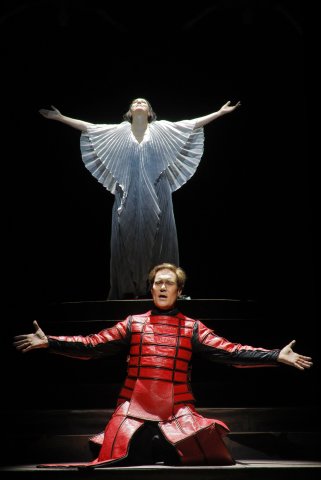
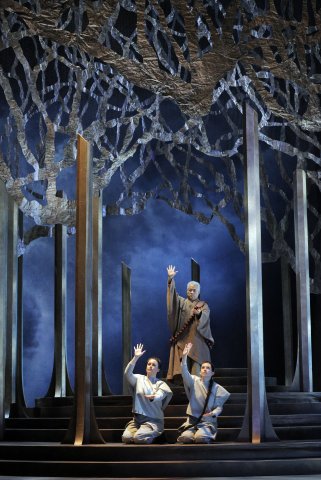
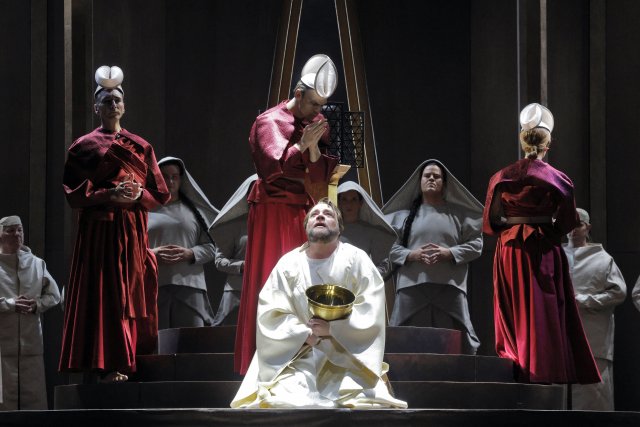
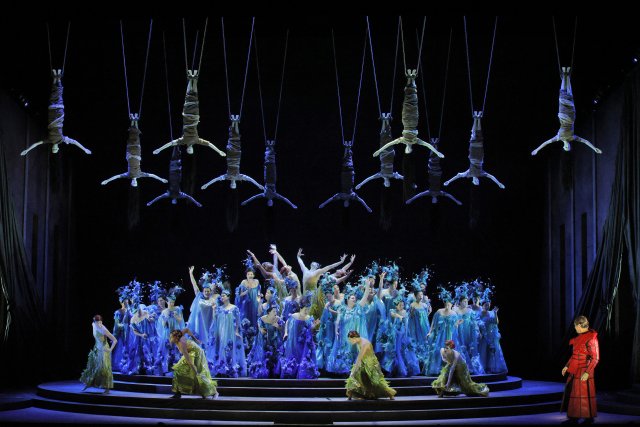
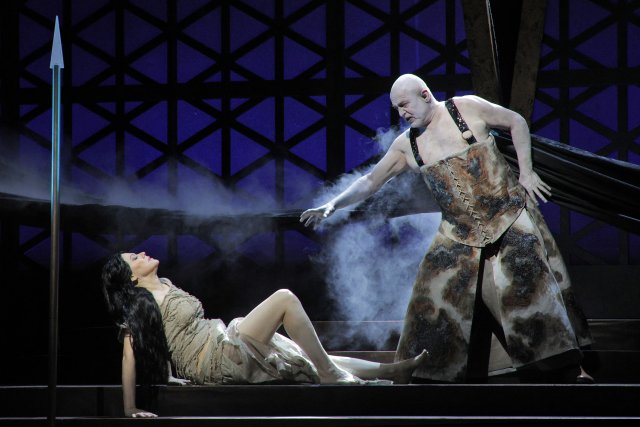
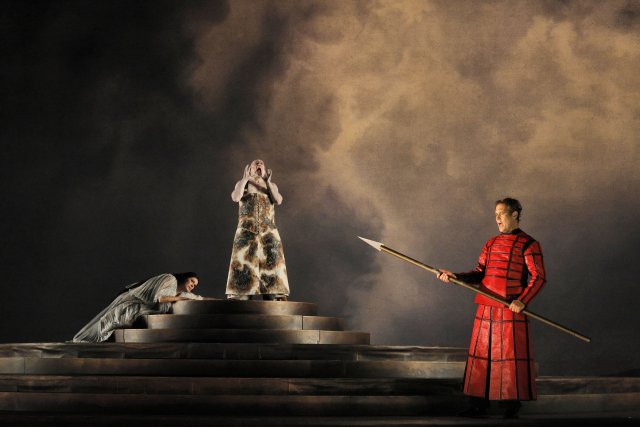
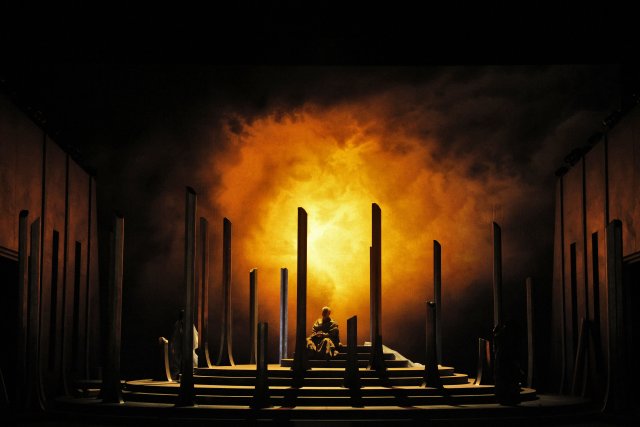
San Francisco Opera’s new production of the exceedingly difficult to mount Parsifal is simply spectacular by every measure, and creative designers deserve recognition up front. Thanks to Director Matthew Ozawa, the stagecraft dazzles, bringing the narrative to life. Robert Innes Hopkins’ diverse sets visually scintillate to include putting pieces in place that are dropped from the fly and rotated in both directions on the turntable, while Yuki Nakase Link’s lighting adds dramatic contrast and detail. Rena Butler’s Asian-influenced choreography is magnetic, and Jessica Jahn’s costumery, with a special nod to the flower costumes of Act 2, dresses the stage with graphic and colorful impact. The photos attached don’t begin to reveal the breadth of stage magic in this production.
Credit Music Director and Conductor Eun Sun Kim for attracting a powerful Wagnerian cast without a weak link complemented by 72 choristers and a juggernaut 77-piece orchestra! With a complement of only 11 brass instruments, it produces a most mellow yet thunderous orchestral sound as big as it gets. This is grand opera at its grandest.
Parsifal draws from the non-Biblical, Middle Ages legend associated with the crucifixion of Christ in which a holy spear pierced Christ and a holy grail (chalice) collected his blood. In this realization, the spear is stolen from Amfortas, King of the Grail, by the villainous sorcerer Klingsor, and prophesy says that only a guileless fool can recover it and restore the crown. The old knight Gurnemanz finds such a person in Parsifal, who is later transformed into a knight. Not only does he recover the spear, but succeeds Amfortas to the throne.
Among the oddities in Parsifal is that the largest singing role does not come from the male principals above, but from the only female lead, the ambiguous Kundry. Endowed with mystery, she serves both Amfortas and Klingsor, who are enemies; exhibits manifestations as everything from a disheveled char woman to a radiant beauty; and acts as an aid and an obstacle to Parsifal. Magnificent mezzo-soprano Tanja Ariane Baumgartner portrays this conflicted role with panache and sings gloriously, reaching the top of the mezzo range and power.
For all of the thrilling bombast associated with the staging, structurally, Parsifal contains relatively little action. Followed by a beautiful but solemn prelude, full of motifs, the proceedings unfold at a leisurely pace. As was Wagner’s practice in his later period, there are no ensemble pieces, and long soliloquies prevail, which contributes to the static feel.
The other role preeminent singing role is Gurnemanz, whose character is not essential to the plotline. The first hour of the libretto belongs largely to him, dominated by his storytelling. Happily, this elderly knight is played by Kwangchul Youn, who demonstrates why he is celebrating his 100th performance of Gurnemanz, which has included a decade at the Bayreuth Festival. He captivates with his presence and produces a big bass sound that is both deep and mellifluous with a warm vibrato.
Another incongruity is that the title character achieves far less stage and singing time than the two who predominate. What’s more, like the amorphous Kundry, he changes so much from a scruffy, homeless type to a sparkling hero that his two facets seem like different characters. Brandon Jovanovich suits the heldentenor requirements of the role completely with a voice that competes well with the orchestra.
Two other principals deserve mention. Brian Mulligan is King Amfortas, and his warm and amply supported baritone seems almost an uprange vocal extension of Youn’s Gurnemanz. Another baritone, Falk Struckmann is the evil Klingsor. Along with a booming voice, he offers a commanding stage presence that gives a supremacy to his character.
Although Wagner achieved new heights of musical expression in Parsifal that are lauded by critics and aficionados alike, it is not without flaws and controversy. As suggested, in many ways, it is plodding. The lethargy is exacerbated by the opera’s length and frequent stasis and by eschewing ensembles and memorable melody.
A religious epic can be loved by its adherents as reinforcing but be considered sanctimonious and divisive by others. Wagner was a Christian who rejected organized denominations and valued wisdom from other religions as evidenced by his incorporation of Buddhist and Hindu thought in Parsifal. However, Wagner’s antisemitism is self-documented. The enigmatic Kundry possesses negative traits falsely attributed to Jews, and the argument is supportable that she was specifically modeled on The Wandering Jew whom Christians revile for refusing to comfort Jesus on his route to the crucifixion. A concrete pejorative indicator is that Wagner gratuitously identifies her as having a past life as Herodias, a Jewish princess associated with killing John the Baptist. While these matters can be ignored and other aspects of the opera appreciated for their virtues, patrons should be aware.
In any event, few opera companies can take on this demanding opus, so when given the chance to see Parsifal, especially a breathtaking production like this one, don’t miss it.
Parsifal, with music, book, and libretto by Richard Wagner, is produced by San Francisco Opera and plays at War Memorial Opera House, 301 Van Ness Ave., San Francisco, CA through November 13, 2025.