

Ragtime at Lincoln Center
An All Time Favorite
By: Karen Isaacs - Nov 03, 2025
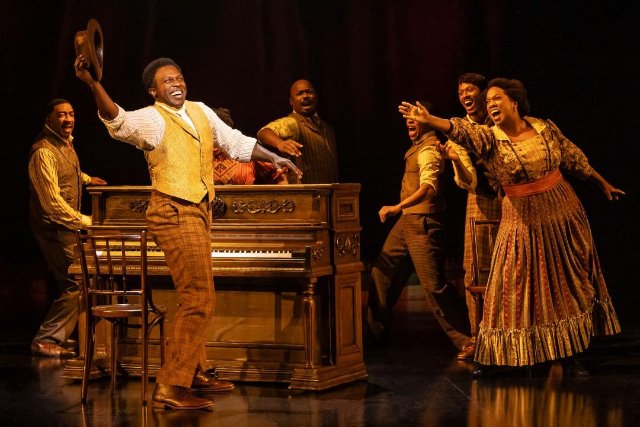
Ragtime is one of my favorite musicals. Every time I see it, I am struck by the universal elements of the plot and the glorious music by Stephen Flaherty and Lynn Ahrens. In the past year, I’ve seen three productions – all outstanding. Last fall at City Center’s Encores, a semi-staged version was terrific; this Spring, Goodspeed Musicals produced a very good production; and now Lincoln Center is offering a version using many of the cast members from the Encores! production. It is terrific.
Based on the E. L. Doctorow novel (which later was an excellent film), Ragtime interweaves three stories showing different aspects of a changing America at the turn of the 20th century. Terrence McNally did a superb job at the adaptation. Doctorow wove historic figures into the narrative, often to highlight elements of the story. From Henry Ford and J. P. Morgan to Booker T. Washington, celebrities Harry Houdini and Evelyne Nesbit, and political activist Emma Goldman.
Director Lear DeBessonet has staged the show’s opening, one of the best musical openings ever, very effectively. It introduces us to the main characters and the three threads of the story. The upper-middle-class family (white and protestant) will be affected by the societal changes. Mother, Father, Grandfather, Mother’s Younger Brother, and Son represent various attitudes. Then we meet Coalhouse Walker, Jr., a ragtime pianist at a bar in Harlem, and the bar’s clientele. Coalhouse refuses to view himself as “second class” and expects respect. Finally, we see the immigrants arriving at Ellis Island, mainly from southern and eastern Europe – mostly Catholics and Jews. They are filled with hope for a better life; what they find – sweatshops, prejudice, tenements – are often as bad or worse than what they left behind.
In many ways, the story’s center is split among Mother, Coalhouse, and Tateh, a Latvian immigrant seeking a better life for his daughter. It begins with Father leaving on a one-year voyage with Admiral Peary to the Arctic. (It is significant that he refuses to shake hands with Perry’s second-in-command, Henson, a black man.)
By the time Father returns, the family’s lives have been upended, and Mother and her brother have changed dramatically. As the song in the show says, “we can never go back to before.”
The show is filled with music reminiscent of the popular music of the period, from Coalhouse’s ragtime to vaudeville numbers, as well as modern musical theater ballads. If you haven’t heard some of these – “Sarah Brown Eyes,” “Goodbye, My Love,” “The Crime of the Century,” and “Make Them Here You” – you will find they not only move the story along but will stay in your memory.
Harry Houdini, the immigrant who became America’s most famous escape artists; Emma Goldman, the socialist firebrand, who rallied the immigrants to fight for fair wages and working conditions while attacking the wealthy; and Booker T. Washington, whose view of how African-Americans could earn equality would sound ridiculously naïve today, as well as Henry Ford, JP, Morgan, and other multimillionaires who felt their success indicated superiority.
This musical, even more so than when it opened in 1998, forces us to confront some truths that we would prefer to ignore. It points out that America has not always lived up to its ideals and, in fact, has at times rejected them. The Statue of Liberty may say, “Give us your poor and huddled masses,” but, in reality, immigrants have been stigmatized and taken advantage of as America has turned a blind eye to injustice and prejudice, whether based on color, race, religion, national origin, or gender.
Joshua Henry makes a powerful and determined Coalhouse, reprising his role from the Encores! production. His “Soliloquy” in Act Two is tremendous. DeBessonet has staged it to emphasize the emotions. Henry’s rendition of “Wheels of a Dream” almost stopped the show.
Caissie Levy and Brandon Uranowitz are also reprising their roles. Each has brought additional depth to Mother and Tateh. Levy’s rendition of “Back to Before” garnered wild applause. Uranowitz’s depiction of Tateh brings out the emotion without turning it into pathos.
Many of the Encores! cast are reprising their roles, including Shania Taub as Emma Goldman, Nick Barrington as an exceptional Houdini with a spectacular entrance, and Ben Levi Ross as Mother’s Younger Brother. Ross’s performance in the role is one of the best I have ever seen.
While Nichelle Lewis was good as Sarah, the performance did not rise to the level of the surrounding cast.
In keeping with the Encores! tradition, the scenic design David Korins is effective at evoking the scenes while still being minimalist. Also very effective was the lighting design by Donald Holder and Adam Honore.
At a time when pit orchestras are getting smaller and smaller, it was wonderful to hear the score played by a full-size orchestra, using the original orchestrations by William David Brohn and directed by James Moore aided by the sound design by Kai Harada. Linda Cho’s period costumes look authentic.
The choreography and movement by Ellenore Scott show off the variety of dance styles of the period.
Ragtime is scheduled for just a 14-week run. It deserves to be extended.