

Les Surprises de l'Amour
Danny Kaye Playhouse, New York City,
By: Jessica Robinson - Nov 12, 2026
Love, War and Too Much Dancing
By Jessica Robinson
On November 9th at the Danny Kaye Playhouse, New York City, Opera Lafayette revived Rameau's Les Surprises de l'Amour, with soprano Elizabeth Sutphen providing the evening's most delightful surprise.
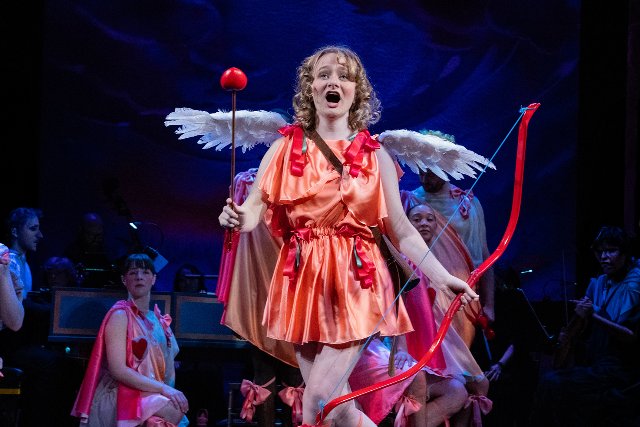
There was no shortage of love in Jean-Philippe Rameau's opera-ballet. Nor was there any shortage of dancing. Indeed, by the end of Opera Lafayette's revival of this 18th-century curiosity, one might have wished Cupid (sung by Kayleigh Sprouse) would put down her bow and give everyone a rest.
The production, directed by Chas Rader-Shieber and conducted by Patrick Dupré Quigley, offered a rare opportunity to experience a work originally commissioned in 1748 by Madame de Pompadour, the influential mistress of Louis XV, for her private theater at Versailles. The occasion was the Treaty of Aix-la-Chapelle, which brought an end to the War of the Austrian Succession. Pompadour, an enthusiastic patron of the arts and an accomplished performer herself, enlisted Rameau, then France's preeminent opera composer, to create an entertainment celebrating peace.
The result was an opéra-ballet, a distinctly French theatrical form combining singing, instrumental music and dance. Its underlying message was that love, rather than war, should govern human affairs.
Opera Lafayette's revival of the original two-act version was an ambitious undertaking, reflecting the company's longstanding commitment to rediscovering neglected works of the Baroque repertoire. But historical significance doesn't necessarily guarantee theatrical excitement.
The plot, such as it is, offers a succession of romantic complications involving gods, goddesses and mortals, all subject to Cupid's mischievous interventions. In one episode, the handsome Adonis (Phillip Lopez) becomes the object of Venus's affections, while Diana represents the competing claims of chastity. Elsewhere, resistance to love proves equally futile.
Psychological complexity is hardly the point. These are entertainments conceived for an aristocratic audience accustomed to allegory, spectacle and elaborate musical diversions. Rameau's score, with its rhythmic invention and richly ornamented vocal writing, provides the musical framework for a succession of dances and dramatic encounters.
And therein lies the problem. Dance was an essential ingredient of French Baroque opera, not merely an embellishment. But there is a difference between movement that illuminates a dramatic situation and movement that seems to exist for its own sake. In this production, the choreography by Isaac Lerner too often interrupted the action rather than advancing it. The repeated dance sequences, however carefully executed, gradually diminished the dramatic momentum.
What might have been a lively succession of romantic surprises became, at least for me, an increasingly repetitive exercise in theatrical ornamentation.
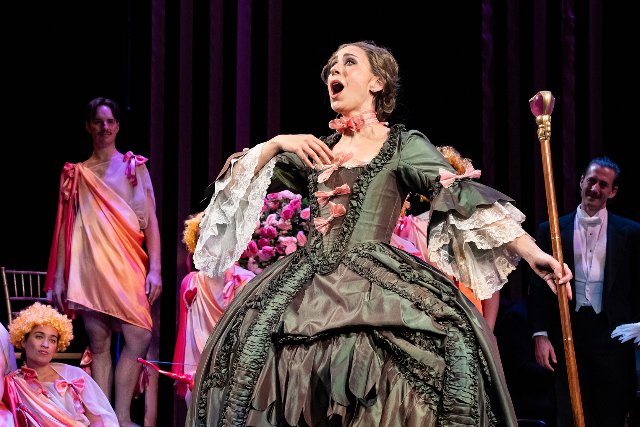
The production was not without its visual pleasures, however. Jimmy Stubbs's set design provided an attractive theatrical setting, capturing something of the elegance and artifice associated with the French court. It was one of the evening's more satisfying elements, offering a welcome visual counterpoint to the overextended choreography.
Fortunately, there was Elizabeth Sutphen.
The American coloratura soprano, appearing as Uranie and Venus, was the evening's undisputed bright spot. With her beautiful, agile voice and expressive acting, Sutphen brought a welcome spark of theatrical life to a production that too often seemed weighed down by its own elaborate entertainments. A graduate of Juilliard, Sutphen has built an impressive international career, singing Sophie in Richard Strauss's Der Rosenkavalier at Glyndebourne, Zerbinetta in Ariadne auf Naxos at Oper Frankfurt, and Gilda in Verdi's Rigoletto at Houston Grand Opera.
She is also no stranger to Rameau, having performed the deliciously comic role of La Folie in Platée at Des Moines Metro Opera. That experience was particularly evident here. Sutphen possesses not only the technical assurance required of a coloratura soprano but also the dramatic intelligence to make highly stylized characters feel genuinely alive. She didn't merely sing beautifully; she inhabited her characters. Her presence provided something the production frequently lacked: a sense of spontaneity.
And perhaps that is the central challenge of reviving an opera created for the pleasures of the French court nearly three centuries ago. How does one honor the conventions of another age without allowing those conventions to become an obstacle to theatrical engagement? Opera Lafayette deserves recognition for asking that question. Founded in 1995, the company has distinguished itself through its dedication to historically informed performances of French Baroque music and the rediscovery of works rarely heard on contemporary stages.
Its productions offer audiences opportunities that larger opera companies seldom provide. There is genuine value in hearing a work like Les Surprises de l'Amour in something approaching its original form, particularly given the extraordinary circumstances of its creation.
But authenticity, however admirable, is not an end in itself. Theatrical works must ultimately communicate with the audiences sitting before them, not merely recreate the tastes of those who first encountered them.
In Les Surprises de l'Amour, the balance proved elusive. What began as an intriguing journey into the world of Madame de Pompadour gradually became an exercise in endurance, despite the considerable charms of Rameau's music, Stubbs's appealing set design and Sutphen's outstanding performance.
Perhaps the greatest surprise of the evening was how little dramatic excitement all that dancing managed to produce. Cupid may have triumphed in the end. But love, as any experienced theatergoer knows, requires more than beautiful music and graceful movement to hold our attention.
Photo by Steven Pisano, Courtesy of Opera Lafayette