
Arthur Miller's The Price
At Long Wharf
By: Karen Isaacs - Nov 19, 2026
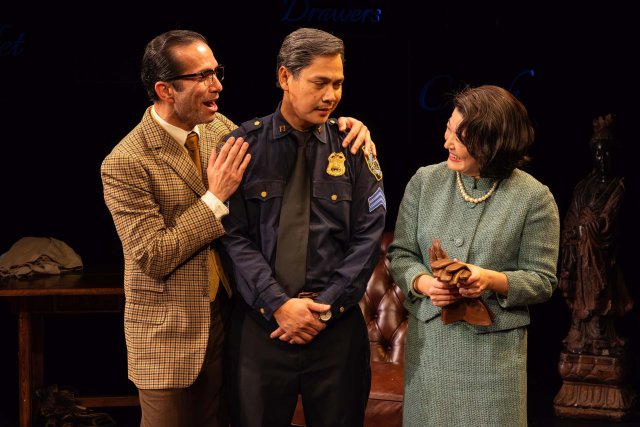
This later Miller work, first performed in 1967, explores and amplifies the themes found in All My Sons and Death of a Salesman. These themes – relationships between fathers and sons, the way capitalism diminishes workers, and the connection between identity and jobs – are all present, but Miller adds in another element – the way the Great Depression destroyed the human spirit.
It is interesting that in his first two major works – although the characters and families have obviously been impacted by the Depression – there is no references to it. Here, it is a major part of the plot.
The Price opens with Victor, a NYC police officer, arriving to the attic storage space where his family’s furniture and mementos are stored. The building is about to be demolished and after 16 years, he is here to finally sell the stuff. Clues tell us this is late ‘50s or early ‘60s. He is waiting for a dealer, Gregory Solomon, to arrive and while waiting, his wife Esther arrives; this provides an opportunity for us to learn background information. Victor has a very successful brother, Walter, whom he has not seen or talked with since the father died; Victor is eligible for retirement but is uncertain what to do with his life after that; Esther is clearly frustrated and angry about his indecision and how their lives have unfolded.
When Solomon arrives, he is a nonagenarian who had retired; Victor must have used an old phone book to find him. But Solomon (the name is obviously significant) is more than just a furniture dealer; he provides humor and wisdom. It is also clear that he is excited about the prospect of again conducting business. He is alive! Act 1 can seem repetitious; Solomon says he will give Victor “a good price” but never actually does, and Victor grows increasingly frustrated asking if Solomon really is interested or just wasting his time.
By Act 2, a deal appears to be struck between Victor and Solomon, but then Walter arrives, and later Esther. Both think the price agreed upon is too low. But that isn’t the real point of the act or the play. It is about the price each of us pays for our decisions. Victor and Walter have very different views of their father, whom Victor sacrificed for. Was he a broken, frightened man or was he a manipulator who allowed his elder son to sacrifice his life? But the questions go beyond that. Was Victor blind to it or did he, deep down, suspect but avoid doing anything about it? Why was he so willing to sacrifice not only his life but the well-being of his family for an illusion? The Price is about what we do for our families and how that fulfills our own psychological needs. Over the years Walter’s insight has grown and he has acted upon it; Victor is stuck with the same rationale he has held for decades and even now refuses to relinquish. He avoids the truth.
Miller’s play is universal; I suspect each of us can point to similar blindness within our family – for me it was my grandmother and her elder daughter, my aunt.
This production has good moments, but it also at times is flat. Ralph B. Peña, the director, lets Alexis Camins as Victor seem, at times, so passive that you wonder how he could have been an effective police officer. Camins’ interpretation seldom lets us see below the surface. Jennifer Lim as Esther, is effective at portraying the frustration and anger but lacks any sense of love for her husband. You are left wondering if their relationship will survive. Carman Lacivita as Walter has more to work with, because his character is more introspective and realistic.
The role of Gregory Solomon is the scene stealer; the role combines humor and wisdom, and Mark Nelson hits all the notes without turning him into a stereotype. Danny DeVito played the role in the last Broadway revival and won a Tony Award for his efforts. But Nelson’s vitality, particularly in the first act opposite Camins unbalances the play.
The play works well on the small Legacy Theatre stage; Riv Rakkulchon’s set design could be more crowded with objects but works as does the lighting by Jiyoun Chang, sound by Fabian Obispo, and costumes by Asheley Soliman.
At heart, The Price is about the price – emotional and psychological – we all experience within the family structure. At the time the characters paid this price, the depression and immediate post-depression era, many families were close knit. The period required families to pull together to survive. Certainly, I saw it in my own family’s history. Therefore, I was surprised that both Peña and Long Wharf believed that casting the roles of Victor, Walter and Esther as Asian Americans brought a new “lens” to the production.
I have always found The Price a fascinating, though perhaps flawed, work. It requires an outstanding production to really hit home. I only wish that this Long Wharf had lived up to its two earlier productions of the play, in 1971 and 2007.
Visit LongWharf.org for information and tickets.
This content courtesy of Shore Publications and Zip06.com