

The Monkey King
Spectacular World Premiere by San Francisco Opera
By: Victor Cordell - Nov 21, 2025
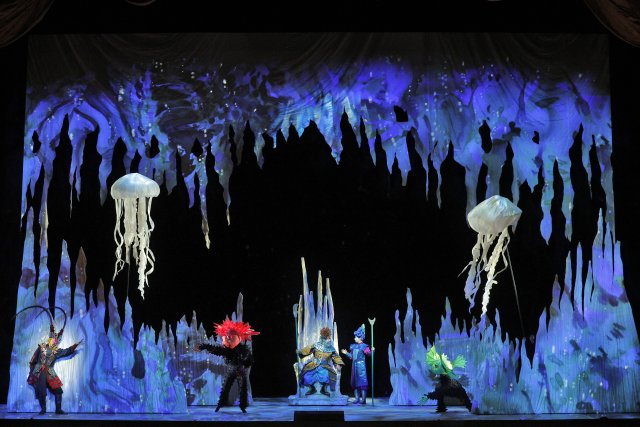
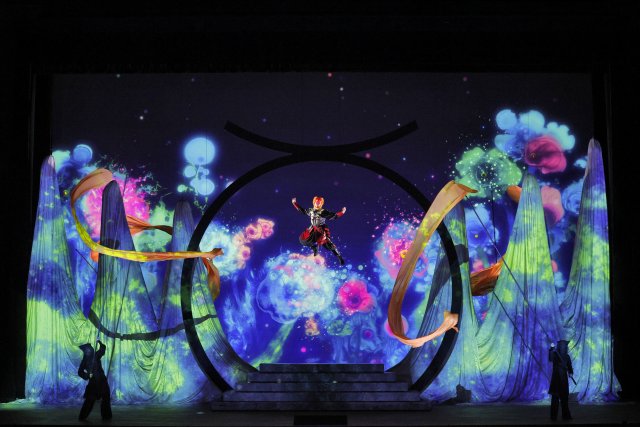
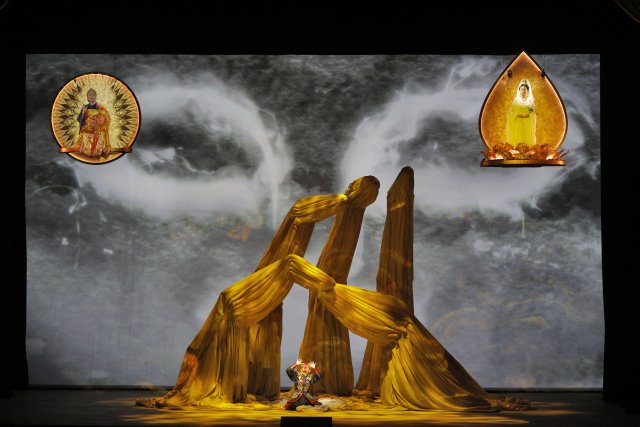
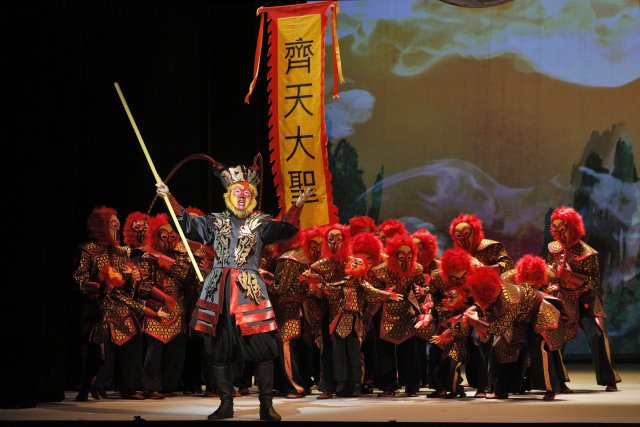
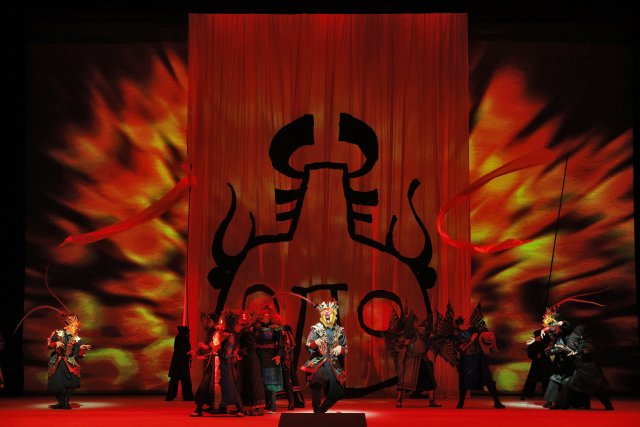
San Francisco Opera has long reigned as a premiere American opera company. The city has served as a gateway to Asia for trade and tourism, containing the country’s oldest and probably most important Chinatown. Further, San Francisco and the overall Bay Area population has the highest concentration of Asians in the U.S. So it is fitting that the company would be home to its third China-focused world premiere opera. Of those, The Monkey King is the second libretto drawn from the renowned four classic Chinese novels. The result is a wildly popular, eye-popping, phantasmagoric opera experience. It is a huge production in every way and demonstrates the power of San Francisco Opera.
The monkey has long held significance in pan-Asian mythology. The 16th century Chinese-Buddhist-influenced Monkey King, dubbed Sun Wukong, can be seen as derived from the ancient Indian-Hindu Monkey God Hanuman. Modern realizations include the Indonesian retelling of the Ramayana through the kecak, or monkey, dance portrayed with 100 or more chanting, gesticulating men. A click-clacking in the orchestra is even reminiscent of the kecak sounds. But Sun Wukong is a superhero popular across Asia who is also represented in contemporary films and games.
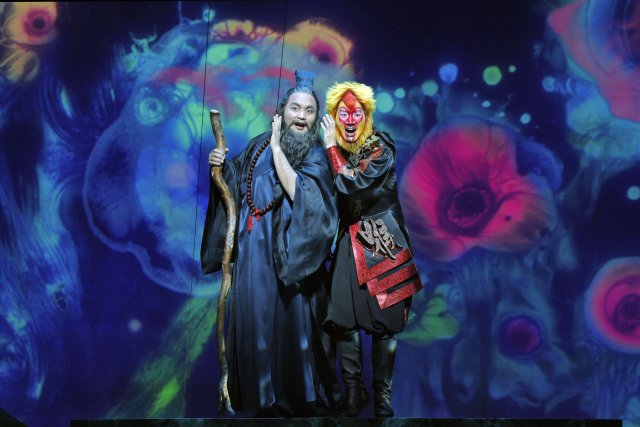
Huang Ruo has composed a score set to David Henry Hwang’s libretto, which is based on the first seven chapters of Journey to the West, written by Wu Cheng’en. But like the character himself, the story is full of contradictions, and to begin with, while Sun travels in his adventures to the sea, the underworld, and elsewhere, there is no journey to the west. The plot, such as it is, is a series of episodes told in flashback. In keeping with the epic sense of time, Sun Wukong has been detained under a mountain for 500 years. We find how he got there; experience his previous conquests; and understand what he had to learn to gain freedom. Many sequences are filled with exciting bursts of animated movement and kaleidoscopic flushes of color.
The music is very much in the modern vernacular, which I find uninspiring, but with strong influences suggestive of traditional Peking opera and other Asian forms to add an exotic touch. For the most part, the orchestration supports the vignettes unobtrusively but becomes more conspicuous, more Chinese, and more distinguished with the use of the pipa, a Chinese plucked lute, and Asian gongs and cymbals. Carolyn Kuan conducts this musical hybrid with great skill.
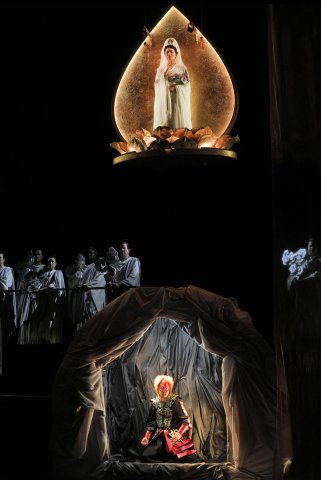
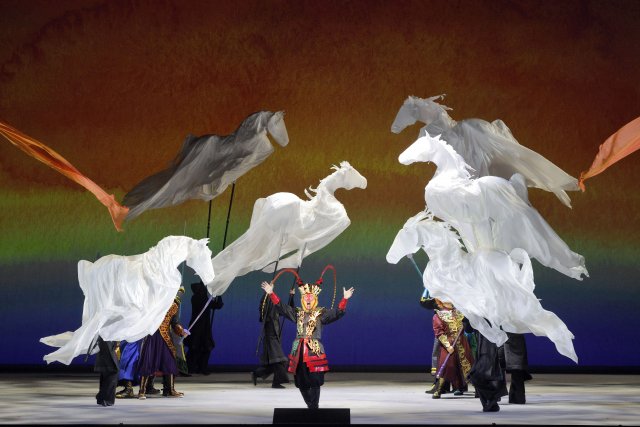
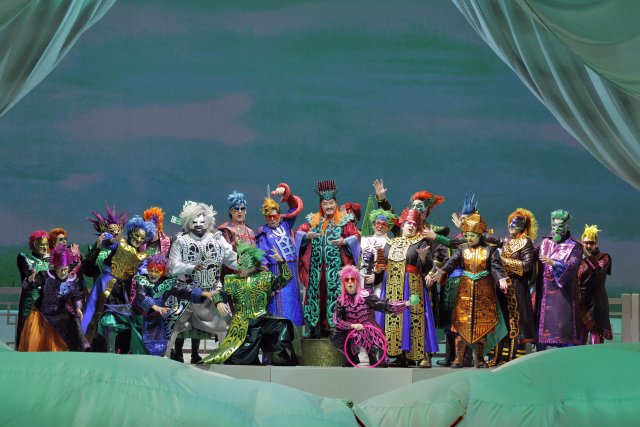
The score actually opens with chants in homage to Buddha. But it is the visual that is the mark of things to come. Guanyin, the Buddhist Goddess of Compassion, performed by refined soprano Mei Gui Zhang, glides about suspended in her light-framed conveyance, the first of many stunning visual effects from Set and Puppetry Designer Basil Twist. Costume Designer Anita Yavich also contributes throughout with a dazzling and colorful array of attire that fills the eye with joy. Yet, to these eyes, the most stunning visual effect is the simple use of white silk. Six life-sized “puppet” horses, each raised on sticks by puppeteers, billow and flow like so many white clouds quivering and galloping in the sky. A still image cannot possibly convey the mesmerizing elegance.
Following on the heels of its visually stunning production of Parsifal, San Francisco Opera is showing itself to be in the forefront of operatic spectacle, inspired image-focused productions. A substantive corollary to Parsifal is that the hero in both must undergo an awakening to attain his goals. While Parsifal is expressly a fool at the outset, The Monkey King has mental acuity, yet he doesn’t realize that when he ascends to heaven all puffed up in self-adulation, that the title he is given, Lord of the Stables, is to denigrate his station.
The Monkey King himself is the most interesting dramatic element in the opera. Though he is portrayed and sung with great verve by tenor Kang Wang, he is also depicted at times by a dancer and by a puppet. Sun’s triumphs are predictable, but his paths and behavior are not. Despite his superpowers, he reveals many of the contradictions of a regular guy. He is a profane rascal and funny as a gaggle of gags. Sun’s silliness provides comic relief, and Kang Wang is adept at triggering laughter with anachronisms, like when he refers to having food for take-out. At one point, the character even lifts his leg and pees, not realizing that he is peeing in the hand of Buddha, which is so vast that Sun can’t escape it!
Following its source material, the opera brims with philosophical wisdom. It draws on the notion that “power is not enough,” and teaches that the key to divinity is a spirit of caring to help all beings. It’s remarkable that we still have to preach that gospel.
The Monkey King, composed by Huang Ruo with libretto by David Henry Hwang and based on part of Journey to the West by Wu Cheng‘en and directed by Diane Paulus, is a world premiere produced by San Francisco Opera and plays at War Memorial Opera House, 301 Van Ness Avenue, San Francisco, CA through November 30, 2025.