
Two Contrasting Plays at NYC's Public Theater
Fine Theater from Fine Pedigrees
By: Victor Cordell - Nov 21, 2026
Starting in 1960, Joseph Papp upended the non-profit theater world with what would become New York’s Public Theater. The Public would be noteworthy if only for two of its most memorable launches, Hair and A Chorus Line, but it has participated in the creation of scores more while also reviving many noted plays, especially from the Shakespeare canon.
THE CURIOUS CASE OF BENJAMIN BUTTON
Among the current offerings, The Public is producing a revival of the musical version of The Curious Case of Benjamin Button. For those unfamiliar, the premise is that Benjamin is born an old man who is hidden away by his parents, and who instead of growing older, grows younger. He would ultimately spring free from his constraints, marry, have children, and share the joys and tragedies of life, while hiding his unique life cycle.
The original source material is from a short story by F. Scott Fitzgerald, who places the initial action in Baltimore, whereas the popular movie from 2008 is based in New Orleans. British are behind the musical. The book is composed by Jethro Compton, with music by Darren Clark, and it commences in Cornwall before spreading to other English locales and ultimately to New England.
The joyous and uplifting musical has much to commend it. The story moves quickly, supported by perky music in the modern English folk vein, and the West End version won three Olivier Awards.
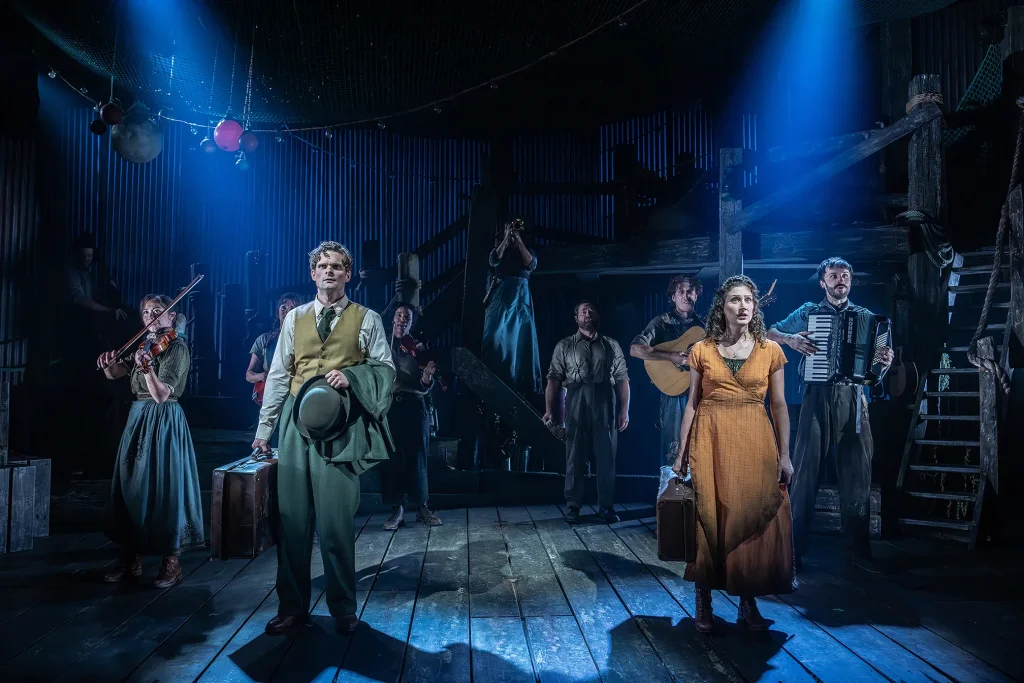
The cast at The Public soars with talent and high energy, led by the accomplished Andrew Durand as Benjamin and Kelsee Kimmel as Elowen, the woman he would marry. Another standout is Sachiko Mae, who plays multiple roles, starting with Mary, Benjamin’s mother, who would take her own life, distressed by the birth of a son old enough to be her grandfather.
The overall feel of the story is uplifting, with many sensitive moments, as Benjamin often faces rejection of the kind that many minorities are accustomed to. In one instance, Benjamin provided support for an oppressed sailor called Young Jack when the latter was a teen. But when Benjamin meets the same man who against expectation has become a captain, Jack dismisses Benjamin, as he can’t reconcile the empathetic old man he knew before and the younger one he sees before him.
The performance I attended received a standing O. Together with its unique plotline and accolades, how can one not give a positive recommendation?
Here is where I object to much philosophy of theater criticism, particularly the notion that a critic should be the undisputed arbiter of worthiness, especially when competent critics frequently disagree on evaluation of elements and overall worth. Many critics express their subjective opinions as if they are objective and unassailable. Particularly in the New York market, where the Times’ primary critic has been a God absent doubt or humility, a bad review often sinks a production, and along with it, tens of jobs and millions of dollars. And you know what? The critic may have just had an argument with their spouse or be having a bad reaction from the dinner that they ate
That said, here are the reasons that Button didn’t work as well for me as for others, some of which you may like or not. Overall, it is so full of conceits and devices, that it seems formulaic. Of course, the very premise is a brilliant and unique conceit that is the sine qua non. In the film, extensive makeup is used to vary Brad Pitt’s appearance of age, but in this case none is used, not even a gray wig to signify age. To his credit, Durand does a fine job using expression, movement, and gesticulation to distinguish the many ages he reverses through.
Several aspects of the design are so conspicuous that the devices become self-referential. One is storytelling by committee, in which the monologue baton is passed on every couple of sentences in the frequent orations. Another is that in virtually every narrative interruption, a date and time stamp is ceremoniously announced right down to the minute.
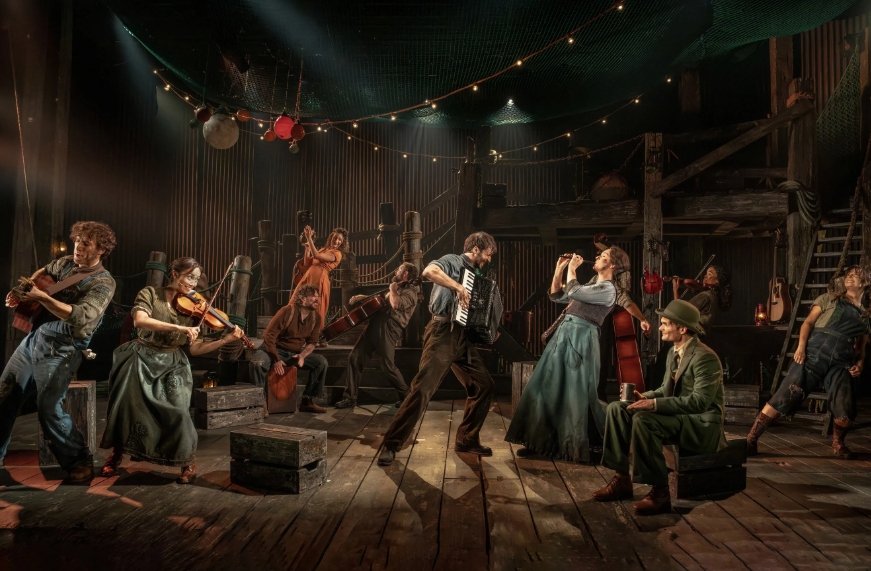
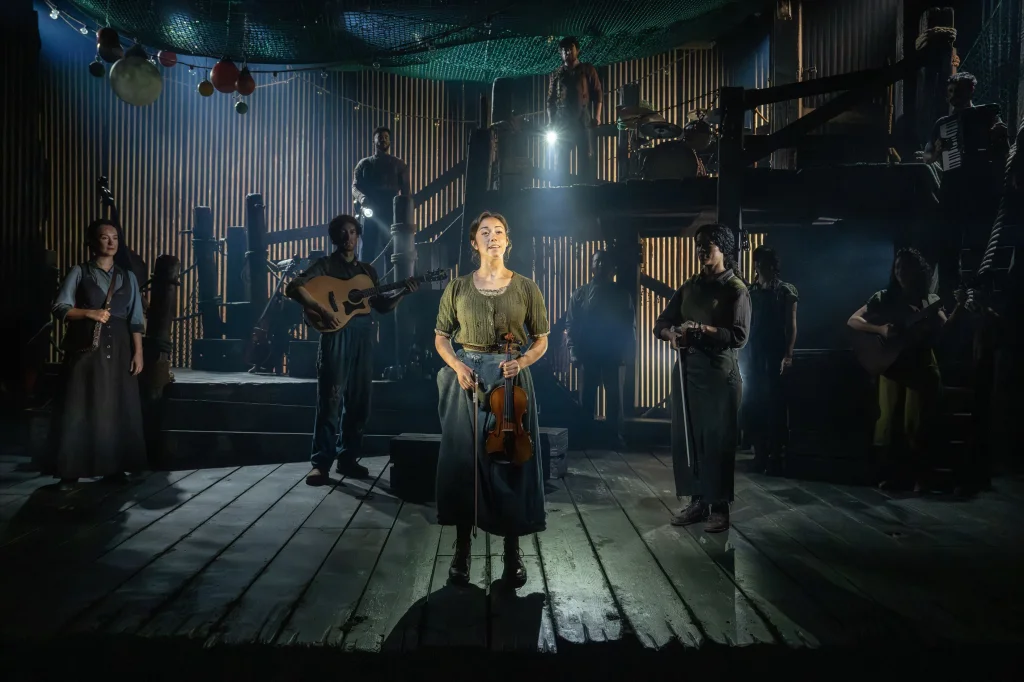
To show enthusiasm, despite micing, speakers shout at the top of their lungs. Rather than leaving the stage when they are inactive, the actors always hang around the set, which looks like a dilapidated refuge from The Pirates of Penzance. Good reasons for cast to remain are that each cast member is a musician (another conspicuous device), virtually all multi-instrumental, and they provide the near-continuous ambient music, chorus singing, as well as background to songs.
As noted, The Curious Case of Benjamin Button has received considerable support and will suit the demands of most theatergoers, but you are forewarned of the recurring self-parody devices. More commentary follows below.
WE’LL SEE
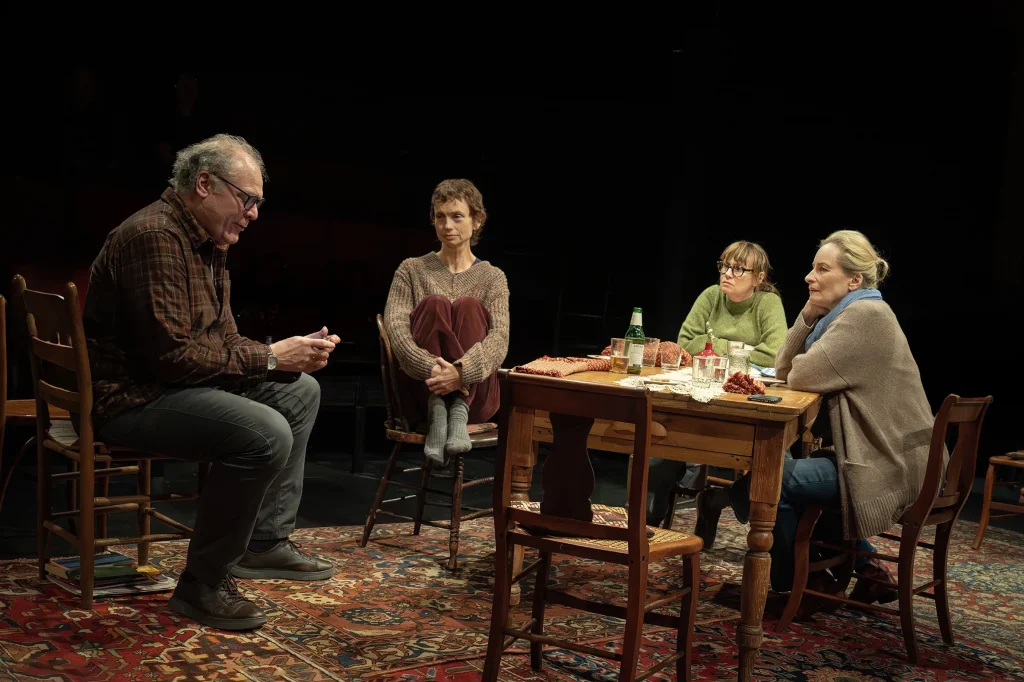
Two decades ago, Oskar Eustice, then new Artistic Director of The Public Theater commissioned Richard Nelson who proposed a series of intimate plays about how people process important events. We’ll See offers his 13th play centering on domestic life in Rhinebeck, New York, a historic town on the Hudson River, 100 miles north of New York City.
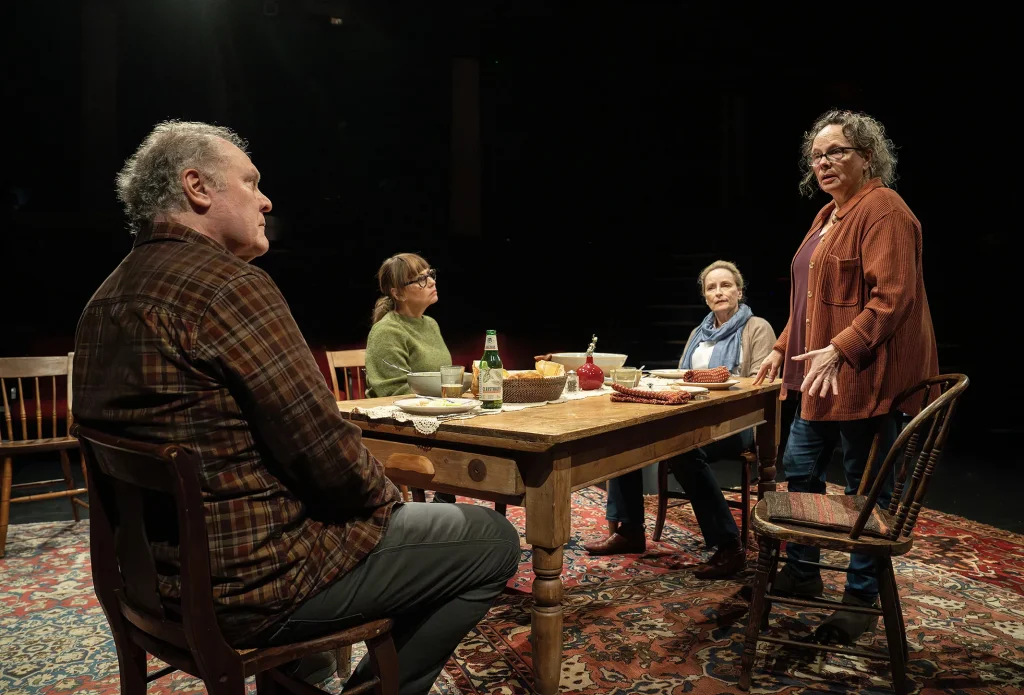
In many ways, We’ll See is the polar opposite of The Curious Case of Benjamin Button. The former takes place in one room in one evening; the latter in numerous English cities, at sea, and in New Hampshire over 80 years. We’ll See involves four elderly siblings and a friend played by five actors in a talkathon. Button has 40 characters from the panoply of life played by 11 actors having multiple roles. The play is very naturalistic, quiet, and static and performed on a small stage in the round. The musical is stylistic and raucous with song and heavily coordinated movement on a large proscenium arch stage.
Time is significant to Nelson in We’ll See as well, but in a different way. Each of the 13 plays of the Rhinebeck Panorama has opened on the same day as the action, in this case, November 3, 2026, election day. We peer into the interactions of the Apples, a politically liberal family. Richard, the only brother, has actually worked for former Democratic Governor Andrew Cuomo.
The family has gathered for dinner with great trepidation about the elections of the day, and a key feature of the play is that it was written before the outcome was known, so the characters can only speculate on what the audience knows has happened. While they are concerned and informed politically, one rule the siblings agree to is that no one will mention “his” name, knowing the outsized play it usually gets.
More than politics, most of their discussions concern their daily life as they actually share a meal. Each of them is put upon in different ways, and each demands respect in different ways. Richard (Jay O. Sanders) talks of his recent trip to Paris. Seventy-four-year-old Barbara (Maryann Plunkett) tells that she has been railroaded into accepting retirement from teaching at the end of the semester. Middle female, Marian, (Laila Robins) tries to keep socially active, while the youngest, Jane (Sally Murphy), is living with her boyfriend in the City and in Rhinebeck. She and Richard are actively writing a history of their one-traffic-light town and unearthing interesting tidbits, but she also discloses that she hasn’t voted, which causes considerable consternation and discussion.
Richard’s younger girlfriend, the appropriately raspy voiced Yvonne (Yvonne Woods), joins later. She is an aspiring stage actress, but in an anomalous twist of fate, she is the one who suffers what is known to be a terminal cancer.
We’ll See has little at stake; divulges little of substance; and lacks a conclusive outcome. Yet, this intimate narrative reveals interactions among people of a certain age at a certain time that has meaning as part of the kaleidoscope of American life. It is completely convincing, in part due to fine acting from a great ensemble led by husband-and-wife team Jay O. Sanders and Maryann Plunkett who have earned a NY Critics Circle Joint Lifetime Achievement Award.
One housekeeping concern is that acoustics in the theater are tricky, and much dialog can be lost, especially when the speaker is facing away. For those with any hearing deficiency, avail the listening aids.
The Curious Case of Benjamin Button, with book and lyrics by Jethro Compton and music and lyrics by Darren Clark, plays through December 6, 2026.
We’ll See, written by Richard Nelson, plays through November 29, 2026.
Both plays are produced by Public Theater and performed on its stages at 425 Lafayette Street, New York, NY.