
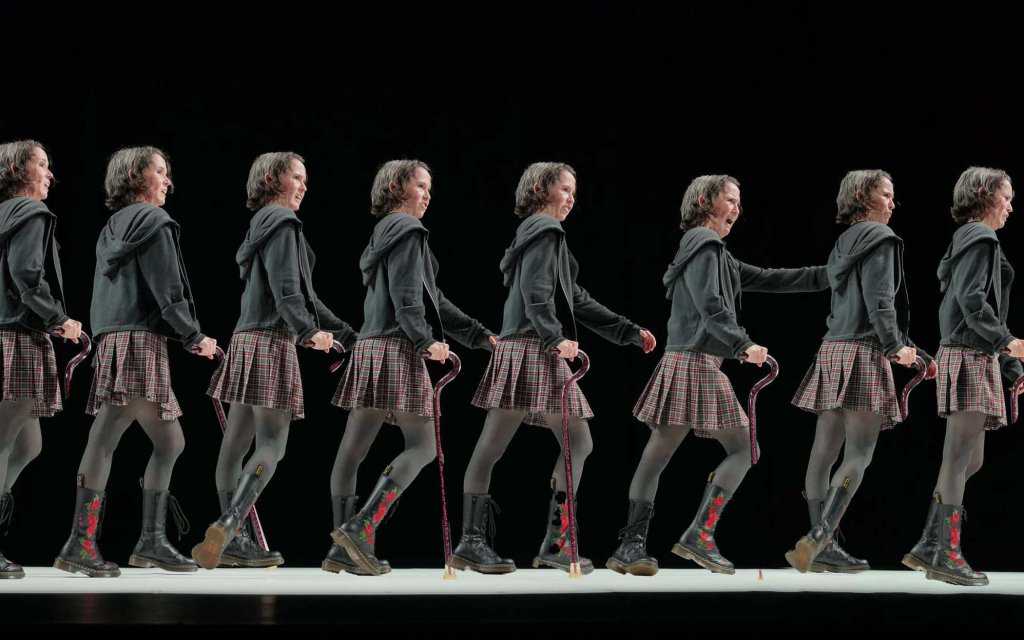
Anne Gridley is a talented writer/performer with two Obie (Off Broadway) Awards to attest to it. She also has a rare hereditary disability that affects her feet, legs and gait. The disease, Hereditary Spastic Paraplegia, is considered an “orphan disease,” so named because it affects such a small group of people that little research or drug development has occurred. This reference causes her two male performers to dress her in the iconic Little Orphan Annie red dress and wig during one of the songs included in the show.
Watch Me Walk now at the Yale Rep through Saturday, Dec. 5 is a production from NYC’s Soho Rep; Yale’s Binger Center for New Theatre provided development support.
The 100-minute show centers not only around Gridley’s disability, but the history of disabilities in society and the medical issues.
I found much of the play interesting and enjoyable. Gridley is a talented theater artist who engages with the audience, but there were elements that seemed prolonged and, at times, purposeless.
The play opens in the dark with a recording of a woman being interviewed; much of the interview centers around finding “Annie” a man. We have no idea who is speaking or, at that moment, who “Annie” is. When the lights come up, Gridley is on stage and true to the title Watch Me Walk, we see her walk back and forth for what seemed many minutes with no words. Her gate seems unsteady; once she begins speaking, we learn a characteristic of her condition is what is called a “dropped foot” which results in her walk being halting with tripping or falling a constant threat. The front of the foot drags.
Gridley is very good at explaining medical terms that makes it easier to follow what she is saying. She explains that both her mother and grandmother had this neurological condition which is often initially misdiagnosed. If earlier family members also had the condition, she does not know. She also tells us that it can occur at any age; hers did not develop until adulthood.
Once we get through the interview and the observation, the play picks up. She answers a few questions that apparently come from the audience, but since they are written, I always wonder if they are real questions.
Gridley intersperses humor – and profanity—with songs and scientific information. You may wonder if this is a lecture or a vaudeville. The mood swings back and forth. Apart form the Little Orphan Annie get up, she also appears as a degenerating upper motor neuron. The two backup performers (Fernando Contreras and Keith Johnson, both called Adonis), act more like back up in a nightclub act. At times they are dressed like tennis players and they dance some (Asil Bulbul did the choreography), but there is little verbal interaction with Annie.
The most interesting moments in the play are when Adonis (I don’t recall which one), recites the history of how the world has viewed those with disabilities – from leaving them to die to hiding them away to blaming them for their condition or considering it a judgement of God.
For me the highlights of the production directed by Eric Ting (formerly associate artistic director at Long Wharf), were two numbers: in the first, Anne talks about the variety of walking sticks she uses; she hates the term cane, which evolves into a choreographed number. The second and best was the song in which she acknowledges that she herself is an “ableist.” The term refers to those using words or holding beliefs that demean or treat those with disabilities differently, even if they view them as “admirable” or “remarkable” for their achievements. Her reference to the term “differently abled” which she hates, reminded me of a George Carlin routine.
The problem with the play is that it doesn’t know when to end. It came to what seemed the conclusion after a song; the stage went black and audience members applauded and began gathering their belongs. But then it continued for another 15 minutes or so; Gridley read a poem, and then we heard more of the taped interview, which though I did not know at the time was with her mother.
Certainly Watch Me Walk will have you considering your own responses to those with disabilities.
Tickets are available at YaleRep.org.