

Decentering Whiteness
A Museum Makeover
By: Noah Kane-Smalls - Dec 12, 2025
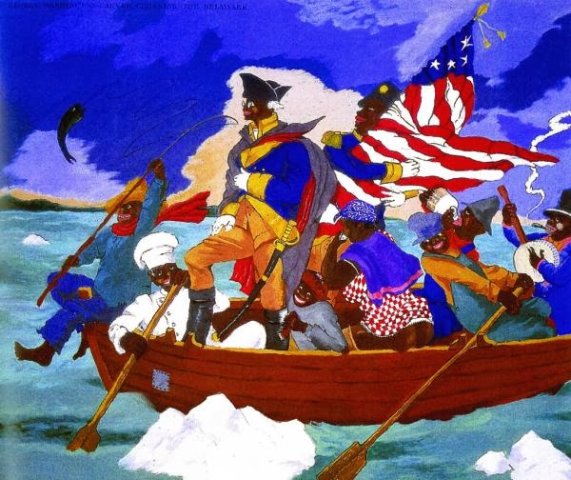
American museums were never built for everyone. They were created for a select few, those who could claim culture as their own and close the door behind them. From the beginning, these institutions have centered whiteness as power, creating spaces of exclusion that dictate who belongs, who leads, and whose histories are recognized.
The American Philosophical Society in Philadelphia, founded in 1743, exemplifies this. Benjamin Franklin and his colleagues were not just intellectual leaders; they were slaveholders and elite collectors. Their exhibitions were private, revealed only to invited members behind curtains, and their wealth and influence were built on the backs of enslaved people. This sense of exclusivity became the DNA of American museums: controlling who sees, who participates, and whose knowledge counts.
Meanwhile, Europe was building empires of art and extraction. French dealers promoted Impressionists while European powers looted African cultural objects, masks, bronzes, ceremonial artifacts, and spiritual technologies, which were shipped to private collections, aristocratic estates, and national museums. Artists like Picasso, Matisse, and Modigliani absorbed these forms, calling them “primitive,” and transformed them into the backbone of modern European art. Those who created the original works were ignored, erased, dehumanized, or worse. The spiritual and intellectual dimensions of these belongings, including rituals, divination systems, and ancestral knowledge, were violently removed from their communities, leaving a fractured global memory.
American higher education adopted the exact blueprint. Institutions like Williams, Yale, and Harvard expanded through stolen land, extracted wealth, and erased Indigenous and African histories. Their museums collected European armor, masterworks, early American art, and looted African objects, often uninterpreted but displayed as spoils of war, solidifying whiteness as cultural authority and replicating it across the country.
Architecture communicates exclusion as well. The Philadelphia Museum of Art, perched atop a mound at the end of the Benjamin Franklin Parkway and modeled after Greek temples and European palaces, asserts monumental authority before offering welcome. Its most famous cultural moment is Rocky Balboa’s stair climb, not any artwork inside. Visitors describe the stairs, oversized bronze doors, and colossal façade as intimidating. The doors tower above a human body, signaling that entry requires privilege or initiation. Most people do not feel large enough, wealthy enough, or prepared to cross the threshold. Whiteness operates here as an architecture of power, determining who is centered, who is deemed worthy, who carries forward historical narratives, and who is excluded.
Whiteness itself is a constructed identity, not an inherent heritage. As Sarah Lewis in her book Unseen Truths argues, the idea of “Caucasian” was fabricated in the 19th century to establish social control. Black Americans are no more monolithically African than white Americans are Caucasian, and Indigenous people were often recategorized in colonial records to erase their distinct identities. Whiteness flattens histories, cultures, and experiences.
A recovering art critic once asked after reading the 1619 Project, “Why don’t you hate all white people?” I asked, “What is a white person anyway?” We realized our identities are far more complex than the containers imposed on us. Whiteness is a burden, built on supremacy, nationalism, colonialism, slavery, and global violence.
It is time to disrupt the systems that sustain white identity in museums. Institutions must share resources equitably, decenter European masterworks, foreground suppressed and stolen histories, confront epistemic violence, and empower communities to participate in curation and governance. Museums can become spaces where we see each other as humans, not as a racial hierarchy. Only by interrupting, reimagining, and liberating these institutions can we acknowledge the complexity and dignity of all people and create a platform for truth, reflection, and collective memory. Let’s remake the field of art history into real scholarship and transform museums into spaces for everyone.