

Hedda Gabler at Yale Rep
Production Leaves Us Floundering
By: Karen Isaacs - Dec 15, 2025

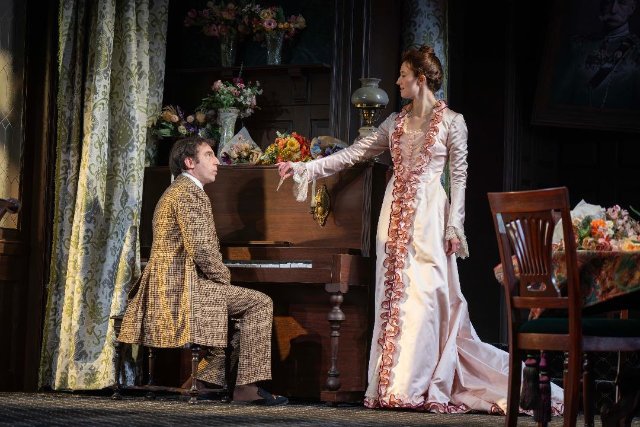
Henrik Ibsen in his play Hedda Gabler created a title character who can be difficult to like or to feel sympathy for unless the director and cast help us dive deep below the surface.
The Yale Rep production of Hedda, unfortunately, leaves us floundering. Where the emotions and the tension among the characters should be electric, they aren’t. The result, the night I saw the play, was one of those rare occasions when an audience did not give a standing ovation.
It’s disappointing because this production is director James Bundy‘s swan song as he retires as Dean of the Drama School and Artistic Director of the Yale Rep in June. He is a fine director.
Hedda can, on the surface, be a malicious, manipulative, and ultimately destructive person, not just to herself but to those around her. The program tries to point out that she is a woman living in a society that does not give her, in modern terms, agency. But when you need extensive notes in the program to flesh out a show, it indicates there is a problem.
Unlike Nora, who in A Doll’s House frees herself, Hedda is lacking, as she will admit, the courage to live outside the boundaries of societal expectation. The result is, she destroys not only herself but most around her.
We meet Hedda in her new home in a provincial Norwegian town after returning from a six-month European honeymoon.
She is restless and bored; it is clear she does not love her husband, Jorgen Tessman, an academic. Hedda is a romantic at heart.
It helps if we realize she had run out of options and had settled for what might be a safe choice. Though her father was a well-known general, it’s clear she was not left with any financial security upon his death. She’s beyond the normal marrying age, and her options have expired. She is afraid to take the leap into love, particularly when the man she might choose has a destructive streak. Safe, boring, and respectable Jorgen Tessman it is.
The honeymoon was dull, with Tesman more interested in researching in dusty libraries than spending time with his new wife. She doesn’t even get to select her own home; rather Tesman and his aunt have gone into debt to provide a home she didn’t really want. Almost immediately, she learns Eilert Lovborg, the man she may have truly been attracted to, has reformed his self-destructive ways and is about to achieve academic success. All she can picture is day after day and year after year of being trapped. If she had been a man, you could have pictured her becoming a military officer.
The problem with this production isn’t Marianna Galius as Hedda. It is that a sense of danger is lacking. The play creates triangles of characters, The first triangle is Jorgen, Hedda, and Judge Brack, a friend. You should feel that Brack (played by Austin Durant) understands her all too well and wants power to use over her. The second, third, and fourth triangles involve Lovborg. The first is him with Hedda and Mrs. Elvsted, who is the cause of his reformation. She has demonstrated the courage that Hedda lacks, taking a leap of faith and violating societal norms. The other is with Hedda, Judge Brack, and Lovborg. Brack knows about their past relationship. In reality, additional triangles exist in the play.
Gailus as Hedda gives a performance that emphasizes her manipulative nature so much so that a friend of mine asked if she was a sociopath. The performance doesn’t reveal enough of her depression, despair, and sense of being trapped.
Judge Brack, played by Austin Durant, gives a totally fine performance, but it is only late in the play that you feel any sense of danger. The play works best when the audience recognizes that Brack wants to exert power over her and can destroy her at will.
Lovborg represents the romantic hero – think of the poet Lord Byron; he violates conventions without a care. She pictures him with “vine leaves in his hair” like some Greek God. James Udom’s Lovborg seems no more interesting or charismatic than Tesman. It is hard to imagine that there was anything romantic or passionate between him and Hedda. Sobriety may have changed him, but in this performance, he has shrunk to a cypher. It is hard for the audience to imagine that there is still electricity between the two.
Perhaps the performance, most true to the character, is Max Gordon Moore as Tesman; he conveys his love for Hedda, his dedication to his research, and his niceness, though he is oblivious to her feelings and what is going on.
Tickets are available at YaleRep.org.
This content is courtesy of Shore Publications and Zip06.com